
STEVEMIT
steve/gear-rack
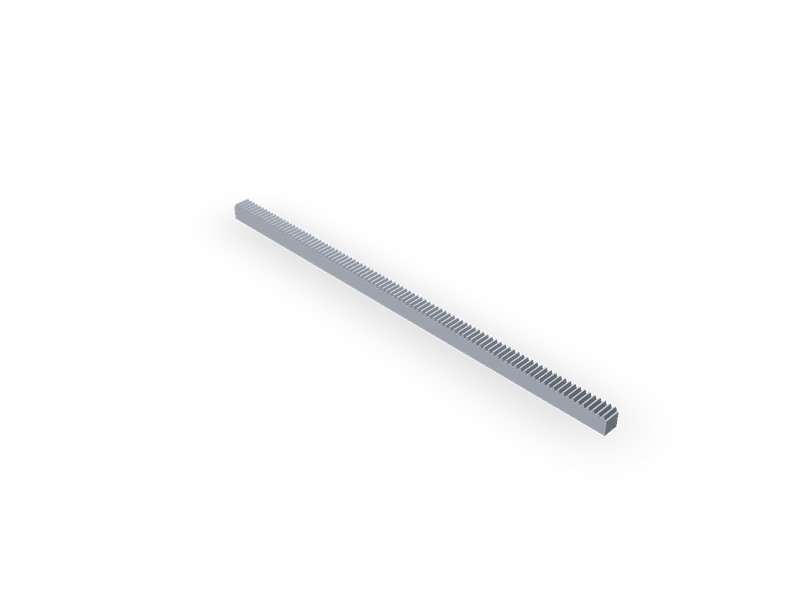
Straight gear rack, ISO 53 basic rack, modules 0.5 to 2, any length, with common lengths as presets.
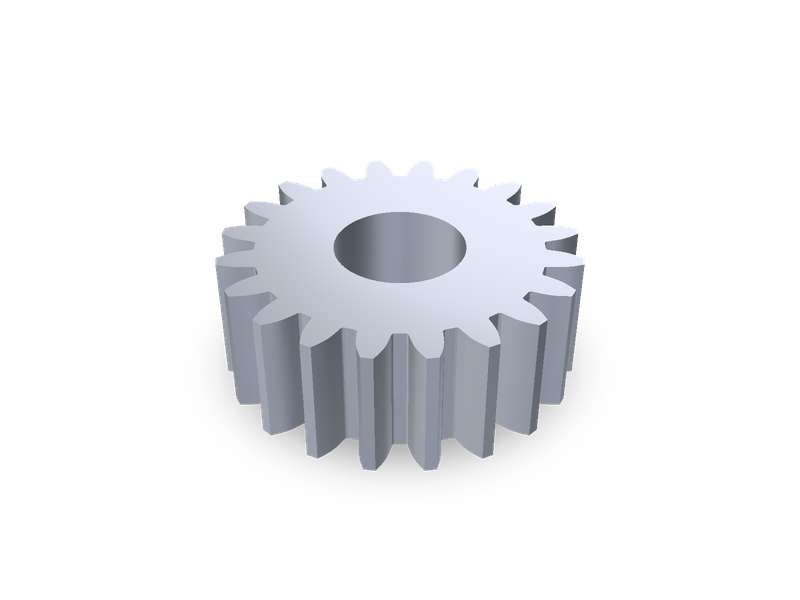
Involute spur gear, ISO 53 basic rack, ISO 54 modules 0.5 to 2: teeth, bore and width as presets.
| 1 | """Spur gear cut from the ISO 53 basic rack: module m, z teeth, pressure angle 20 degrees, addendum 1.0 m, dedendum 1.25 m, no profile shift, a plain disc |
| 2 | with a round bore. Axis along Z, centred on the origin. detail = "full": involute flanks, and below them the root curve the rack's tip corner cuts (a trochoid), which |
| 3 | undercuts small tooth counts as a real cutter does; flanks are smooth splines on computed involute points, the root curve a polyline. detail = "simple": a disc at the tip diameter, for big assemblies.""" |
| 4 | import math |
| 5 | |
| 6 | from steve import Model |
| 7 | |
| 8 | module = 1 # ISO 54 module |
| 9 | teeth = 20 # Number of teeth |
| 10 | bore = 8 # mm Bore |
| 11 | width = 8 # mm Face width |
| 12 | detail = "full" # full: real teeth; simple: a disc at the tip diameter |
| 13 | |
| 14 | PRESSURE_ANGLE = 20 # degrees: ISO 53:1998 standard basic rack, profile A |
| 15 | ADDENDUM = 1.0 # x module: ISO 53 |
| 16 | DEDENDUM = 1.25 # x module: ISO 53 |
| 17 | FLANK_POINTS = 5 # involute points on each flank |
| 18 | MIN_WALL = 1.0 # x module: least ring left between the bore and the root circle, or the gear reads as a thin hoop |
| 19 | |
| 20 | a = math.radians(PRESSURE_ANGLE) |
| 21 | rp = module * teeth / 2 |
| 22 | rb = rp * math.cos(a) |
| 23 | ra = rp + ADDENDUM * module |
| 24 | h = DEDENDUM * module |
| 25 | rf = rp - h |
| 26 | if rf - bore / 2 < MIN_WALL * module: |
| 27 | raise ValueError(f"Bore {bore} leaves less than one module of wall under the teeth: the root diameter is {2 * rf:.2f} mm.") |
| 28 | |
| 29 | |
| 30 | def involute(angle): |
| 31 | return math.tan(angle) - angle |
| 32 | |
| 33 | |
| 34 | def flank_angle(r): |
| 35 | """Half the tooth's angular width on the involute at radius r (r >= rb).""" |
| 36 | return math.pi / (2 * teeth) + involute(a) - involute(math.acos(rb / r)) |
| 37 | |
| 38 | |
| 39 | # the rack's tip corner, at c from the tooth's axis on the rack's tip line, traces the root curve as the rack rolls on the pitch circle |
| 40 | c = math.pi * module / 4 + h * math.tan(a) |
| 41 | start = c / rp |
| 42 | root_curve = [] |
| 43 | for i in range(40): |
| 44 | beta = start * (1 + i / 39 * 1.5) |
| 45 | x = (c - beta * rp) * math.cos(beta) + rf * math.sin(beta) |
| 46 | y = -(c - beta * rp) * math.sin(beta) + rf * math.cos(beta) |
| 47 | root_curve.append((math.hypot(x, y), math.atan2(x, y))) |
| 48 | if h <= rp * math.sin(a) ** 2: # no undercut: the involute starts where the rack's flank ends |
| 49 | join = max(rf, math.sqrt(rb ** 2 + (rp * math.sin(a) - h / math.sin(a)) ** 2)) |
| 50 | else: # undercut: the root curve crosses the involute |
| 51 | join = next((r for r, angle in root_curve if r >= rb and angle >= flank_angle(r)), max(rb, rf)) |
| 52 | kept = [p for p in root_curve if p[0] < join - 1e-6] |
| 53 | step = max(1, len(kept) // 4) |
| 54 | root_part = kept[::step] + [(join, flank_angle(join) if join >= rb else kept[-1][1])] if kept else [] |
| 55 | if root_part and join >= rb: |
| 56 | root_part[-1] = (join, flank_angle(join)) |
| 57 | flank_part = [(join + (ra - join) * i / (FLANK_POINTS - 1), 0) for i in range(FLANK_POINTS)] |
| 58 | flank_part = [(r, flank_angle(r)) for r, _ in flank_part] |
| 59 | if not root_part: |
| 60 | root_part = [(rf, flank_angle(max(rf, rb)))] |
| 61 | |
| 62 | |
| 63 | def at(r, angle): |
| 64 | return (r * math.sin(angle), r * math.cos(angle)) |
| 65 | |
| 66 | |
| 67 | model = Model() |
| 68 | if detail == "simple": |
| 69 | with model.sketch("gear_sketch", on="XY", name="Disc") as sk: |
| 70 | sk.circle("tip", (0, 0), ra) |
| 71 | sk.circle("bore_d", (0, 0), bore / 2) |
| 72 | else: |
| 73 | with model.sketch("gear_sketch", on="XY", name="Tooth profile") as sk: |
| 74 | for n in range(teeth): |
| 75 | centre = 2 * math.pi * n / teeth |
| 76 | rise = [at(r, centre - angle) for r, angle in root_part] |
| 77 | fall = [at(r, centre + angle) for r, angle in reversed(root_part)] |
| 78 | if len(rise) > 1: |
| 79 | sk.polyline(f"root_a_{n}", rise, closed=False) |
| 80 | sk.polyline(f"root_b_{n}", fall, closed=False) |
| 81 | sk.spline(f"flank_a_{n}", [at(r, centre - angle) for r, angle in flank_part]) |
| 82 | sk.polyline(f"tip_{n}", [at(flank_part[-1][0], centre - flank_part[-1][1]), at(flank_part[-1][0], centre + flank_part[-1][1])], closed=False) |
| 83 | sk.spline(f"flank_b_{n}", [at(r, centre + angle) for r, angle in reversed(flank_part)]) |
| 84 | following = centre + 2 * math.pi / teeth |
| 85 | sk.polyline(f"land_{n}", [fall[-1], at(root_part[0][0], following - root_part[0][1])], closed=False) |
| 86 | sk.circle("bore_d", (0, 0), bore / 2) |
| 87 | model.extrude("gear", "gear_sketch", distance=width, both=True, name="Gear") |
| 88 | model.material("steel-generic", color="#b4b8bd") |
| 89 | result = model.result() |
| 90 |
| 1 | name = "steve/spur-gear" |
| 2 | version = "1.0.0" |
| 3 | runtime = "steve" |
| 4 | license = "MIT" |
| 5 | summary = "Involute spur gear, ISO 53 basic rack, ISO 54 modules 0.5 to 2: teeth, bore and width as presets." |
| 6 | description = """Spur gear with real teeth cut from the ISO 53 basic rack: involute flanks and the trochoid root a rack cutter makes (20 degree pressure angle, no profile shift), as a plain disc with a round bore. detail = simple gives a disc at the tip diameter for big assemblies. Axis along Z, centred on the origin. See the README.""" |
| 7 | tags = ["gear", "spur-gear", "involute", "iso-53", "metric", "power-transmission"] |
| 8 | |
| 9 | [parameters.module] |
| 10 | type = "choice" |
| 11 | default = 1 |
| 12 | choices = [0.5, 0.8, 1, 1.25, 1.5, 2] |
| 13 | label = "Module" |
| 14 | |
| 15 | [parameters.teeth] |
| 16 | type = "integer" |
| 17 | default = 20 |
| 18 | min = 10 |
| 19 | max = 120 |
| 20 | label = "Teeth" |
| 21 | |
| 22 | [parameters.bore] |
| 23 | type = "number" |
| 24 | default = 8 |
| 25 | min = 1 |
| 26 | max = 100 |
| 27 | unit = "mm" |
| 28 | label = "Bore" |
| 29 | description = "Must leave at least 0.25 mm of wall under the root circle." |
| 30 | |
| 31 | [parameters.width] |
| 32 | type = "number" |
| 33 | default = 8 |
| 34 | min = 1 |
| 35 | max = 60 |
| 36 | unit = "mm" |
| 37 | label = "Face width" |
| 38 | |
| 39 | [parameters.detail] |
| 40 | type = "choice" |
| 41 | default = "full" |
| 42 | choices = ["full", "simple"] |
| 43 | label = "Detail" |
| 44 | description = "full: real teeth. simple: a disc at the tip diameter, for big assemblies." |
| 45 |
| 1 | # Presets of this part (factory/PRESETS.md). Written by factory/gen.py. |
| 2 | |
| 3 | [[presets]] |
| 4 | id = "M0.5-12T-B3" |
| 5 | title = "Module 0.5, 12 teeth, bore 3" |
| 6 | params = { module = 0.5, teeth = 12, bore = 3, width = 4, detail = "full" } |
| 7 | aliases = ["M0.5 12T", "module 0.5 12 tooth gear", "spur gear M0.5 12T", "spur gear module 0.5 12 teeth bore 3", "12 tooth gear M0.5", "module 0.5", "gear type=spur; module=0.5; teeth=12; bore=3 mm; width=4.0 mm"] |
| 8 | standard = "ISO 53" |
| 9 | |
| 10 | [[presets]] |
| 11 | id = "M0.5-16T-B3" |
| 12 | title = "Module 0.5, 16 teeth, bore 3" |
| 13 | params = { module = 0.5, teeth = 16, bore = 3, width = 4, detail = "full" } |
| 14 | aliases = ["M0.5 16T", "module 0.5 16 tooth gear", "spur gear M0.5 16T", "spur gear module 0.5 16 teeth bore 3", "16 tooth gear M0.5", "module 0.5", "gear type=spur; module=0.5; teeth=16; bore=3 mm; width=4.0 mm"] |
| 15 | standard = "ISO 53" |
| 16 | |
| 17 | [[presets]] |
| 18 | id = "M0.5-16T-B5" |
| 19 | title = "Module 0.5, 16 teeth, bore 5" |
| 20 | params = { module = 0.5, teeth = 16, bore = 5, width = 4, detail = "full" } |
| 21 | aliases = ["M0.5 16T", "module 0.5 16 tooth gear", "spur gear M0.5 16T", "spur gear module 0.5 16 teeth bore 5", "16 tooth gear M0.5", "module 0.5", "gear type=spur; module=0.5; teeth=16; bore=5 mm; width=4.0 mm"] |
| 22 | standard = "ISO 53" |
| 23 | |
| 24 | [[presets]] |
| 25 | id = "M0.5-20T-B3" |
| 26 | title = "Module 0.5, 20 teeth, bore 3" |
| 27 | params = { module = 0.5, teeth = 20, bore = 3, width = 4, detail = "full" } |
| 28 | aliases = ["M0.5 20T", "module 0.5 20 tooth gear", "spur gear M0.5 20T", "spur gear module 0.5 20 teeth bore 3", "20 tooth gear M0.5", "module 0.5", "gear type=spur; module=0.5; teeth=20; bore=3 mm; width=4.0 mm"] |
| 29 | standard = "ISO 53" |
| 30 | |
| 31 | [[presets]] |
| 32 | id = "M0.5-20T-B5" |
| 33 | title = "Module 0.5, 20 teeth, bore 5" |
| 34 | params = { module = 0.5, teeth = 20, bore = 5, width = 4, detail = "full" } |
| 35 | aliases = ["M0.5 20T", "module 0.5 20 tooth gear", "spur gear M0.5 20T", "spur gear module 0.5 20 teeth bore 5", "20 tooth gear M0.5", "module 0.5", "gear type=spur; module=0.5; teeth=20; bore=5 mm; width=4.0 mm"] |
| 36 | standard = "ISO 53" |
| 37 | |
| 38 | [[presets]] |
| 39 | id = "M0.5-20T-B6" |
| 40 | title = "Module 0.5, 20 teeth, bore 6" |
| 41 | params = { module = 0.5, teeth = 20, bore = 6, width = 4, detail = "full" } |
| 42 | aliases = ["M0.5 20T", "module 0.5 20 tooth gear", "spur gear M0.5 20T", "spur gear module 0.5 20 teeth bore 6", "20 tooth gear M0.5", "module 0.5", "gear type=spur; module=0.5; teeth=20; bore=6 mm; width=4.0 mm"] |
| 43 | standard = "ISO 53" |
| 44 | |
| 45 | [[presets]] |
| 46 | id = "M0.5-24T-B3" |
| 47 | title = "Module 0.5, 24 teeth, bore 3" |
| 48 | params = { module = 0.5, teeth = 24, bore = 3, width = 4, detail = "full" } |
| 49 | aliases = ["M0.5 24T", "module 0.5 24 tooth gear", "spur gear M0.5 24T", "spur gear module 0.5 24 teeth bore 3", "24 tooth gear M0.5", "module 0.5", "gear type=spur; module=0.5; teeth=24; bore=3 mm; width=4.0 mm"] |
| 50 | standard = "ISO 53" |
| 51 | |
| 52 | [[presets]] |
| 53 | id = "M0.5-24T-B5" |
| 54 | title = "Module 0.5, 24 teeth, bore 5" |
| 55 | params = { module = 0.5, teeth = 24, bore = 5, width = 4, detail = "full" } |
| 56 | aliases = ["M0.5 24T", "module 0.5 24 tooth gear", "spur gear M0.5 24T", "spur gear module 0.5 24 teeth bore 5", "24 tooth gear M0.5", "module 0.5", "gear type=spur; module=0.5; teeth=24; bore=5 mm; width=4.0 mm"] |
| 57 | standard = "ISO 53" |
| 58 | |
| 59 | [[presets]] |
| 60 | id = "M0.5-24T-B6" |
| 61 | title = "Module 0.5, 24 teeth, bore 6" |
| 62 | params = { module = 0.5, teeth = 24, bore = 6, width = 4, detail = "full" } |
| 63 | aliases = ["M0.5 24T", "module 0.5 24 tooth gear", "spur gear M0.5 24T", "spur gear module 0.5 24 teeth bore 6", "24 tooth gear M0.5", "module 0.5", "gear type=spur; module=0.5; teeth=24; bore=6 mm; width=4.0 mm"] |
| 64 | standard = "ISO 53" |
| 65 | |
| 66 | [[presets]] |
| 67 | id = "M0.5-24T-B8" |
| 68 | title = "Module 0.5, 24 teeth, bore 8" |
| 69 | params = { module = 0.5, teeth = 24, bore = 8, width = 4, detail = "full" } |
| 70 | aliases = ["M0.5 24T", "module 0.5 24 tooth gear", "spur gear M0.5 24T", "spur gear module 0.5 24 teeth bore 8", "24 tooth gear M0.5", "module 0.5", "gear type=spur; module=0.5; teeth=24; bore=8 mm; width=4.0 mm"] |
| 71 | standard = "ISO 53" |
| 72 | |
| 73 | [[presets]] |
| 74 | id = "M0.5-30T-B3" |
| 75 | title = "Module 0.5, 30 teeth, bore 3" |
| 76 | params = { module = 0.5, teeth = 30, bore = 3, width = 4, detail = "full" } |
| 77 | aliases = ["M0.5 30T", "module 0.5 30 tooth gear", "spur gear M0.5 30T", "spur gear module 0.5 30 teeth bore 3", "30 tooth gear M0.5", "module 0.5", "gear type=spur; module=0.5; teeth=30; bore=3 mm; width=4.0 mm"] |
| 78 | standard = "ISO 53" |
| 79 | |
| 80 | [[presets]] |
| 81 | id = "M0.5-30T-B5" |
| 82 | title = "Module 0.5, 30 teeth, bore 5" |
| 83 | params = { module = 0.5, teeth = 30, bore = 5, width = 4, detail = "full" } |
| 84 | aliases = ["M0.5 30T", "module 0.5 30 tooth gear", "spur gear M0.5 30T", "spur gear module 0.5 30 teeth bore 5", "30 tooth gear M0.5", "module 0.5", "gear type=spur; module=0.5; teeth=30; bore=5 mm; width=4.0 mm"] |
| 85 | standard = "ISO 53" |
| 86 | |
| 87 | [[presets]] |
| 88 | id = "M0.5-30T-B6" |
| 89 | title = "Module 0.5, 30 teeth, bore 6" |
| 90 | params = { module = 0.5, teeth = 30, bore = 6, width = 4, detail = "full" } |
| 91 | aliases = ["M0.5 30T", "module 0.5 30 tooth gear", "spur gear M0.5 30T", "spur gear module 0.5 30 teeth bore 6", "30 tooth gear M0.5", "module 0.5", "gear type=spur; module=0.5; teeth=30; bore=6 mm; width=4.0 mm"] |
| 92 | standard = "ISO 53" |
| 93 | |
| 94 | [[presets]] |
| 95 | id = "M0.5-30T-B8" |
| 96 | title = "Module 0.5, 30 teeth, bore 8" |
| 97 | params = { module = 0.5, teeth = 30, bore = 8, width = 4, detail = "full" } |
| 98 | aliases = ["M0.5 30T", "module 0.5 30 tooth gear", "spur gear M0.5 30T", "spur gear module 0.5 30 teeth bore 8", "30 tooth gear M0.5", "module 0.5", "gear type=spur; module=0.5; teeth=30; bore=8 mm; width=4.0 mm"] |
| 99 | standard = "ISO 53" |
| 100 | |
| 101 | [[presets]] |
| 102 | id = "M0.5-30T-B10" |
| 103 | title = "Module 0.5, 30 teeth, bore 10" |
| 104 | params = { module = 0.5, teeth = 30, bore = 10, width = 4, detail = "full" } |
| 105 | aliases = ["M0.5 30T", "module 0.5 30 tooth gear", "spur gear M0.5 30T", "spur gear module 0.5 30 teeth bore 10", "30 tooth gear M0.5", "module 0.5", "gear type=spur; module=0.5; teeth=30; bore=10 mm; width=4.0 mm"] |
| 106 | standard = "ISO 53" |
| 107 | |
| 108 | [[presets]] |
| 109 | id = "M0.5-36T-B3" |
| 110 | title = "Module 0.5, 36 teeth, bore 3" |
| 111 | params = { module = 0.5, teeth = 36, bore = 3, width = 4, detail = "full" } |
| 112 | aliases = ["M0.5 36T", "module 0.5 36 tooth gear", "spur gear M0.5 36T", "spur gear module 0.5 36 teeth bore 3", "36 tooth gear M0.5", "module 0.5", "gear type=spur; module=0.5; teeth=36; bore=3 mm; width=4.0 mm"] |
| 113 | standard = "ISO 53" |
| 114 | |
| 115 | [[presets]] |
| 116 | id = "M0.5-36T-B5" |
| 117 | title = "Module 0.5, 36 teeth, bore 5" |
| 118 | params = { module = 0.5, teeth = 36, bore = 5, width = 4, detail = "full" } |
| 119 | aliases = ["M0.5 36T", "module 0.5 36 tooth gear", "spur gear M0.5 36T", "spur gear module 0.5 36 teeth bore 5", "36 tooth gear M0.5", "module 0.5", "gear type=spur; module=0.5; teeth=36; bore=5 mm; width=4.0 mm"] |
| 120 | standard = "ISO 53" |
| 121 | |
| 122 | [[presets]] |
| 123 | id = "M0.5-36T-B6" |
| 124 | title = "Module 0.5, 36 teeth, bore 6" |
| 125 | params = { module = 0.5, teeth = 36, bore = 6, width = 4, detail = "full" } |
| 126 | aliases = ["M0.5 36T", "module 0.5 36 tooth gear", "spur gear M0.5 36T", "spur gear module 0.5 36 teeth bore 6", "36 tooth gear M0.5", "module 0.5", "gear type=spur; module=0.5; teeth=36; bore=6 mm; width=4.0 mm"] |
| 127 | standard = "ISO 53" |
| 128 | |
| 129 | [[presets]] |
| 130 | id = "M0.5-36T-B8" |
| 131 | title = "Module 0.5, 36 teeth, bore 8" |
| 132 | params = { module = 0.5, teeth = 36, bore = 8, width = 4, detail = "full" } |
| 133 | aliases = ["M0.5 36T", "module 0.5 36 tooth gear", "spur gear M0.5 36T", "spur gear module 0.5 36 teeth bore 8", "36 tooth gear M0.5", "module 0.5", "gear type=spur; module=0.5; teeth=36; bore=8 mm; width=4.0 mm"] |
| 134 | standard = "ISO 53" |
| 135 | |
| 136 | [[presets]] |
| 137 | id = "M0.5-36T-B10" |
| 138 | title = "Module 0.5, 36 teeth, bore 10" |
| 139 | params = { module = 0.5, teeth = 36, bore = 10, width = 4, detail = "full" } |
| 140 | aliases = ["M0.5 36T", "module 0.5 36 tooth gear", "spur gear M0.5 36T", "spur gear module 0.5 36 teeth bore 10", "36 tooth gear M0.5", "module 0.5", "gear type=spur; module=0.5; teeth=36; bore=10 mm; width=4.0 mm"] |
| 141 | standard = "ISO 53" |
| 142 | |
| 143 | [[presets]] |
| 144 | id = "M0.5-40T-B3" |
| 145 | title = "Module 0.5, 40 teeth, bore 3" |
| 146 | params = { module = 0.5, teeth = 40, bore = 3, width = 4, detail = "full" } |
| 147 | aliases = ["M0.5 40T", "module 0.5 40 tooth gear", "spur gear M0.5 40T", "spur gear module 0.5 40 teeth bore 3", "40 tooth gear M0.5", "module 0.5", "gear type=spur; module=0.5; teeth=40; bore=3 mm; width=4.0 mm"] |
| 148 | standard = "ISO 53" |
| 149 | |
| 150 | [[presets]] |
| 151 | id = "M0.5-40T-B5" |
| 152 | title = "Module 0.5, 40 teeth, bore 5" |
| 153 | params = { module = 0.5, teeth = 40, bore = 5, width = 4, detail = "full" } |
| 154 | aliases = ["M0.5 40T", "module 0.5 40 tooth gear", "spur gear M0.5 40T", "spur gear module 0.5 40 teeth bore 5", "40 tooth gear M0.5", "module 0.5", "gear type=spur; module=0.5; teeth=40; bore=5 mm; width=4.0 mm"] |
| 155 | standard = "ISO 53" |
| 156 | |
| 157 | [[presets]] |
| 158 | id = "M0.5-40T-B6" |
| 159 | title = "Module 0.5, 40 teeth, bore 6" |
| 160 | params = { module = 0.5, teeth = 40, bore = 6, width = 4, detail = "full" } |
| 161 | aliases = ["M0.5 40T", "module 0.5 40 tooth gear", "spur gear M0.5 40T", "spur gear module 0.5 40 teeth bore 6", "40 tooth gear M0.5", "module 0.5", "gear type=spur; module=0.5; teeth=40; bore=6 mm; width=4.0 mm"] |
| 162 | standard = "ISO 53" |
| 163 | |
| 164 | [[presets]] |
| 165 | id = "M0.5-40T-B8" |
| 166 | title = "Module 0.5, 40 teeth, bore 8" |
| 167 | params = { module = 0.5, teeth = 40, bore = 8, width = 4, detail = "full" } |
| 168 | aliases = ["M0.5 40T", "module 0.5 40 tooth gear", "spur gear M0.5 40T", "spur gear module 0.5 40 teeth bore 8", "40 tooth gear M0.5", "module 0.5", "gear type=spur; module=0.5; teeth=40; bore=8 mm; width=4.0 mm"] |
| 169 | standard = "ISO 53" |
| 170 | |
| 171 | [[presets]] |
| 172 | id = "M0.5-40T-B10" |
| 173 | title = "Module 0.5, 40 teeth, bore 10" |
| 174 | params = { module = 0.5, teeth = 40, bore = 10, width = 4, detail = "full" } |
| 175 | aliases = ["M0.5 40T", "module 0.5 40 tooth gear", "spur gear M0.5 40T", "spur gear module 0.5 40 teeth bore 10", "40 tooth gear M0.5", "module 0.5", "gear type=spur; module=0.5; teeth=40; bore=10 mm; width=4.0 mm"] |
| 176 | standard = "ISO 53" |
| 177 | |
| 178 | [[presets]] |
| 179 | id = "M0.5-48T-B3" |
| 180 | title = "Module 0.5, 48 teeth, bore 3" |
| 181 | params = { module = 0.5, teeth = 48, bore = 3, width = 4, detail = "full" } |
| 182 | aliases = ["M0.5 48T", "module 0.5 48 tooth gear", "spur gear M0.5 48T", "spur gear module 0.5 48 teeth bore 3", "48 tooth gear M0.5", "module 0.5", "gear type=spur; module=0.5; teeth=48; bore=3 mm; width=4.0 mm"] |
| 183 | standard = "ISO 53" |
| 184 | |
| 185 | [[presets]] |
| 186 | id = "M0.5-48T-B5" |
| 187 | title = "Module 0.5, 48 teeth, bore 5" |
| 188 | params = { module = 0.5, teeth = 48, bore = 5, width = 4, detail = "full" } |
| 189 | aliases = ["M0.5 48T", "module 0.5 48 tooth gear", "spur gear M0.5 48T", "spur gear module 0.5 48 teeth bore 5", "48 tooth gear M0.5", "module 0.5", "gear type=spur; module=0.5; teeth=48; bore=5 mm; width=4.0 mm"] |
| 190 | standard = "ISO 53" |
| 191 | |
| 192 | [[presets]] |
| 193 | id = "M0.5-48T-B6" |
| 194 | title = "Module 0.5, 48 teeth, bore 6" |
| 195 | params = { module = 0.5, teeth = 48, bore = 6, width = 4, detail = "full" } |
| 196 | aliases = ["M0.5 48T", "module 0.5 48 tooth gear", "spur gear M0.5 48T", "spur gear module 0.5 48 teeth bore 6", "48 tooth gear M0.5", "module 0.5", "gear type=spur; module=0.5; teeth=48; bore=6 mm; width=4.0 mm"] |
| 197 | standard = "ISO 53" |
| 198 | |
| 199 | [[presets]] |
| 200 | id = "M0.5-48T-B8" |
| 201 | title = "Module 0.5, 48 teeth, bore 8" |
| 202 | params = { module = 0.5, teeth = 48, bore = 8, width = 4, detail = "full" } |
| 203 | aliases = ["M0.5 48T", "module 0.5 48 tooth gear", "spur gear M0.5 48T", "spur gear module 0.5 48 teeth bore 8", "48 tooth gear M0.5", "module 0.5", "gear type=spur; module=0.5; teeth=48; bore=8 mm; width=4.0 mm"] |
| 204 | standard = "ISO 53" |
| 205 | |
| 206 | [[presets]] |
| 207 | id = "M0.5-48T-B10" |
| 208 | title = "Module 0.5, 48 teeth, bore 10" |
| 209 | params = { module = 0.5, teeth = 48, bore = 10, width = 4, detail = "full" } |
| 210 | aliases = ["M0.5 48T", "module 0.5 48 tooth gear", "spur gear M0.5 48T", "spur gear module 0.5 48 teeth bore 10", "48 tooth gear M0.5", "module 0.5", "gear type=spur; module=0.5; teeth=48; bore=10 mm; width=4.0 mm"] |
| 211 | standard = "ISO 53" |
| 212 | |
| 213 | [[presets]] |
| 214 | id = "M0.5-60T-B3" |
| 215 | title = "Module 0.5, 60 teeth, bore 3" |
| 216 | params = { module = 0.5, teeth = 60, bore = 3, width = 4, detail = "full" } |
| 217 | aliases = ["M0.5 60T", "module 0.5 60 tooth gear", "spur gear M0.5 60T", "spur gear module 0.5 60 teeth bore 3", "60 tooth gear M0.5", "module 0.5", "gear type=spur; module=0.5; teeth=60; bore=3 mm; width=4.0 mm"] |
| 218 | standard = "ISO 53" |
| 219 | |
| 220 | [[presets]] |
| 221 | id = "M0.5-60T-B5" |
| 222 | title = "Module 0.5, 60 teeth, bore 5" |
| 223 | params = { module = 0.5, teeth = 60, bore = 5, width = 4, detail = "full" } |
| 224 | aliases = ["M0.5 60T", "module 0.5 60 tooth gear", "spur gear M0.5 60T", "spur gear module 0.5 60 teeth bore 5", "60 tooth gear M0.5", "module 0.5", "gear type=spur; module=0.5; teeth=60; bore=5 mm; width=4.0 mm"] |
| 225 | standard = "ISO 53" |
| 226 | |
| 227 | [[presets]] |
| 228 | id = "M0.5-60T-B6" |
| 229 | title = "Module 0.5, 60 teeth, bore 6" |
| 230 | params = { module = 0.5, teeth = 60, bore = 6, width = 4, detail = "full" } |
| 231 | aliases = ["M0.5 60T", "module 0.5 60 tooth gear", "spur gear M0.5 60T", "spur gear module 0.5 60 teeth bore 6", "60 tooth gear M0.5", "module 0.5", "gear type=spur; module=0.5; teeth=60; bore=6 mm; width=4.0 mm"] |
| 232 | standard = "ISO 53" |
| 233 | |
| 234 | [[presets]] |
| 235 | id = "M0.5-60T-B8" |
| 236 | title = "Module 0.5, 60 teeth, bore 8" |
| 237 | params = { module = 0.5, teeth = 60, bore = 8, width = 4, detail = "full" } |
| 238 | aliases = ["M0.5 60T", "module 0.5 60 tooth gear", "spur gear M0.5 60T", "spur gear module 0.5 60 teeth bore 8", "60 tooth gear M0.5", "module 0.5", "gear type=spur; module=0.5; teeth=60; bore=8 mm; width=4.0 mm"] |
| 239 | standard = "ISO 53" |
| 240 | |
| 241 | [[presets]] |
| 242 | id = "M0.5-60T-B10" |
| 243 | title = "Module 0.5, 60 teeth, bore 10" |
| 244 | params = { module = 0.5, teeth = 60, bore = 10, width = 4, detail = "full" } |
| 245 | aliases = ["M0.5 60T", "module 0.5 60 tooth gear", "spur gear M0.5 60T", "spur gear module 0.5 60 teeth bore 10", "60 tooth gear M0.5", "module 0.5", "gear type=spur; module=0.5; teeth=60; bore=10 mm; width=4.0 mm"] |
| 246 | standard = "ISO 53" |
| 247 | |
| 248 | [[presets]] |
| 249 | id = "M0.5-80T-B3" |
| 250 | title = "Module 0.5, 80 teeth, bore 3" |
| 251 | params = { module = 0.5, teeth = 80, bore = 3, width = 4, detail = "full" } |
| 252 | aliases = ["M0.5 80T", "module 0.5 80 tooth gear", "spur gear M0.5 80T", "spur gear module 0.5 80 teeth bore 3", "80 tooth gear M0.5", "module 0.5", "gear type=spur; module=0.5; teeth=80; bore=3 mm; width=4.0 mm"] |
| 253 | standard = "ISO 53" |
| 254 | |
| 255 | [[presets]] |
| 256 | id = "M0.5-80T-B5" |
| 257 | title = "Module 0.5, 80 teeth, bore 5" |
| 258 | params = { module = 0.5, teeth = 80, bore = 5, width = 4, detail = "full" } |
| 259 | aliases = ["M0.5 80T", "module 0.5 80 tooth gear", "spur gear M0.5 80T", "spur gear module 0.5 80 teeth bore 5", "80 tooth gear M0.5", "module 0.5", "gear type=spur; module=0.5; teeth=80; bore=5 mm; width=4.0 mm"] |
| 260 | standard = "ISO 53" |
| 261 | |
| 262 | [[presets]] |
| 263 | id = "M0.5-80T-B6" |
| 264 | title = "Module 0.5, 80 teeth, bore 6" |
| 265 | params = { module = 0.5, teeth = 80, bore = 6, width = 4, detail = "full" } |
| 266 | aliases = ["M0.5 80T", "module 0.5 80 tooth gear", "spur gear M0.5 80T", "spur gear module 0.5 80 teeth bore 6", "80 tooth gear M0.5", "module 0.5", "gear type=spur; module=0.5; teeth=80; bore=6 mm; width=4.0 mm"] |
| 267 | standard = "ISO 53" |
| 268 | |
| 269 | [[presets]] |
| 270 | id = "M0.5-80T-B8" |
| 271 | title = "Module 0.5, 80 teeth, bore 8" |
| 272 | params = { module = 0.5, teeth = 80, bore = 8, width = 4, detail = "full" } |
| 273 | aliases = ["M0.5 80T", "module 0.5 80 tooth gear", "spur gear M0.5 80T", "spur gear module 0.5 80 teeth bore 8", "80 tooth gear M0.5", "module 0.5", "gear type=spur; module=0.5; teeth=80; bore=8 mm; width=4.0 mm"] |
| 274 | standard = "ISO 53" |
| 275 | |
| 276 | [[presets]] |
| 277 | id = "M0.5-80T-B10" |
| 278 | title = "Module 0.5, 80 teeth, bore 10" |
| 279 | params = { module = 0.5, teeth = 80, bore = 10, width = 4, detail = "full" } |
| 280 | aliases = ["M0.5 80T", "module 0.5 80 tooth gear", "spur gear M0.5 80T", "spur gear module 0.5 80 teeth bore 10", "80 tooth gear M0.5", "module 0.5", "gear type=spur; module=0.5; teeth=80; bore=10 mm; width=4.0 mm"] |
| 281 | standard = "ISO 53" |
| 282 | |
| 283 | [[presets]] |
| 284 | id = "M0.8-10T-B3" |
| 285 | title = "Module 0.8, 10 teeth, bore 3" |
| 286 | params = { module = 0.8, teeth = 10, bore = 3, width = 6.4, detail = "full" } |
| 287 | aliases = ["M0.8 10T", "module 0.8 10 tooth gear", "spur gear M0.8 10T", "spur gear module 0.8 10 teeth bore 3", "10 tooth gear M0.8", "module 0.8", "gear type=spur; module=0.8; teeth=10; bore=3 mm; width=6.4 mm"] |
| 288 | standard = "ISO 53" |
| 289 | |
| 290 | [[presets]] |
| 291 | id = "M0.8-12T-B3" |
| 292 | title = "Module 0.8, 12 teeth, bore 3" |
| 293 | params = { module = 0.8, teeth = 12, bore = 3, width = 6.4, detail = "full" } |
| 294 | aliases = ["M0.8 12T", "module 0.8 12 tooth gear", "spur gear M0.8 12T", "spur gear module 0.8 12 teeth bore 3", "12 tooth gear M0.8", "module 0.8", "gear type=spur; module=0.8; teeth=12; bore=3 mm; width=6.4 mm"] |
| 295 | standard = "ISO 53" |
| 296 | |
| 297 | [[presets]] |
| 298 | id = "M0.8-12T-B5" |
| 299 | title = "Module 0.8, 12 teeth, bore 5" |
| 300 | params = { module = 0.8, teeth = 12, bore = 5, width = 6.4, detail = "full" } |
| 301 | aliases = ["M0.8 12T", "module 0.8 12 tooth gear", "spur gear M0.8 12T", "spur gear module 0.8 12 teeth bore 5", "12 tooth gear M0.8", "module 0.8", "gear type=spur; module=0.8; teeth=12; bore=5 mm; width=6.4 mm"] |
| 302 | standard = "ISO 53" |
| 303 | |
| 304 | [[presets]] |
| 305 | id = "M0.8-12T-B6" |
| 306 | title = "Module 0.8, 12 teeth, bore 6" |
| 307 | params = { module = 0.8, teeth = 12, bore = 6, width = 6.4, detail = "full" } |
| 308 | aliases = ["M0.8 12T", "module 0.8 12 tooth gear", "spur gear M0.8 12T", "spur gear module 0.8 12 teeth bore 6", "12 tooth gear M0.8", "module 0.8", "gear type=spur; module=0.8; teeth=12; bore=6 mm; width=6.4 mm"] |
| 309 | standard = "ISO 53" |
| 310 | |
| 311 | [[presets]] |
| 312 | id = "M0.8-16T-B3" |
| 313 | title = "Module 0.8, 16 teeth, bore 3" |
| 314 | params = { module = 0.8, teeth = 16, bore = 3, width = 6.4, detail = "full" } |
| 315 | aliases = ["M0.8 16T", "module 0.8 16 tooth gear", "spur gear M0.8 16T", "spur gear module 0.8 16 teeth bore 3", "16 tooth gear M0.8", "module 0.8", "gear type=spur; module=0.8; teeth=16; bore=3 mm; width=6.4 mm"] |
| 316 | standard = "ISO 53" |
| 317 | |
| 318 | [[presets]] |
| 319 | id = "M0.8-16T-B5" |
| 320 | title = "Module 0.8, 16 teeth, bore 5" |
| 321 | params = { module = 0.8, teeth = 16, bore = 5, width = 6.4, detail = "full" } |
| 322 | aliases = ["M0.8 16T", "module 0.8 16 tooth gear", "spur gear M0.8 16T", "spur gear module 0.8 16 teeth bore 5", "16 tooth gear M0.8", "module 0.8", "gear type=spur; module=0.8; teeth=16; bore=5 mm; width=6.4 mm"] |
| 323 | standard = "ISO 53" |
| 324 | |
| 325 | [[presets]] |
| 326 | id = "M0.8-16T-B6" |
| 327 | title = "Module 0.8, 16 teeth, bore 6" |
| 328 | params = { module = 0.8, teeth = 16, bore = 6, width = 6.4, detail = "full" } |
| 329 | aliases = ["M0.8 16T", "module 0.8 16 tooth gear", "spur gear M0.8 16T", "spur gear module 0.8 16 teeth bore 6", "16 tooth gear M0.8", "module 0.8", "gear type=spur; module=0.8; teeth=16; bore=6 mm; width=6.4 mm"] |
| 330 | standard = "ISO 53" |
| 331 | |
| 332 | [[presets]] |
| 333 | id = "M0.8-16T-B8" |
| 334 | title = "Module 0.8, 16 teeth, bore 8" |
| 335 | params = { module = 0.8, teeth = 16, bore = 8, width = 6.4, detail = "full" } |
| 336 | aliases = ["M0.8 16T", "module 0.8 16 tooth gear", "spur gear M0.8 16T", "spur gear module 0.8 16 teeth bore 8", "16 tooth gear M0.8", "module 0.8", "gear type=spur; module=0.8; teeth=16; bore=8 mm; width=6.4 mm"] |
| 337 | standard = "ISO 53" |
| 338 | |
| 339 | [[presets]] |
| 340 | id = "M0.8-20T-B3" |
| 341 | title = "Module 0.8, 20 teeth, bore 3" |
| 342 | params = { module = 0.8, teeth = 20, bore = 3, width = 6.4, detail = "full" } |
| 343 | aliases = ["M0.8 20T", "module 0.8 20 tooth gear", "spur gear M0.8 20T", "spur gear module 0.8 20 teeth bore 3", "20 tooth gear M0.8", "module 0.8", "gear type=spur; module=0.8; teeth=20; bore=3 mm; width=6.4 mm"] |
| 344 | standard = "ISO 53" |
| 345 | |
| 346 | [[presets]] |
| 347 | id = "M0.8-20T-B5" |
| 348 | title = "Module 0.8, 20 teeth, bore 5" |
| 349 | params = { module = 0.8, teeth = 20, bore = 5, width = 6.4, detail = "full" } |
| 350 | aliases = ["M0.8 20T", "module 0.8 20 tooth gear", "spur gear M0.8 20T", "spur gear module 0.8 20 teeth bore 5", "20 tooth gear M0.8", "module 0.8", "gear type=spur; module=0.8; teeth=20; bore=5 mm; width=6.4 mm"] |
| 351 | standard = "ISO 53" |
| 352 | |
| 353 | [[presets]] |
| 354 | id = "M0.8-20T-B6" |
| 355 | title = "Module 0.8, 20 teeth, bore 6" |
| 356 | params = { module = 0.8, teeth = 20, bore = 6, width = 6.4, detail = "full" } |
| 357 | aliases = ["M0.8 20T", "module 0.8 20 tooth gear", "spur gear M0.8 20T", "spur gear module 0.8 20 teeth bore 6", "20 tooth gear M0.8", "module 0.8", "gear type=spur; module=0.8; teeth=20; bore=6 mm; width=6.4 mm"] |
| 358 | standard = "ISO 53" |
| 359 | |
| 360 | [[presets]] |
| 361 | id = "M0.8-20T-B8" |
| 362 | title = "Module 0.8, 20 teeth, bore 8" |
| 363 | params = { module = 0.8, teeth = 20, bore = 8, width = 6.4, detail = "full" } |
| 364 | aliases = ["M0.8 20T", "module 0.8 20 tooth gear", "spur gear M0.8 20T", "spur gear module 0.8 20 teeth bore 8", "20 tooth gear M0.8", "module 0.8", "gear type=spur; module=0.8; teeth=20; bore=8 mm; width=6.4 mm"] |
| 365 | standard = "ISO 53" |
| 366 | |
| 367 | [[presets]] |
| 368 | id = "M0.8-20T-B10" |
| 369 | title = "Module 0.8, 20 teeth, bore 10" |
| 370 | params = { module = 0.8, teeth = 20, bore = 10, width = 6.4, detail = "full" } |
| 371 | aliases = ["M0.8 20T", "module 0.8 20 tooth gear", "spur gear M0.8 20T", "spur gear module 0.8 20 teeth bore 10", "20 tooth gear M0.8", "module 0.8", "gear type=spur; module=0.8; teeth=20; bore=10 mm; width=6.4 mm"] |
| 372 | standard = "ISO 53" |
| 373 | |
| 374 | [[presets]] |
| 375 | id = "M0.8-24T-B3" |
| 376 | title = "Module 0.8, 24 teeth, bore 3" |
| 377 | params = { module = 0.8, teeth = 24, bore = 3, width = 6.4, detail = "full" } |
| 378 | aliases = ["M0.8 24T", "module 0.8 24 tooth gear", "spur gear M0.8 24T", "spur gear module 0.8 24 teeth bore 3", "24 tooth gear M0.8", "module 0.8", "gear type=spur; module=0.8; teeth=24; bore=3 mm; width=6.4 mm"] |
| 379 | standard = "ISO 53" |
| 380 | |
| 381 | [[presets]] |
| 382 | id = "M0.8-24T-B5" |
| 383 | title = "Module 0.8, 24 teeth, bore 5" |
| 384 | params = { module = 0.8, teeth = 24, bore = 5, width = 6.4, detail = "full" } |
| 385 | aliases = ["M0.8 24T", "module 0.8 24 tooth gear", "spur gear M0.8 24T", "spur gear module 0.8 24 teeth bore 5", "24 tooth gear M0.8", "module 0.8", "gear type=spur; module=0.8; teeth=24; bore=5 mm; width=6.4 mm"] |
| 386 | standard = "ISO 53" |
| 387 | |
| 388 | [[presets]] |
| 389 | id = "M0.8-24T-B6" |
| 390 | title = "Module 0.8, 24 teeth, bore 6" |
| 391 | params = { module = 0.8, teeth = 24, bore = 6, width = 6.4, detail = "full" } |
| 392 | aliases = ["M0.8 24T", "module 0.8 24 tooth gear", "spur gear M0.8 24T", "spur gear module 0.8 24 teeth bore 6", "24 tooth gear M0.8", "module 0.8", "gear type=spur; module=0.8; teeth=24; bore=6 mm; width=6.4 mm"] |
| 393 | standard = "ISO 53" |
| 394 | |
| 395 | [[presets]] |
| 396 | id = "M0.8-24T-B8" |
| 397 | title = "Module 0.8, 24 teeth, bore 8" |
| 398 | params = { module = 0.8, teeth = 24, bore = 8, width = 6.4, detail = "full" } |
| 399 | aliases = ["M0.8 24T", "module 0.8 24 tooth gear", "spur gear M0.8 24T", "spur gear module 0.8 24 teeth bore 8", "24 tooth gear M0.8", "module 0.8", "gear type=spur; module=0.8; teeth=24; bore=8 mm; width=6.4 mm"] |
| 400 | standard = "ISO 53" |
| 401 | |
| 402 | [[presets]] |
| 403 | id = "M0.8-24T-B10" |
| 404 | title = "Module 0.8, 24 teeth, bore 10" |
| 405 | params = { module = 0.8, teeth = 24, bore = 10, width = 6.4, detail = "full" } |
| 406 | aliases = ["M0.8 24T", "module 0.8 24 tooth gear", "spur gear M0.8 24T", "spur gear module 0.8 24 teeth bore 10", "24 tooth gear M0.8", "module 0.8", "gear type=spur; module=0.8; teeth=24; bore=10 mm; width=6.4 mm"] |
| 407 | standard = "ISO 53" |
| 408 | |
| 409 | [[presets]] |
| 410 | id = "M0.8-30T-B3" |
| 411 | title = "Module 0.8, 30 teeth, bore 3" |
| 412 | params = { module = 0.8, teeth = 30, bore = 3, width = 6.4, detail = "full" } |
| 413 | aliases = ["M0.8 30T", "module 0.8 30 tooth gear", "spur gear M0.8 30T", "spur gear module 0.8 30 teeth bore 3", "30 tooth gear M0.8", "module 0.8", "gear type=spur; module=0.8; teeth=30; bore=3 mm; width=6.4 mm"] |
| 414 | standard = "ISO 53" |
| 415 | |
| 416 | [[presets]] |
| 417 | id = "M0.8-30T-B5" |
| 418 | title = "Module 0.8, 30 teeth, bore 5" |
| 419 | params = { module = 0.8, teeth = 30, bore = 5, width = 6.4, detail = "full" } |
| 420 | aliases = ["M0.8 30T", "module 0.8 30 tooth gear", "spur gear M0.8 30T", "spur gear module 0.8 30 teeth bore 5", "30 tooth gear M0.8", "module 0.8", "gear type=spur; module=0.8; teeth=30; bore=5 mm; width=6.4 mm"] |
| 421 | standard = "ISO 53" |
| 422 | |
| 423 | [[presets]] |
| 424 | id = "M0.8-30T-B6" |
| 425 | title = "Module 0.8, 30 teeth, bore 6" |
| 426 | params = { module = 0.8, teeth = 30, bore = 6, width = 6.4, detail = "full" } |
| 427 | aliases = ["M0.8 30T", "module 0.8 30 tooth gear", "spur gear M0.8 30T", "spur gear module 0.8 30 teeth bore 6", "30 tooth gear M0.8", "module 0.8", "gear type=spur; module=0.8; teeth=30; bore=6 mm; width=6.4 mm"] |
| 428 | standard = "ISO 53" |
| 429 | |
| 430 | [[presets]] |
| 431 | id = "M0.8-30T-B8" |
| 432 | title = "Module 0.8, 30 teeth, bore 8" |
| 433 | params = { module = 0.8, teeth = 30, bore = 8, width = 6.4, detail = "full" } |
| 434 | aliases = ["M0.8 30T", "module 0.8 30 tooth gear", "spur gear M0.8 30T", "spur gear module 0.8 30 teeth bore 8", "30 tooth gear M0.8", "module 0.8", "gear type=spur; module=0.8; teeth=30; bore=8 mm; width=6.4 mm"] |
| 435 | standard = "ISO 53" |
| 436 | |
| 437 | [[presets]] |
| 438 | id = "M0.8-30T-B10" |
| 439 | title = "Module 0.8, 30 teeth, bore 10" |
| 440 | params = { module = 0.8, teeth = 30, bore = 10, width = 6.4, detail = "full" } |
| 441 | aliases = ["M0.8 30T", "module 0.8 30 tooth gear", "spur gear M0.8 30T", "spur gear module 0.8 30 teeth bore 10", "30 tooth gear M0.8", "module 0.8", "gear type=spur; module=0.8; teeth=30; bore=10 mm; width=6.4 mm"] |
| 442 | standard = "ISO 53" |
| 443 | |
| 444 | [[presets]] |
| 445 | id = "M0.8-36T-B3" |
| 446 | title = "Module 0.8, 36 teeth, bore 3" |
| 447 | params = { module = 0.8, teeth = 36, bore = 3, width = 6.4, detail = "full" } |
| 448 | aliases = ["M0.8 36T", "module 0.8 36 tooth gear", "spur gear M0.8 36T", "spur gear module 0.8 36 teeth bore 3", "36 tooth gear M0.8", "module 0.8", "gear type=spur; module=0.8; teeth=36; bore=3 mm; width=6.4 mm"] |
| 449 | standard = "ISO 53" |
| 450 | |
| 451 | [[presets]] |
| 452 | id = "M0.8-36T-B5" |
| 453 | title = "Module 0.8, 36 teeth, bore 5" |
| 454 | params = { module = 0.8, teeth = 36, bore = 5, width = 6.4, detail = "full" } |
| 455 | aliases = ["M0.8 36T", "module 0.8 36 tooth gear", "spur gear M0.8 36T", "spur gear module 0.8 36 teeth bore 5", "36 tooth gear M0.8", "module 0.8", "gear type=spur; module=0.8; teeth=36; bore=5 mm; width=6.4 mm"] |
| 456 | standard = "ISO 53" |
| 457 | |
| 458 | [[presets]] |
| 459 | id = "M0.8-36T-B6" |
| 460 | title = "Module 0.8, 36 teeth, bore 6" |
| 461 | params = { module = 0.8, teeth = 36, bore = 6, width = 6.4, detail = "full" } |
| 462 | aliases = ["M0.8 36T", "module 0.8 36 tooth gear", "spur gear M0.8 36T", "spur gear module 0.8 36 teeth bore 6", "36 tooth gear M0.8", "module 0.8", "gear type=spur; module=0.8; teeth=36; bore=6 mm; width=6.4 mm"] |
| 463 | standard = "ISO 53" |
| 464 | |
| 465 | [[presets]] |
| 466 | id = "M0.8-36T-B8" |
| 467 | title = "Module 0.8, 36 teeth, bore 8" |
| 468 | params = { module = 0.8, teeth = 36, bore = 8, width = 6.4, detail = "full" } |
| 469 | aliases = ["M0.8 36T", "module 0.8 36 tooth gear", "spur gear M0.8 36T", "spur gear module 0.8 36 teeth bore 8", "36 tooth gear M0.8", "module 0.8", "gear type=spur; module=0.8; teeth=36; bore=8 mm; width=6.4 mm"] |
| 470 | standard = "ISO 53" |
| 471 | |
| 472 | [[presets]] |
| 473 | id = "M0.8-36T-B10" |
| 474 | title = "Module 0.8, 36 teeth, bore 10" |
| 475 | params = { module = 0.8, teeth = 36, bore = 10, width = 6.4, detail = "full" } |
| 476 | aliases = ["M0.8 36T", "module 0.8 36 tooth gear", "spur gear M0.8 36T", "spur gear module 0.8 36 teeth bore 10", "36 tooth gear M0.8", "module 0.8", "gear type=spur; module=0.8; teeth=36; bore=10 mm; width=6.4 mm"] |
| 477 | standard = "ISO 53" |
| 478 | |
| 479 | [[presets]] |
| 480 | id = "M0.8-40T-B3" |
| 481 | title = "Module 0.8, 40 teeth, bore 3" |
| 482 | params = { module = 0.8, teeth = 40, bore = 3, width = 6.4, detail = "full" } |
| 483 | aliases = ["M0.8 40T", "module 0.8 40 tooth gear", "spur gear M0.8 40T", "spur gear module 0.8 40 teeth bore 3", "40 tooth gear M0.8", "module 0.8", "gear type=spur; module=0.8; teeth=40; bore=3 mm; width=6.4 mm"] |
| 484 | standard = "ISO 53" |
| 485 | |
| 486 | [[presets]] |
| 487 | id = "M0.8-40T-B5" |
| 488 | title = "Module 0.8, 40 teeth, bore 5" |
| 489 | params = { module = 0.8, teeth = 40, bore = 5, width = 6.4, detail = "full" } |
| 490 | aliases = ["M0.8 40T", "module 0.8 40 tooth gear", "spur gear M0.8 40T", "spur gear module 0.8 40 teeth bore 5", "40 tooth gear M0.8", "module 0.8", "gear type=spur; module=0.8; teeth=40; bore=5 mm; width=6.4 mm"] |
| 491 | standard = "ISO 53" |
| 492 | |
| 493 | [[presets]] |
| 494 | id = "M0.8-40T-B6" |
| 495 | title = "Module 0.8, 40 teeth, bore 6" |
| 496 | params = { module = 0.8, teeth = 40, bore = 6, width = 6.4, detail = "full" } |
| 497 | aliases = ["M0.8 40T", "module 0.8 40 tooth gear", "spur gear M0.8 40T", "spur gear module 0.8 40 teeth bore 6", "40 tooth gear M0.8", "module 0.8", "gear type=spur; module=0.8; teeth=40; bore=6 mm; width=6.4 mm"] |
| 498 | standard = "ISO 53" |
| 499 | |
| 500 | [[presets]] |
| 501 | id = "M0.8-40T-B8" |
| 502 | title = "Module 0.8, 40 teeth, bore 8" |
| 503 | params = { module = 0.8, teeth = 40, bore = 8, width = 6.4, detail = "full" } |
| 504 | aliases = ["M0.8 40T", "module 0.8 40 tooth gear", "spur gear M0.8 40T", "spur gear module 0.8 40 teeth bore 8", "40 tooth gear M0.8", "module 0.8", "gear type=spur; module=0.8; teeth=40; bore=8 mm; width=6.4 mm"] |
| 505 | standard = "ISO 53" |
| 506 | |
| 507 | [[presets]] |
| 508 | id = "M0.8-40T-B10" |
| 509 | title = "Module 0.8, 40 teeth, bore 10" |
| 510 | params = { module = 0.8, teeth = 40, bore = 10, width = 6.4, detail = "full" } |
| 511 | aliases = ["M0.8 40T", "module 0.8 40 tooth gear", "spur gear M0.8 40T", "spur gear module 0.8 40 teeth bore 10", "40 tooth gear M0.8", "module 0.8", "gear type=spur; module=0.8; teeth=40; bore=10 mm; width=6.4 mm"] |
| 512 | standard = "ISO 53" |
| 513 | |
| 514 | [[presets]] |
| 515 | id = "M0.8-48T-B3" |
| 516 | title = "Module 0.8, 48 teeth, bore 3" |
| 517 | params = { module = 0.8, teeth = 48, bore = 3, width = 6.4, detail = "full" } |
| 518 | aliases = ["M0.8 48T", "module 0.8 48 tooth gear", "spur gear M0.8 48T", "spur gear module 0.8 48 teeth bore 3", "48 tooth gear M0.8", "module 0.8", "gear type=spur; module=0.8; teeth=48; bore=3 mm; width=6.4 mm"] |
| 519 | standard = "ISO 53" |
| 520 | |
| 521 | [[presets]] |
| 522 | id = "M0.8-48T-B5" |
| 523 | title = "Module 0.8, 48 teeth, bore 5" |
| 524 | params = { module = 0.8, teeth = 48, bore = 5, width = 6.4, detail = "full" } |
| 525 | aliases = ["M0.8 48T", "module 0.8 48 tooth gear", "spur gear M0.8 48T", "spur gear module 0.8 48 teeth bore 5", "48 tooth gear M0.8", "module 0.8", "gear type=spur; module=0.8; teeth=48; bore=5 mm; width=6.4 mm"] |
| 526 | standard = "ISO 53" |
| 527 | |
| 528 | [[presets]] |
| 529 | id = "M0.8-48T-B6" |
| 530 | title = "Module 0.8, 48 teeth, bore 6" |
| 531 | params = { module = 0.8, teeth = 48, bore = 6, width = 6.4, detail = "full" } |
| 532 | aliases = ["M0.8 48T", "module 0.8 48 tooth gear", "spur gear M0.8 48T", "spur gear module 0.8 48 teeth bore 6", "48 tooth gear M0.8", "module 0.8", "gear type=spur; module=0.8; teeth=48; bore=6 mm; width=6.4 mm"] |
| 533 | standard = "ISO 53" |
| 534 | |
| 535 | [[presets]] |
| 536 | id = "M0.8-48T-B8" |
| 537 | title = "Module 0.8, 48 teeth, bore 8" |
| 538 | params = { module = 0.8, teeth = 48, bore = 8, width = 6.4, detail = "full" } |
| 539 | aliases = ["M0.8 48T", "module 0.8 48 tooth gear", "spur gear M0.8 48T", "spur gear module 0.8 48 teeth bore 8", "48 tooth gear M0.8", "module 0.8", "gear type=spur; module=0.8; teeth=48; bore=8 mm; width=6.4 mm"] |
| 540 | standard = "ISO 53" |
| 541 | |
| 542 | [[presets]] |
| 543 | id = "M0.8-48T-B10" |
| 544 | title = "Module 0.8, 48 teeth, bore 10" |
| 545 | params = { module = 0.8, teeth = 48, bore = 10, width = 6.4, detail = "full" } |
| 546 | aliases = ["M0.8 48T", "module 0.8 48 tooth gear", "spur gear M0.8 48T", "spur gear module 0.8 48 teeth bore 10", "48 tooth gear M0.8", "module 0.8", "gear type=spur; module=0.8; teeth=48; bore=10 mm; width=6.4 mm"] |
| 547 | standard = "ISO 53" |
| 548 | |
| 549 | [[presets]] |
| 550 | id = "M0.8-60T-B3" |
| 551 | title = "Module 0.8, 60 teeth, bore 3" |
| 552 | params = { module = 0.8, teeth = 60, bore = 3, width = 6.4, detail = "full" } |
| 553 | aliases = ["M0.8 60T", "module 0.8 60 tooth gear", "spur gear M0.8 60T", "spur gear module 0.8 60 teeth bore 3", "60 tooth gear M0.8", "module 0.8", "gear type=spur; module=0.8; teeth=60; bore=3 mm; width=6.4 mm"] |
| 554 | standard = "ISO 53" |
| 555 | |
| 556 | [[presets]] |
| 557 | id = "M0.8-60T-B5" |
| 558 | title = "Module 0.8, 60 teeth, bore 5" |
| 559 | params = { module = 0.8, teeth = 60, bore = 5, width = 6.4, detail = "full" } |
| 560 | aliases = ["M0.8 60T", "module 0.8 60 tooth gear", "spur gear M0.8 60T", "spur gear module 0.8 60 teeth bore 5", "60 tooth gear M0.8", "module 0.8", "gear type=spur; module=0.8; teeth=60; bore=5 mm; width=6.4 mm"] |
| 561 | standard = "ISO 53" |
| 562 | |
| 563 | [[presets]] |
| 564 | id = "M0.8-60T-B6" |
| 565 | title = "Module 0.8, 60 teeth, bore 6" |
| 566 | params = { module = 0.8, teeth = 60, bore = 6, width = 6.4, detail = "full" } |
| 567 | aliases = ["M0.8 60T", "module 0.8 60 tooth gear", "spur gear M0.8 60T", "spur gear module 0.8 60 teeth bore 6", "60 tooth gear M0.8", "module 0.8", "gear type=spur; module=0.8; teeth=60; bore=6 mm; width=6.4 mm"] |
| 568 | standard = "ISO 53" |
| 569 | |
| 570 | [[presets]] |
| 571 | id = "M0.8-60T-B8" |
| 572 | title = "Module 0.8, 60 teeth, bore 8" |
| 573 | params = { module = 0.8, teeth = 60, bore = 8, width = 6.4, detail = "full" } |
| 574 | aliases = ["M0.8 60T", "module 0.8 60 tooth gear", "spur gear M0.8 60T", "spur gear module 0.8 60 teeth bore 8", "60 tooth gear M0.8", "module 0.8", "gear type=spur; module=0.8; teeth=60; bore=8 mm; width=6.4 mm"] |
| 575 | standard = "ISO 53" |
| 576 | |
| 577 | [[presets]] |
| 578 | id = "M0.8-60T-B10" |
| 579 | title = "Module 0.8, 60 teeth, bore 10" |
| 580 | params = { module = 0.8, teeth = 60, bore = 10, width = 6.4, detail = "full" } |
| 581 | aliases = ["M0.8 60T", "module 0.8 60 tooth gear", "spur gear M0.8 60T", "spur gear module 0.8 60 teeth bore 10", "60 tooth gear M0.8", "module 0.8", "gear type=spur; module=0.8; teeth=60; bore=10 mm; width=6.4 mm"] |
| 582 | standard = "ISO 53" |
| 583 | |
| 584 | [[presets]] |
| 585 | id = "M0.8-80T-B3" |
| 586 | title = "Module 0.8, 80 teeth, bore 3" |
| 587 | params = { module = 0.8, teeth = 80, bore = 3, width = 6.4, detail = "full" } |
| 588 | aliases = ["M0.8 80T", "module 0.8 80 tooth gear", "spur gear M0.8 80T", "spur gear module 0.8 80 teeth bore 3", "80 tooth gear M0.8", "module 0.8", "gear type=spur; module=0.8; teeth=80; bore=3 mm; width=6.4 mm"] |
| 589 | standard = "ISO 53" |
| 590 | |
| 591 | [[presets]] |
| 592 | id = "M0.8-80T-B5" |
| 593 | title = "Module 0.8, 80 teeth, bore 5" |
| 594 | params = { module = 0.8, teeth = 80, bore = 5, width = 6.4, detail = "full" } |
| 595 | aliases = ["M0.8 80T", "module 0.8 80 tooth gear", "spur gear M0.8 80T", "spur gear module 0.8 80 teeth bore 5", "80 tooth gear M0.8", "module 0.8", "gear type=spur; module=0.8; teeth=80; bore=5 mm; width=6.4 mm"] |
| 596 | standard = "ISO 53" |
| 597 | |
| 598 | [[presets]] |
| 599 | id = "M0.8-80T-B6" |
| 600 | title = "Module 0.8, 80 teeth, bore 6" |
| 601 | params = { module = 0.8, teeth = 80, bore = 6, width = 6.4, detail = "full" } |
| 602 | aliases = ["M0.8 80T", "module 0.8 80 tooth gear", "spur gear M0.8 80T", "spur gear module 0.8 80 teeth bore 6", "80 tooth gear M0.8", "module 0.8", "gear type=spur; module=0.8; teeth=80; bore=6 mm; width=6.4 mm"] |
| 603 | standard = "ISO 53" |
| 604 | |
| 605 | [[presets]] |
| 606 | id = "M0.8-80T-B8" |
| 607 | title = "Module 0.8, 80 teeth, bore 8" |
| 608 | params = { module = 0.8, teeth = 80, bore = 8, width = 6.4, detail = "full" } |
| 609 | aliases = ["M0.8 80T", "module 0.8 80 tooth gear", "spur gear M0.8 80T", "spur gear module 0.8 80 teeth bore 8", "80 tooth gear M0.8", "module 0.8", "gear type=spur; module=0.8; teeth=80; bore=8 mm; width=6.4 mm"] |
| 610 | standard = "ISO 53" |
| 611 | |
| 612 | [[presets]] |
| 613 | id = "M0.8-80T-B10" |
| 614 | title = "Module 0.8, 80 teeth, bore 10" |
| 615 | params = { module = 0.8, teeth = 80, bore = 10, width = 6.4, detail = "full" } |
| 616 | aliases = ["M0.8 80T", "module 0.8 80 tooth gear", "spur gear M0.8 80T", "spur gear module 0.8 80 teeth bore 10", "80 tooth gear M0.8", "module 0.8", "gear type=spur; module=0.8; teeth=80; bore=10 mm; width=6.4 mm"] |
| 617 | standard = "ISO 53" |
| 618 | |
| 619 | [[presets]] |
| 620 | id = "M1-10T-B3" |
| 621 | title = "Module 1, 10 teeth, bore 3" |
| 622 | params = { module = 1, teeth = 10, bore = 3, width = 8, detail = "full" } |
| 623 | aliases = ["M1 10T", "module 1 10 tooth gear", "spur gear M1 10T", "spur gear module 1 10 teeth bore 3", "10 tooth gear M1", "module 1.0", "gear type=spur; module=1.0; teeth=10; bore=3 mm; width=8.0 mm"] |
| 624 | standard = "ISO 53" |
| 625 | |
| 626 | [[presets]] |
| 627 | id = "M1-10T-B5" |
| 628 | title = "Module 1, 10 teeth, bore 5" |
| 629 | params = { module = 1, teeth = 10, bore = 5, width = 8, detail = "full" } |
| 630 | aliases = ["M1 10T", "module 1 10 tooth gear", "spur gear M1 10T", "spur gear module 1 10 teeth bore 5", "10 tooth gear M1", "module 1.0", "gear type=spur; module=1.0; teeth=10; bore=5 mm; width=8.0 mm"] |
| 631 | standard = "ISO 53" |
| 632 | |
| 633 | [[presets]] |
| 634 | id = "M1-12T-B3" |
| 635 | title = "Module 1, 12 teeth, bore 3" |
| 636 | params = { module = 1, teeth = 12, bore = 3, width = 8, detail = "full" } |
| 637 | aliases = ["M1 12T", "module 1 12 tooth gear", "spur gear M1 12T", "spur gear module 1 12 teeth bore 3", "12 tooth gear M1", "module 1.0", "gear type=spur; module=1.0; teeth=12; bore=3 mm; width=8.0 mm"] |
| 638 | standard = "ISO 53" |
| 639 | |
| 640 | [[presets]] |
| 641 | id = "M1-12T-B5" |
| 642 | title = "Module 1, 12 teeth, bore 5" |
| 643 | params = { module = 1, teeth = 12, bore = 5, width = 8, detail = "full" } |
| 644 | aliases = ["M1 12T", "module 1 12 tooth gear", "spur gear M1 12T", "spur gear module 1 12 teeth bore 5", "12 tooth gear M1", "module 1.0", "gear type=spur; module=1.0; teeth=12; bore=5 mm; width=8.0 mm"] |
| 645 | standard = "ISO 53" |
| 646 | |
| 647 | [[presets]] |
| 648 | id = "M1-12T-B6" |
| 649 | title = "Module 1, 12 teeth, bore 6" |
| 650 | params = { module = 1, teeth = 12, bore = 6, width = 8, detail = "full" } |
| 651 | aliases = ["M1 12T", "module 1 12 tooth gear", "spur gear M1 12T", "spur gear module 1 12 teeth bore 6", "12 tooth gear M1", "module 1.0", "gear type=spur; module=1.0; teeth=12; bore=6 mm; width=8.0 mm"] |
| 652 | standard = "ISO 53" |
| 653 | |
| 654 | [[presets]] |
| 655 | id = "M1-16T-B3" |
| 656 | title = "Module 1, 16 teeth, bore 3" |
| 657 | params = { module = 1, teeth = 16, bore = 3, width = 8, detail = "full" } |
| 658 | aliases = ["M1 16T", "module 1 16 tooth gear", "spur gear M1 16T", "spur gear module 1 16 teeth bore 3", "16 tooth gear M1", "module 1.0", "gear type=spur; module=1.0; teeth=16; bore=3 mm; width=8.0 mm"] |
| 659 | standard = "ISO 53" |
| 660 | |
| 661 | [[presets]] |
| 662 | id = "M1-16T-B5" |
| 663 | title = "Module 1, 16 teeth, bore 5" |
| 664 | params = { module = 1, teeth = 16, bore = 5, width = 8, detail = "full" } |
| 665 | aliases = ["M1 16T", "module 1 16 tooth gear", "spur gear M1 16T", "spur gear module 1 16 teeth bore 5", "16 tooth gear M1", "module 1.0", "gear type=spur; module=1.0; teeth=16; bore=5 mm; width=8.0 mm"] |
| 666 | standard = "ISO 53" |
| 667 | |
| 668 | [[presets]] |
| 669 | id = "M1-16T-B6" |
| 670 | title = "Module 1, 16 teeth, bore 6" |
| 671 | params = { module = 1, teeth = 16, bore = 6, width = 8, detail = "full" } |
| 672 | aliases = ["M1 16T", "module 1 16 tooth gear", "spur gear M1 16T", "spur gear module 1 16 teeth bore 6", "16 tooth gear M1", "module 1.0", "gear type=spur; module=1.0; teeth=16; bore=6 mm; width=8.0 mm"] |
| 673 | standard = "ISO 53" |
| 674 | |
| 675 | [[presets]] |
| 676 | id = "M1-16T-B8" |
| 677 | title = "Module 1, 16 teeth, bore 8" |
| 678 | params = { module = 1, teeth = 16, bore = 8, width = 8, detail = "full" } |
| 679 | aliases = ["M1 16T", "module 1 16 tooth gear", "spur gear M1 16T", "spur gear module 1 16 teeth bore 8", "16 tooth gear M1", "module 1.0", "gear type=spur; module=1.0; teeth=16; bore=8 mm; width=8.0 mm"] |
| 680 | standard = "ISO 53" |
| 681 | |
| 682 | [[presets]] |
| 683 | id = "M1-16T-B10" |
| 684 | title = "Module 1, 16 teeth, bore 10" |
| 685 | params = { module = 1, teeth = 16, bore = 10, width = 8, detail = "full" } |
| 686 | aliases = ["M1 16T", "module 1 16 tooth gear", "spur gear M1 16T", "spur gear module 1 16 teeth bore 10", "16 tooth gear M1", "module 1.0", "gear type=spur; module=1.0; teeth=16; bore=10 mm; width=8.0 mm"] |
| 687 | standard = "ISO 53" |
| 688 | |
| 689 | [[presets]] |
| 690 | id = "M1-20T-B3" |
| 691 | title = "Module 1, 20 teeth, bore 3" |
| 692 | params = { module = 1, teeth = 20, bore = 3, width = 8, detail = "full" } |
| 693 | aliases = ["M1 20T", "module 1 20 tooth gear", "spur gear M1 20T", "spur gear module 1 20 teeth bore 3", "20 tooth gear M1", "module 1.0", "gear type=spur; module=1.0; teeth=20; bore=3 mm; width=8.0 mm"] |
| 694 | standard = "ISO 53" |
| 695 | |
| 696 | [[presets]] |
| 697 | id = "M1-20T-B5" |
| 698 | title = "Module 1, 20 teeth, bore 5" |
| 699 | params = { module = 1, teeth = 20, bore = 5, width = 8, detail = "full" } |
| 700 | aliases = ["M1 20T", "module 1 20 tooth gear", "spur gear M1 20T", "spur gear module 1 20 teeth bore 5", "20 tooth gear M1", "module 1.0", "gear type=spur; module=1.0; teeth=20; bore=5 mm; width=8.0 mm"] |
| 701 | standard = "ISO 53" |
| 702 | |
| 703 | [[presets]] |
| 704 | id = "M1-20T-B6" |
| 705 | title = "Module 1, 20 teeth, bore 6" |
| 706 | params = { module = 1, teeth = 20, bore = 6, width = 8, detail = "full" } |
| 707 | aliases = ["M1 20T", "module 1 20 tooth gear", "spur gear M1 20T", "spur gear module 1 20 teeth bore 6", "20 tooth gear M1", "module 1.0", "gear type=spur; module=1.0; teeth=20; bore=6 mm; width=8.0 mm"] |
| 708 | standard = "ISO 53" |
| 709 | |
| 710 | [[presets]] |
| 711 | id = "M1-20T-B8" |
| 712 | title = "Module 1, 20 teeth, bore 8" |
| 713 | params = { module = 1, teeth = 20, bore = 8, width = 8, detail = "full" } |
| 714 | aliases = ["M1 20T", "module 1 20 tooth gear", "spur gear M1 20T", "spur gear module 1 20 teeth bore 8", "20 tooth gear M1", "module 1.0", "gear type=spur; module=1.0; teeth=20; bore=8 mm; width=8.0 mm"] |
| 715 | standard = "ISO 53" |
| 716 | |
| 717 | [[presets]] |
| 718 | id = "M1-20T-B10" |
| 719 | title = "Module 1, 20 teeth, bore 10" |
| 720 | params = { module = 1, teeth = 20, bore = 10, width = 8, detail = "full" } |
| 721 | aliases = ["M1 20T", "module 1 20 tooth gear", "spur gear M1 20T", "spur gear module 1 20 teeth bore 10", "20 tooth gear M1", "module 1.0", "gear type=spur; module=1.0; teeth=20; bore=10 mm; width=8.0 mm"] |
| 722 | standard = "ISO 53" |
| 723 | |
| 724 | [[presets]] |
| 725 | id = "M1-24T-B3" |
| 726 | title = "Module 1, 24 teeth, bore 3" |
| 727 | params = { module = 1, teeth = 24, bore = 3, width = 8, detail = "full" } |
| 728 | aliases = ["M1 24T", "module 1 24 tooth gear", "spur gear M1 24T", "spur gear module 1 24 teeth bore 3", "24 tooth gear M1", "module 1.0", "gear type=spur; module=1.0; teeth=24; bore=3 mm; width=8.0 mm"] |
| 729 | standard = "ISO 53" |
| 730 | |
| 731 | [[presets]] |
| 732 | id = "M1-24T-B5" |
| 733 | title = "Module 1, 24 teeth, bore 5" |
| 734 | params = { module = 1, teeth = 24, bore = 5, width = 8, detail = "full" } |
| 735 | aliases = ["M1 24T", "module 1 24 tooth gear", "spur gear M1 24T", "spur gear module 1 24 teeth bore 5", "24 tooth gear M1", "module 1.0", "gear type=spur; module=1.0; teeth=24; bore=5 mm; width=8.0 mm"] |
| 736 | standard = "ISO 53" |
| 737 | |
| 738 | [[presets]] |
| 739 | id = "M1-24T-B6" |
| 740 | title = "Module 1, 24 teeth, bore 6" |
| 741 | params = { module = 1, teeth = 24, bore = 6, width = 8, detail = "full" } |
| 742 | aliases = ["M1 24T", "module 1 24 tooth gear", "spur gear M1 24T", "spur gear module 1 24 teeth bore 6", "24 tooth gear M1", "module 1.0", "gear type=spur; module=1.0; teeth=24; bore=6 mm; width=8.0 mm"] |
| 743 | standard = "ISO 53" |
| 744 | |
| 745 | [[presets]] |
| 746 | id = "M1-24T-B8" |
| 747 | title = "Module 1, 24 teeth, bore 8" |
| 748 | params = { module = 1, teeth = 24, bore = 8, width = 8, detail = "full" } |
| 749 | aliases = ["M1 24T", "module 1 24 tooth gear", "spur gear M1 24T", "spur gear module 1 24 teeth bore 8", "24 tooth gear M1", "module 1.0", "gear type=spur; module=1.0; teeth=24; bore=8 mm; width=8.0 mm"] |
| 750 | standard = "ISO 53" |
| 751 | |
| 752 | [[presets]] |
| 753 | id = "M1-24T-B10" |
| 754 | title = "Module 1, 24 teeth, bore 10" |
| 755 | params = { module = 1, teeth = 24, bore = 10, width = 8, detail = "full" } |
| 756 | aliases = ["M1 24T", "module 1 24 tooth gear", "spur gear M1 24T", "spur gear module 1 24 teeth bore 10", "24 tooth gear M1", "module 1.0", "gear type=spur; module=1.0; teeth=24; bore=10 mm; width=8.0 mm"] |
| 757 | standard = "ISO 53" |
| 758 | |
| 759 | [[presets]] |
| 760 | id = "M1-30T-B3" |
| 761 | title = "Module 1, 30 teeth, bore 3" |
| 762 | params = { module = 1, teeth = 30, bore = 3, width = 8, detail = "full" } |
| 763 | aliases = ["M1 30T", "module 1 30 tooth gear", "spur gear M1 30T", "spur gear module 1 30 teeth bore 3", "30 tooth gear M1", "module 1.0", "gear type=spur; module=1.0; teeth=30; bore=3 mm; width=8.0 mm"] |
| 764 | standard = "ISO 53" |
| 765 | |
| 766 | [[presets]] |
| 767 | id = "M1-30T-B5" |
| 768 | title = "Module 1, 30 teeth, bore 5" |
| 769 | params = { module = 1, teeth = 30, bore = 5, width = 8, detail = "full" } |
| 770 | aliases = ["M1 30T", "module 1 30 tooth gear", "spur gear M1 30T", "spur gear module 1 30 teeth bore 5", "30 tooth gear M1", "module 1.0", "gear type=spur; module=1.0; teeth=30; bore=5 mm; width=8.0 mm"] |
| 771 | standard = "ISO 53" |
| 772 | |
| 773 | [[presets]] |
| 774 | id = "M1-30T-B6" |
| 775 | title = "Module 1, 30 teeth, bore 6" |
| 776 | params = { module = 1, teeth = 30, bore = 6, width = 8, detail = "full" } |
| 777 | aliases = ["M1 30T", "module 1 30 tooth gear", "spur gear M1 30T", "spur gear module 1 30 teeth bore 6", "30 tooth gear M1", "module 1.0", "gear type=spur; module=1.0; teeth=30; bore=6 mm; width=8.0 mm"] |
| 778 | standard = "ISO 53" |
| 779 | |
| 780 | [[presets]] |
| 781 | id = "M1-30T-B8" |
| 782 | title = "Module 1, 30 teeth, bore 8" |
| 783 | params = { module = 1, teeth = 30, bore = 8, width = 8, detail = "full" } |
| 784 | aliases = ["M1 30T", "module 1 30 tooth gear", "spur gear M1 30T", "spur gear module 1 30 teeth bore 8", "30 tooth gear M1", "module 1.0", "gear type=spur; module=1.0; teeth=30; bore=8 mm; width=8.0 mm"] |
| 785 | standard = "ISO 53" |
| 786 | |
| 787 | [[presets]] |
| 788 | id = "M1-30T-B10" |
| 789 | title = "Module 1, 30 teeth, bore 10" |
| 790 | params = { module = 1, teeth = 30, bore = 10, width = 8, detail = "full" } |
| 791 | aliases = ["M1 30T", "module 1 30 tooth gear", "spur gear M1 30T", "spur gear module 1 30 teeth bore 10", "30 tooth gear M1", "module 1.0", "gear type=spur; module=1.0; teeth=30; bore=10 mm; width=8.0 mm"] |
| 792 | standard = "ISO 53" |
| 793 | |
| 794 | [[presets]] |
| 795 | id = "M1-36T-B3" |
| 796 | title = "Module 1, 36 teeth, bore 3" |
| 797 | params = { module = 1, teeth = 36, bore = 3, width = 8, detail = "full" } |
| 798 | aliases = ["M1 36T", "module 1 36 tooth gear", "spur gear M1 36T", "spur gear module 1 36 teeth bore 3", "36 tooth gear M1", "module 1.0", "gear type=spur; module=1.0; teeth=36; bore=3 mm; width=8.0 mm"] |
| 799 | standard = "ISO 53" |
| 800 | |
| 801 | [[presets]] |
| 802 | id = "M1-36T-B5" |
| 803 | title = "Module 1, 36 teeth, bore 5" |
| 804 | params = { module = 1, teeth = 36, bore = 5, width = 8, detail = "full" } |
| 805 | aliases = ["M1 36T", "module 1 36 tooth gear", "spur gear M1 36T", "spur gear module 1 36 teeth bore 5", "36 tooth gear M1", "module 1.0", "gear type=spur; module=1.0; teeth=36; bore=5 mm; width=8.0 mm"] |
| 806 | standard = "ISO 53" |
| 807 | |
| 808 | [[presets]] |
| 809 | id = "M1-36T-B6" |
| 810 | title = "Module 1, 36 teeth, bore 6" |
| 811 | params = { module = 1, teeth = 36, bore = 6, width = 8, detail = "full" } |
| 812 | aliases = ["M1 36T", "module 1 36 tooth gear", "spur gear M1 36T", "spur gear module 1 36 teeth bore 6", "36 tooth gear M1", "module 1.0", "gear type=spur; module=1.0; teeth=36; bore=6 mm; width=8.0 mm"] |
| 813 | standard = "ISO 53" |
| 814 | |
| 815 | [[presets]] |
| 816 | id = "M1-36T-B8" |
| 817 | title = "Module 1, 36 teeth, bore 8" |
| 818 | params = { module = 1, teeth = 36, bore = 8, width = 8, detail = "full" } |
| 819 | aliases = ["M1 36T", "module 1 36 tooth gear", "spur gear M1 36T", "spur gear module 1 36 teeth bore 8", "36 tooth gear M1", "module 1.0", "gear type=spur; module=1.0; teeth=36; bore=8 mm; width=8.0 mm"] |
| 820 | standard = "ISO 53" |
| 821 | |
| 822 | [[presets]] |
| 823 | id = "M1-36T-B10" |
| 824 | title = "Module 1, 36 teeth, bore 10" |
| 825 | params = { module = 1, teeth = 36, bore = 10, width = 8, detail = "full" } |
| 826 | aliases = ["M1 36T", "module 1 36 tooth gear", "spur gear M1 36T", "spur gear module 1 36 teeth bore 10", "36 tooth gear M1", "module 1.0", "gear type=spur; module=1.0; teeth=36; bore=10 mm; width=8.0 mm"] |
| 827 | standard = "ISO 53" |
| 828 | |
| 829 | [[presets]] |
| 830 | id = "M1-40T-B3" |
| 831 | title = "Module 1, 40 teeth, bore 3" |
| 832 | params = { module = 1, teeth = 40, bore = 3, width = 8, detail = "full" } |
| 833 | aliases = ["M1 40T", "module 1 40 tooth gear", "spur gear M1 40T", "spur gear module 1 40 teeth bore 3", "40 tooth gear M1", "module 1.0", "gear type=spur; module=1.0; teeth=40; bore=3 mm; width=8.0 mm"] |
| 834 | standard = "ISO 53" |
| 835 | |
| 836 | [[presets]] |
| 837 | id = "M1-40T-B5" |
| 838 | title = "Module 1, 40 teeth, bore 5" |
| 839 | params = { module = 1, teeth = 40, bore = 5, width = 8, detail = "full" } |
| 840 | aliases = ["M1 40T", "module 1 40 tooth gear", "spur gear M1 40T", "spur gear module 1 40 teeth bore 5", "40 tooth gear M1", "module 1.0", "gear type=spur; module=1.0; teeth=40; bore=5 mm; width=8.0 mm"] |
| 841 | standard = "ISO 53" |
| 842 | |
| 843 | [[presets]] |
| 844 | id = "M1-40T-B6" |
| 845 | title = "Module 1, 40 teeth, bore 6" |
| 846 | params = { module = 1, teeth = 40, bore = 6, width = 8, detail = "full" } |
| 847 | aliases = ["M1 40T", "module 1 40 tooth gear", "spur gear M1 40T", "spur gear module 1 40 teeth bore 6", "40 tooth gear M1", "module 1.0", "gear type=spur; module=1.0; teeth=40; bore=6 mm; width=8.0 mm"] |
| 848 | standard = "ISO 53" |
| 849 | |
| 850 | [[presets]] |
| 851 | id = "M1-40T-B8" |
| 852 | title = "Module 1, 40 teeth, bore 8" |
| 853 | params = { module = 1, teeth = 40, bore = 8, width = 8, detail = "full" } |
| 854 | aliases = ["M1 40T", "module 1 40 tooth gear", "spur gear M1 40T", "spur gear module 1 40 teeth bore 8", "40 tooth gear M1", "module 1.0", "gear type=spur; module=1.0; teeth=40; bore=8 mm; width=8.0 mm"] |
| 855 | standard = "ISO 53" |
| 856 | |
| 857 | [[presets]] |
| 858 | id = "M1-40T-B10" |
| 859 | title = "Module 1, 40 teeth, bore 10" |
| 860 | params = { module = 1, teeth = 40, bore = 10, width = 8, detail = "full" } |
| 861 | aliases = ["M1 40T", "module 1 40 tooth gear", "spur gear M1 40T", "spur gear module 1 40 teeth bore 10", "40 tooth gear M1", "module 1.0", "gear type=spur; module=1.0; teeth=40; bore=10 mm; width=8.0 mm"] |
| 862 | standard = "ISO 53" |
| 863 | |
| 864 | [[presets]] |
| 865 | id = "M1-48T-B3" |
| 866 | title = "Module 1, 48 teeth, bore 3" |
| 867 | params = { module = 1, teeth = 48, bore = 3, width = 8, detail = "full" } |
| 868 | aliases = ["M1 48T", "module 1 48 tooth gear", "spur gear M1 48T", "spur gear module 1 48 teeth bore 3", "48 tooth gear M1", "module 1.0", "gear type=spur; module=1.0; teeth=48; bore=3 mm; width=8.0 mm"] |
| 869 | standard = "ISO 53" |
| 870 | |
| 871 | [[presets]] |
| 872 | id = "M1-48T-B5" |
| 873 | title = "Module 1, 48 teeth, bore 5" |
| 874 | params = { module = 1, teeth = 48, bore = 5, width = 8, detail = "full" } |
| 875 | aliases = ["M1 48T", "module 1 48 tooth gear", "spur gear M1 48T", "spur gear module 1 48 teeth bore 5", "48 tooth gear M1", "module 1.0", "gear type=spur; module=1.0; teeth=48; bore=5 mm; width=8.0 mm"] |
| 876 | standard = "ISO 53" |
| 877 | |
| 878 | [[presets]] |
| 879 | id = "M1-48T-B6" |
| 880 | title = "Module 1, 48 teeth, bore 6" |
| 881 | params = { module = 1, teeth = 48, bore = 6, width = 8, detail = "full" } |
| 882 | aliases = ["M1 48T", "module 1 48 tooth gear", "spur gear M1 48T", "spur gear module 1 48 teeth bore 6", "48 tooth gear M1", "module 1.0", "gear type=spur; module=1.0; teeth=48; bore=6 mm; width=8.0 mm"] |
| 883 | standard = "ISO 53" |
| 884 | |
| 885 | [[presets]] |
| 886 | id = "M1-48T-B8" |
| 887 | title = "Module 1, 48 teeth, bore 8" |
| 888 | params = { module = 1, teeth = 48, bore = 8, width = 8, detail = "full" } |
| 889 | aliases = ["M1 48T", "module 1 48 tooth gear", "spur gear M1 48T", "spur gear module 1 48 teeth bore 8", "48 tooth gear M1", "module 1.0", "gear type=spur; module=1.0; teeth=48; bore=8 mm; width=8.0 mm"] |
| 890 | standard = "ISO 53" |
| 891 | |
| 892 | [[presets]] |
| 893 | id = "M1-48T-B10" |
| 894 | title = "Module 1, 48 teeth, bore 10" |
| 895 | params = { module = 1, teeth = 48, bore = 10, width = 8, detail = "full" } |
| 896 | aliases = ["M1 48T", "module 1 48 tooth gear", "spur gear M1 48T", "spur gear module 1 48 teeth bore 10", "48 tooth gear M1", "module 1.0", "gear type=spur; module=1.0; teeth=48; bore=10 mm; width=8.0 mm"] |
| 897 | standard = "ISO 53" |
| 898 | |
| 899 | [[presets]] |
| 900 | id = "M1-60T-B3" |
| 901 | title = "Module 1, 60 teeth, bore 3" |
| 902 | params = { module = 1, teeth = 60, bore = 3, width = 8, detail = "full" } |
| 903 | aliases = ["M1 60T", "module 1 60 tooth gear", "spur gear M1 60T", "spur gear module 1 60 teeth bore 3", "60 tooth gear M1", "module 1.0", "gear type=spur; module=1.0; teeth=60; bore=3 mm; width=8.0 mm"] |
| 904 | standard = "ISO 53" |
| 905 | |
| 906 | [[presets]] |
| 907 | id = "M1-60T-B5" |
| 908 | title = "Module 1, 60 teeth, bore 5" |
| 909 | params = { module = 1, teeth = 60, bore = 5, width = 8, detail = "full" } |
| 910 | aliases = ["M1 60T", "module 1 60 tooth gear", "spur gear M1 60T", "spur gear module 1 60 teeth bore 5", "60 tooth gear M1", "module 1.0", "gear type=spur; module=1.0; teeth=60; bore=5 mm; width=8.0 mm"] |
| 911 | standard = "ISO 53" |
| 912 | |
| 913 | [[presets]] |
| 914 | id = "M1-60T-B6" |
| 915 | title = "Module 1, 60 teeth, bore 6" |
| 916 | params = { module = 1, teeth = 60, bore = 6, width = 8, detail = "full" } |
| 917 | aliases = ["M1 60T", "module 1 60 tooth gear", "spur gear M1 60T", "spur gear module 1 60 teeth bore 6", "60 tooth gear M1", "module 1.0", "gear type=spur; module=1.0; teeth=60; bore=6 mm; width=8.0 mm"] |
| 918 | standard = "ISO 53" |
| 919 | |
| 920 | [[presets]] |
| 921 | id = "M1-60T-B8" |
| 922 | title = "Module 1, 60 teeth, bore 8" |
| 923 | params = { module = 1, teeth = 60, bore = 8, width = 8, detail = "full" } |
| 924 | aliases = ["M1 60T", "module 1 60 tooth gear", "spur gear M1 60T", "spur gear module 1 60 teeth bore 8", "60 tooth gear M1", "module 1.0", "gear type=spur; module=1.0; teeth=60; bore=8 mm; width=8.0 mm"] |
| 925 | standard = "ISO 53" |
| 926 | |
| 927 | [[presets]] |
| 928 | id = "M1-60T-B10" |
| 929 | title = "Module 1, 60 teeth, bore 10" |
| 930 | params = { module = 1, teeth = 60, bore = 10, width = 8, detail = "full" } |
| 931 | aliases = ["M1 60T", "module 1 60 tooth gear", "spur gear M1 60T", "spur gear module 1 60 teeth bore 10", "60 tooth gear M1", "module 1.0", "gear type=spur; module=1.0; teeth=60; bore=10 mm; width=8.0 mm"] |
| 932 | standard = "ISO 53" |
| 933 | |
| 934 | [[presets]] |
| 935 | id = "M1-80T-B3" |
| 936 | title = "Module 1, 80 teeth, bore 3" |
| 937 | params = { module = 1, teeth = 80, bore = 3, width = 8, detail = "full" } |
| 938 | aliases = ["M1 80T", "module 1 80 tooth gear", "spur gear M1 80T", "spur gear module 1 80 teeth bore 3", "80 tooth gear M1", "module 1.0", "gear type=spur; module=1.0; teeth=80; bore=3 mm; width=8.0 mm"] |
| 939 | standard = "ISO 53" |
| 940 | |
| 941 | [[presets]] |
| 942 | id = "M1-80T-B5" |
| 943 | title = "Module 1, 80 teeth, bore 5" |
| 944 | params = { module = 1, teeth = 80, bore = 5, width = 8, detail = "full" } |
| 945 | aliases = ["M1 80T", "module 1 80 tooth gear", "spur gear M1 80T", "spur gear module 1 80 teeth bore 5", "80 tooth gear M1", "module 1.0", "gear type=spur; module=1.0; teeth=80; bore=5 mm; width=8.0 mm"] |
| 946 | standard = "ISO 53" |
| 947 | |
| 948 | [[presets]] |
| 949 | id = "M1-80T-B6" |
| 950 | title = "Module 1, 80 teeth, bore 6" |
| 951 | params = { module = 1, teeth = 80, bore = 6, width = 8, detail = "full" } |
| 952 | aliases = ["M1 80T", "module 1 80 tooth gear", "spur gear M1 80T", "spur gear module 1 80 teeth bore 6", "80 tooth gear M1", "module 1.0", "gear type=spur; module=1.0; teeth=80; bore=6 mm; width=8.0 mm"] |
| 953 | standard = "ISO 53" |
| 954 | |
| 955 | [[presets]] |
| 956 | id = "M1-80T-B8" |
| 957 | title = "Module 1, 80 teeth, bore 8" |
| 958 | params = { module = 1, teeth = 80, bore = 8, width = 8, detail = "full" } |
| 959 | aliases = ["M1 80T", "module 1 80 tooth gear", "spur gear M1 80T", "spur gear module 1 80 teeth bore 8", "80 tooth gear M1", "module 1.0", "gear type=spur; module=1.0; teeth=80; bore=8 mm; width=8.0 mm"] |
| 960 | standard = "ISO 53" |
| 961 | |
| 962 | [[presets]] |
| 963 | id = "M1-80T-B10" |
| 964 | title = "Module 1, 80 teeth, bore 10" |
| 965 | params = { module = 1, teeth = 80, bore = 10, width = 8, detail = "full" } |
| 966 | aliases = ["M1 80T", "module 1 80 tooth gear", "spur gear M1 80T", "spur gear module 1 80 teeth bore 10", "80 tooth gear M1", "module 1.0", "gear type=spur; module=1.0; teeth=80; bore=10 mm; width=8.0 mm"] |
| 967 | standard = "ISO 53" |
| 968 | |
| 969 | [[presets]] |
| 970 | id = "M1.25-10T-B3" |
| 971 | title = "Module 1.25, 10 teeth, bore 3" |
| 972 | params = { module = 1.25, teeth = 10, bore = 3, width = 10, detail = "full" } |
| 973 | aliases = ["M1.25 10T", "module 1.25 10 tooth gear", "spur gear M1.25 10T", "spur gear module 1.25 10 teeth bore 3", "10 tooth gear M1.25", "module 1.25", "gear type=spur; module=1.25; teeth=10; bore=3 mm; width=10.0 mm"] |
| 974 | standard = "ISO 53" |
| 975 | |
| 976 | [[presets]] |
| 977 | id = "M1.25-10T-B5" |
| 978 | title = "Module 1.25, 10 teeth, bore 5" |
| 979 | params = { module = 1.25, teeth = 10, bore = 5, width = 10, detail = "full" } |
| 980 | aliases = ["M1.25 10T", "module 1.25 10 tooth gear", "spur gear M1.25 10T", "spur gear module 1.25 10 teeth bore 5", "10 tooth gear M1.25", "module 1.25", "gear type=spur; module=1.25; teeth=10; bore=5 mm; width=10.0 mm"] |
| 981 | standard = "ISO 53" |
| 982 | |
| 983 | [[presets]] |
| 984 | id = "M1.25-10T-B6" |
| 985 | title = "Module 1.25, 10 teeth, bore 6" |
| 986 | params = { module = 1.25, teeth = 10, bore = 6, width = 10, detail = "full" } |
| 987 | aliases = ["M1.25 10T", "module 1.25 10 tooth gear", "spur gear M1.25 10T", "spur gear module 1.25 10 teeth bore 6", "10 tooth gear M1.25", "module 1.25", "gear type=spur; module=1.25; teeth=10; bore=6 mm; width=10.0 mm"] |
| 988 | standard = "ISO 53" |
| 989 | |
| 990 | [[presets]] |
| 991 | id = "M1.25-12T-B3" |
| 992 | title = "Module 1.25, 12 teeth, bore 3" |
| 993 | params = { module = 1.25, teeth = 12, bore = 3, width = 10, detail = "full" } |
| 994 | aliases = ["M1.25 12T", "module 1.25 12 tooth gear", "spur gear M1.25 12T", "spur gear module 1.25 12 teeth bore 3", "12 tooth gear M1.25", "module 1.25", "gear type=spur; module=1.25; teeth=12; bore=3 mm; width=10.0 mm"] |
| 995 | standard = "ISO 53" |
| 996 | |
| 997 | [[presets]] |
| 998 | id = "M1.25-12T-B5" |
| 999 | title = "Module 1.25, 12 teeth, bore 5" |
| 1000 | params = { module = 1.25, teeth = 12, bore = 5, width = 10, detail = "full" } |
| 1001 | aliases = ["M1.25 12T", "module 1.25 12 tooth gear", "spur gear M1.25 12T", "spur gear module 1.25 12 teeth bore 5", "12 tooth gear M1.25", "module 1.25", "gear type=spur; module=1.25; teeth=12; bore=5 mm; width=10.0 mm"] |
| 1002 | standard = "ISO 53" |
| 1003 | |
| 1004 | [[presets]] |
| 1005 | id = "M1.25-12T-B6" |
| 1006 | title = "Module 1.25, 12 teeth, bore 6" |
| 1007 | params = { module = 1.25, teeth = 12, bore = 6, width = 10, detail = "full" } |
| 1008 | aliases = ["M1.25 12T", "module 1.25 12 tooth gear", "spur gear M1.25 12T", "spur gear module 1.25 12 teeth bore 6", "12 tooth gear M1.25", "module 1.25", "gear type=spur; module=1.25; teeth=12; bore=6 mm; width=10.0 mm"] |
| 1009 | standard = "ISO 53" |
| 1010 | |
| 1011 | [[presets]] |
| 1012 | id = "M1.25-12T-B8" |
| 1013 | title = "Module 1.25, 12 teeth, bore 8" |
| 1014 | params = { module = 1.25, teeth = 12, bore = 8, width = 10, detail = "full" } |
| 1015 | aliases = ["M1.25 12T", "module 1.25 12 tooth gear", "spur gear M1.25 12T", "spur gear module 1.25 12 teeth bore 8", "12 tooth gear M1.25", "module 1.25", "gear type=spur; module=1.25; teeth=12; bore=8 mm; width=10.0 mm"] |
| 1016 | standard = "ISO 53" |
| 1017 | |
| 1018 | [[presets]] |
| 1019 | id = "M1.25-16T-B3" |
| 1020 | title = "Module 1.25, 16 teeth, bore 3" |
| 1021 | params = { module = 1.25, teeth = 16, bore = 3, width = 10, detail = "full" } |
| 1022 | aliases = ["M1.25 16T", "module 1.25 16 tooth gear", "spur gear M1.25 16T", "spur gear module 1.25 16 teeth bore 3", "16 tooth gear M1.25", "module 1.25", "gear type=spur; module=1.25; teeth=16; bore=3 mm; width=10.0 mm"] |
| 1023 | standard = "ISO 53" |
| 1024 | |
| 1025 | [[presets]] |
| 1026 | id = "M1.25-16T-B5" |
| 1027 | title = "Module 1.25, 16 teeth, bore 5" |
| 1028 | params = { module = 1.25, teeth = 16, bore = 5, width = 10, detail = "full" } |
| 1029 | aliases = ["M1.25 16T", "module 1.25 16 tooth gear", "spur gear M1.25 16T", "spur gear module 1.25 16 teeth bore 5", "16 tooth gear M1.25", "module 1.25", "gear type=spur; module=1.25; teeth=16; bore=5 mm; width=10.0 mm"] |
| 1030 | standard = "ISO 53" |
| 1031 | |
| 1032 | [[presets]] |
| 1033 | id = "M1.25-16T-B6" |
| 1034 | title = "Module 1.25, 16 teeth, bore 6" |
| 1035 | params = { module = 1.25, teeth = 16, bore = 6, width = 10, detail = "full" } |
| 1036 | aliases = ["M1.25 16T", "module 1.25 16 tooth gear", "spur gear M1.25 16T", "spur gear module 1.25 16 teeth bore 6", "16 tooth gear M1.25", "module 1.25", "gear type=spur; module=1.25; teeth=16; bore=6 mm; width=10.0 mm"] |
| 1037 | standard = "ISO 53" |
| 1038 | |
| 1039 | [[presets]] |
| 1040 | id = "M1.25-16T-B8" |
| 1041 | title = "Module 1.25, 16 teeth, bore 8" |
| 1042 | params = { module = 1.25, teeth = 16, bore = 8, width = 10, detail = "full" } |
| 1043 | aliases = ["M1.25 16T", "module 1.25 16 tooth gear", "spur gear M1.25 16T", "spur gear module 1.25 16 teeth bore 8", "16 tooth gear M1.25", "module 1.25", "gear type=spur; module=1.25; teeth=16; bore=8 mm; width=10.0 mm"] |
| 1044 | standard = "ISO 53" |
| 1045 | |
| 1046 | [[presets]] |
| 1047 | id = "M1.25-16T-B10" |
| 1048 | title = "Module 1.25, 16 teeth, bore 10" |
| 1049 | params = { module = 1.25, teeth = 16, bore = 10, width = 10, detail = "full" } |
| 1050 | aliases = ["M1.25 16T", "module 1.25 16 tooth gear", "spur gear M1.25 16T", "spur gear module 1.25 16 teeth bore 10", "16 tooth gear M1.25", "module 1.25", "gear type=spur; module=1.25; teeth=16; bore=10 mm; width=10.0 mm"] |
| 1051 | standard = "ISO 53" |
| 1052 | |
| 1053 | [[presets]] |
| 1054 | id = "M1.25-20T-B3" |
| 1055 | title = "Module 1.25, 20 teeth, bore 3" |
| 1056 | params = { module = 1.25, teeth = 20, bore = 3, width = 10, detail = "full" } |
| 1057 | aliases = ["M1.25 20T", "module 1.25 20 tooth gear", "spur gear M1.25 20T", "spur gear module 1.25 20 teeth bore 3", "20 tooth gear M1.25", "module 1.25", "gear type=spur; module=1.25; teeth=20; bore=3 mm; width=10.0 mm"] |
| 1058 | standard = "ISO 53" |
| 1059 | |
| 1060 | [[presets]] |
| 1061 | id = "M1.25-20T-B5" |
| 1062 | title = "Module 1.25, 20 teeth, bore 5" |
| 1063 | params = { module = 1.25, teeth = 20, bore = 5, width = 10, detail = "full" } |
| 1064 | aliases = ["M1.25 20T", "module 1.25 20 tooth gear", "spur gear M1.25 20T", "spur gear module 1.25 20 teeth bore 5", "20 tooth gear M1.25", "module 1.25", "gear type=spur; module=1.25; teeth=20; bore=5 mm; width=10.0 mm"] |
| 1065 | standard = "ISO 53" |
| 1066 | |
| 1067 | [[presets]] |
| 1068 | id = "M1.25-20T-B6" |
| 1069 | title = "Module 1.25, 20 teeth, bore 6" |
| 1070 | params = { module = 1.25, teeth = 20, bore = 6, width = 10, detail = "full" } |
| 1071 | aliases = ["M1.25 20T", "module 1.25 20 tooth gear", "spur gear M1.25 20T", "spur gear module 1.25 20 teeth bore 6", "20 tooth gear M1.25", "module 1.25", "gear type=spur; module=1.25; teeth=20; bore=6 mm; width=10.0 mm"] |
| 1072 | standard = "ISO 53" |
| 1073 | |
| 1074 | [[presets]] |
| 1075 | id = "M1.25-20T-B8" |
| 1076 | title = "Module 1.25, 20 teeth, bore 8" |
| 1077 | params = { module = 1.25, teeth = 20, bore = 8, width = 10, detail = "full" } |
| 1078 | aliases = ["M1.25 20T", "module 1.25 20 tooth gear", "spur gear M1.25 20T", "spur gear module 1.25 20 teeth bore 8", "20 tooth gear M1.25", "module 1.25", "gear type=spur; module=1.25; teeth=20; bore=8 mm; width=10.0 mm"] |
| 1079 | standard = "ISO 53" |
| 1080 | |
| 1081 | [[presets]] |
| 1082 | id = "M1.25-20T-B10" |
| 1083 | title = "Module 1.25, 20 teeth, bore 10" |
| 1084 | params = { module = 1.25, teeth = 20, bore = 10, width = 10, detail = "full" } |
| 1085 | aliases = ["M1.25 20T", "module 1.25 20 tooth gear", "spur gear M1.25 20T", "spur gear module 1.25 20 teeth bore 10", "20 tooth gear M1.25", "module 1.25", "gear type=spur; module=1.25; teeth=20; bore=10 mm; width=10.0 mm"] |
| 1086 | standard = "ISO 53" |
| 1087 | |
| 1088 | [[presets]] |
| 1089 | id = "M1.25-24T-B3" |
| 1090 | title = "Module 1.25, 24 teeth, bore 3" |
| 1091 | params = { module = 1.25, teeth = 24, bore = 3, width = 10, detail = "full" } |
| 1092 | aliases = ["M1.25 24T", "module 1.25 24 tooth gear", "spur gear M1.25 24T", "spur gear module 1.25 24 teeth bore 3", "24 tooth gear M1.25", "module 1.25", "gear type=spur; module=1.25; teeth=24; bore=3 mm; width=10.0 mm"] |
| 1093 | standard = "ISO 53" |
| 1094 | |
| 1095 | [[presets]] |
| 1096 | id = "M1.25-24T-B5" |
| 1097 | title = "Module 1.25, 24 teeth, bore 5" |
| 1098 | params = { module = 1.25, teeth = 24, bore = 5, width = 10, detail = "full" } |
| 1099 | aliases = ["M1.25 24T", "module 1.25 24 tooth gear", "spur gear M1.25 24T", "spur gear module 1.25 24 teeth bore 5", "24 tooth gear M1.25", "module 1.25", "gear type=spur; module=1.25; teeth=24; bore=5 mm; width=10.0 mm"] |
| 1100 | standard = "ISO 53" |
| 1101 | |
| 1102 | [[presets]] |
| 1103 | id = "M1.25-24T-B6" |
| 1104 | title = "Module 1.25, 24 teeth, bore 6" |
| 1105 | params = { module = 1.25, teeth = 24, bore = 6, width = 10, detail = "full" } |
| 1106 | aliases = ["M1.25 24T", "module 1.25 24 tooth gear", "spur gear M1.25 24T", "spur gear module 1.25 24 teeth bore 6", "24 tooth gear M1.25", "module 1.25", "gear type=spur; module=1.25; teeth=24; bore=6 mm; width=10.0 mm"] |
| 1107 | standard = "ISO 53" |
| 1108 | |
| 1109 | [[presets]] |
| 1110 | id = "M1.25-24T-B8" |
| 1111 | title = "Module 1.25, 24 teeth, bore 8" |
| 1112 | params = { module = 1.25, teeth = 24, bore = 8, width = 10, detail = "full" } |
| 1113 | aliases = ["M1.25 24T", "module 1.25 24 tooth gear", "spur gear M1.25 24T", "spur gear module 1.25 24 teeth bore 8", "24 tooth gear M1.25", "module 1.25", "gear type=spur; module=1.25; teeth=24; bore=8 mm; width=10.0 mm"] |
| 1114 | standard = "ISO 53" |
| 1115 | |
| 1116 | [[presets]] |
| 1117 | id = "M1.25-24T-B10" |
| 1118 | title = "Module 1.25, 24 teeth, bore 10" |
| 1119 | params = { module = 1.25, teeth = 24, bore = 10, width = 10, detail = "full" } |
| 1120 | aliases = ["M1.25 24T", "module 1.25 24 tooth gear", "spur gear M1.25 24T", "spur gear module 1.25 24 teeth bore 10", "24 tooth gear M1.25", "module 1.25", "gear type=spur; module=1.25; teeth=24; bore=10 mm; width=10.0 mm"] |
| 1121 | standard = "ISO 53" |
| 1122 | |
| 1123 | [[presets]] |
| 1124 | id = "M1.25-30T-B3" |
| 1125 | title = "Module 1.25, 30 teeth, bore 3" |
| 1126 | params = { module = 1.25, teeth = 30, bore = 3, width = 10, detail = "full" } |
| 1127 | aliases = ["M1.25 30T", "module 1.25 30 tooth gear", "spur gear M1.25 30T", "spur gear module 1.25 30 teeth bore 3", "30 tooth gear M1.25", "module 1.25", "gear type=spur; module=1.25; teeth=30; bore=3 mm; width=10.0 mm"] |
| 1128 | standard = "ISO 53" |
| 1129 | |
| 1130 | [[presets]] |
| 1131 | id = "M1.25-30T-B5" |
| 1132 | title = "Module 1.25, 30 teeth, bore 5" |
| 1133 | params = { module = 1.25, teeth = 30, bore = 5, width = 10, detail = "full" } |
| 1134 | aliases = ["M1.25 30T", "module 1.25 30 tooth gear", "spur gear M1.25 30T", "spur gear module 1.25 30 teeth bore 5", "30 tooth gear M1.25", "module 1.25", "gear type=spur; module=1.25; teeth=30; bore=5 mm; width=10.0 mm"] |
| 1135 | standard = "ISO 53" |
| 1136 | |
| 1137 | [[presets]] |
| 1138 | id = "M1.25-30T-B6" |
| 1139 | title = "Module 1.25, 30 teeth, bore 6" |
| 1140 | params = { module = 1.25, teeth = 30, bore = 6, width = 10, detail = "full" } |
| 1141 | aliases = ["M1.25 30T", "module 1.25 30 tooth gear", "spur gear M1.25 30T", "spur gear module 1.25 30 teeth bore 6", "30 tooth gear M1.25", "module 1.25", "gear type=spur; module=1.25; teeth=30; bore=6 mm; width=10.0 mm"] |
| 1142 | standard = "ISO 53" |
| 1143 | |
| 1144 | [[presets]] |
| 1145 | id = "M1.25-30T-B8" |
| 1146 | title = "Module 1.25, 30 teeth, bore 8" |
| 1147 | params = { module = 1.25, teeth = 30, bore = 8, width = 10, detail = "full" } |
| 1148 | aliases = ["M1.25 30T", "module 1.25 30 tooth gear", "spur gear M1.25 30T", "spur gear module 1.25 30 teeth bore 8", "30 tooth gear M1.25", "module 1.25", "gear type=spur; module=1.25; teeth=30; bore=8 mm; width=10.0 mm"] |
| 1149 | standard = "ISO 53" |
| 1150 | |
| 1151 | [[presets]] |
| 1152 | id = "M1.25-30T-B10" |
| 1153 | title = "Module 1.25, 30 teeth, bore 10" |
| 1154 | params = { module = 1.25, teeth = 30, bore = 10, width = 10, detail = "full" } |
| 1155 | aliases = ["M1.25 30T", "module 1.25 30 tooth gear", "spur gear M1.25 30T", "spur gear module 1.25 30 teeth bore 10", "30 tooth gear M1.25", "module 1.25", "gear type=spur; module=1.25; teeth=30; bore=10 mm; width=10.0 mm"] |
| 1156 | standard = "ISO 53" |
| 1157 | |
| 1158 | [[presets]] |
| 1159 | id = "M1.25-36T-B3" |
| 1160 | title = "Module 1.25, 36 teeth, bore 3" |
| 1161 | params = { module = 1.25, teeth = 36, bore = 3, width = 10, detail = "full" } |
| 1162 | aliases = ["M1.25 36T", "module 1.25 36 tooth gear", "spur gear M1.25 36T", "spur gear module 1.25 36 teeth bore 3", "36 tooth gear M1.25", "module 1.25", "gear type=spur; module=1.25; teeth=36; bore=3 mm; width=10.0 mm"] |
| 1163 | standard = "ISO 53" |
| 1164 | |
| 1165 | [[presets]] |
| 1166 | id = "M1.25-36T-B5" |
| 1167 | title = "Module 1.25, 36 teeth, bore 5" |
| 1168 | params = { module = 1.25, teeth = 36, bore = 5, width = 10, detail = "full" } |
| 1169 | aliases = ["M1.25 36T", "module 1.25 36 tooth gear", "spur gear M1.25 36T", "spur gear module 1.25 36 teeth bore 5", "36 tooth gear M1.25", "module 1.25", "gear type=spur; module=1.25; teeth=36; bore=5 mm; width=10.0 mm"] |
| 1170 | standard = "ISO 53" |
| 1171 | |
| 1172 | [[presets]] |
| 1173 | id = "M1.25-36T-B6" |
| 1174 | title = "Module 1.25, 36 teeth, bore 6" |
| 1175 | params = { module = 1.25, teeth = 36, bore = 6, width = 10, detail = "full" } |
| 1176 | aliases = ["M1.25 36T", "module 1.25 36 tooth gear", "spur gear M1.25 36T", "spur gear module 1.25 36 teeth bore 6", "36 tooth gear M1.25", "module 1.25", "gear type=spur; module=1.25; teeth=36; bore=6 mm; width=10.0 mm"] |
| 1177 | standard = "ISO 53" |
| 1178 | |
| 1179 | [[presets]] |
| 1180 | id = "M1.25-36T-B8" |
| 1181 | title = "Module 1.25, 36 teeth, bore 8" |
| 1182 | params = { module = 1.25, teeth = 36, bore = 8, width = 10, detail = "full" } |
| 1183 | aliases = ["M1.25 36T", "module 1.25 36 tooth gear", "spur gear M1.25 36T", "spur gear module 1.25 36 teeth bore 8", "36 tooth gear M1.25", "module 1.25", "gear type=spur; module=1.25; teeth=36; bore=8 mm; width=10.0 mm"] |
| 1184 | standard = "ISO 53" |
| 1185 | |
| 1186 | [[presets]] |
| 1187 | id = "M1.25-36T-B10" |
| 1188 | title = "Module 1.25, 36 teeth, bore 10" |
| 1189 | params = { module = 1.25, teeth = 36, bore = 10, width = 10, detail = "full" } |
| 1190 | aliases = ["M1.25 36T", "module 1.25 36 tooth gear", "spur gear M1.25 36T", "spur gear module 1.25 36 teeth bore 10", "36 tooth gear M1.25", "module 1.25", "gear type=spur; module=1.25; teeth=36; bore=10 mm; width=10.0 mm"] |
| 1191 | standard = "ISO 53" |
| 1192 | |
| 1193 | [[presets]] |
| 1194 | id = "M1.25-40T-B3" |
| 1195 | title = "Module 1.25, 40 teeth, bore 3" |
| 1196 | params = { module = 1.25, teeth = 40, bore = 3, width = 10, detail = "full" } |
| 1197 | aliases = ["M1.25 40T", "module 1.25 40 tooth gear", "spur gear M1.25 40T", "spur gear module 1.25 40 teeth bore 3", "40 tooth gear M1.25", "module 1.25", "gear type=spur; module=1.25; teeth=40; bore=3 mm; width=10.0 mm"] |
| 1198 | standard = "ISO 53" |
| 1199 | |
| 1200 | [[presets]] |
| 1201 | id = "M1.25-40T-B5" |
| 1202 | title = "Module 1.25, 40 teeth, bore 5" |
| 1203 | params = { module = 1.25, teeth = 40, bore = 5, width = 10, detail = "full" } |
| 1204 | aliases = ["M1.25 40T", "module 1.25 40 tooth gear", "spur gear M1.25 40T", "spur gear module 1.25 40 teeth bore 5", "40 tooth gear M1.25", "module 1.25", "gear type=spur; module=1.25; teeth=40; bore=5 mm; width=10.0 mm"] |
| 1205 | standard = "ISO 53" |
| 1206 | |
| 1207 | [[presets]] |
| 1208 | id = "M1.25-40T-B6" |
| 1209 | title = "Module 1.25, 40 teeth, bore 6" |
| 1210 | params = { module = 1.25, teeth = 40, bore = 6, width = 10, detail = "full" } |
| 1211 | aliases = ["M1.25 40T", "module 1.25 40 tooth gear", "spur gear M1.25 40T", "spur gear module 1.25 40 teeth bore 6", "40 tooth gear M1.25", "module 1.25", "gear type=spur; module=1.25; teeth=40; bore=6 mm; width=10.0 mm"] |
| 1212 | standard = "ISO 53" |
| 1213 | |
| 1214 | [[presets]] |
| 1215 | id = "M1.25-40T-B8" |
| 1216 | title = "Module 1.25, 40 teeth, bore 8" |
| 1217 | params = { module = 1.25, teeth = 40, bore = 8, width = 10, detail = "full" } |
| 1218 | aliases = ["M1.25 40T", "module 1.25 40 tooth gear", "spur gear M1.25 40T", "spur gear module 1.25 40 teeth bore 8", "40 tooth gear M1.25", "module 1.25", "gear type=spur; module=1.25; teeth=40; bore=8 mm; width=10.0 mm"] |
| 1219 | standard = "ISO 53" |
| 1220 | |
| 1221 | [[presets]] |
| 1222 | id = "M1.25-40T-B10" |
| 1223 | title = "Module 1.25, 40 teeth, bore 10" |
| 1224 | params = { module = 1.25, teeth = 40, bore = 10, width = 10, detail = "full" } |
| 1225 | aliases = ["M1.25 40T", "module 1.25 40 tooth gear", "spur gear M1.25 40T", "spur gear module 1.25 40 teeth bore 10", "40 tooth gear M1.25", "module 1.25", "gear type=spur; module=1.25; teeth=40; bore=10 mm; width=10.0 mm"] |
| 1226 | standard = "ISO 53" |
| 1227 | |
| 1228 | [[presets]] |
| 1229 | id = "M1.25-48T-B3" |
| 1230 | title = "Module 1.25, 48 teeth, bore 3" |
| 1231 | params = { module = 1.25, teeth = 48, bore = 3, width = 10, detail = "full" } |
| 1232 | aliases = ["M1.25 48T", "module 1.25 48 tooth gear", "spur gear M1.25 48T", "spur gear module 1.25 48 teeth bore 3", "48 tooth gear M1.25", "module 1.25", "gear type=spur; module=1.25; teeth=48; bore=3 mm; width=10.0 mm"] |
| 1233 | standard = "ISO 53" |
| 1234 | |
| 1235 | [[presets]] |
| 1236 | id = "M1.25-48T-B5" |
| 1237 | title = "Module 1.25, 48 teeth, bore 5" |
| 1238 | params = { module = 1.25, teeth = 48, bore = 5, width = 10, detail = "full" } |
| 1239 | aliases = ["M1.25 48T", "module 1.25 48 tooth gear", "spur gear M1.25 48T", "spur gear module 1.25 48 teeth bore 5", "48 tooth gear M1.25", "module 1.25", "gear type=spur; module=1.25; teeth=48; bore=5 mm; width=10.0 mm"] |
| 1240 | standard = "ISO 53" |
| 1241 | |
| 1242 | [[presets]] |
| 1243 | id = "M1.25-48T-B6" |
| 1244 | title = "Module 1.25, 48 teeth, bore 6" |
| 1245 | params = { module = 1.25, teeth = 48, bore = 6, width = 10, detail = "full" } |
| 1246 | aliases = ["M1.25 48T", "module 1.25 48 tooth gear", "spur gear M1.25 48T", "spur gear module 1.25 48 teeth bore 6", "48 tooth gear M1.25", "module 1.25", "gear type=spur; module=1.25; teeth=48; bore=6 mm; width=10.0 mm"] |
| 1247 | standard = "ISO 53" |
| 1248 | |
| 1249 | [[presets]] |
| 1250 | id = "M1.25-48T-B8" |
| 1251 | title = "Module 1.25, 48 teeth, bore 8" |
| 1252 | params = { module = 1.25, teeth = 48, bore = 8, width = 10, detail = "full" } |
| 1253 | aliases = ["M1.25 48T", "module 1.25 48 tooth gear", "spur gear M1.25 48T", "spur gear module 1.25 48 teeth bore 8", "48 tooth gear M1.25", "module 1.25", "gear type=spur; module=1.25; teeth=48; bore=8 mm; width=10.0 mm"] |
| 1254 | standard = "ISO 53" |
| 1255 | |
| 1256 | [[presets]] |
| 1257 | id = "M1.25-48T-B10" |
| 1258 | title = "Module 1.25, 48 teeth, bore 10" |
| 1259 | params = { module = 1.25, teeth = 48, bore = 10, width = 10, detail = "full" } |
| 1260 | aliases = ["M1.25 48T", "module 1.25 48 tooth gear", "spur gear M1.25 48T", "spur gear module 1.25 48 teeth bore 10", "48 tooth gear M1.25", "module 1.25", "gear type=spur; module=1.25; teeth=48; bore=10 mm; width=10.0 mm"] |
| 1261 | standard = "ISO 53" |
| 1262 | |
| 1263 | [[presets]] |
| 1264 | id = "M1.25-60T-B3" |
| 1265 | title = "Module 1.25, 60 teeth, bore 3" |
| 1266 | params = { module = 1.25, teeth = 60, bore = 3, width = 10, detail = "full" } |
| 1267 | aliases = ["M1.25 60T", "module 1.25 60 tooth gear", "spur gear M1.25 60T", "spur gear module 1.25 60 teeth bore 3", "60 tooth gear M1.25", "module 1.25", "gear type=spur; module=1.25; teeth=60; bore=3 mm; width=10.0 mm"] |
| 1268 | standard = "ISO 53" |
| 1269 | |
| 1270 | [[presets]] |
| 1271 | id = "M1.25-60T-B5" |
| 1272 | title = "Module 1.25, 60 teeth, bore 5" |
| 1273 | params = { module = 1.25, teeth = 60, bore = 5, width = 10, detail = "full" } |
| 1274 | aliases = ["M1.25 60T", "module 1.25 60 tooth gear", "spur gear M1.25 60T", "spur gear module 1.25 60 teeth bore 5", "60 tooth gear M1.25", "module 1.25", "gear type=spur; module=1.25; teeth=60; bore=5 mm; width=10.0 mm"] |
| 1275 | standard = "ISO 53" |
| 1276 | |
| 1277 | [[presets]] |
| 1278 | id = "M1.25-60T-B6" |
| 1279 | title = "Module 1.25, 60 teeth, bore 6" |
| 1280 | params = { module = 1.25, teeth = 60, bore = 6, width = 10, detail = "full" } |
| 1281 | aliases = ["M1.25 60T", "module 1.25 60 tooth gear", "spur gear M1.25 60T", "spur gear module 1.25 60 teeth bore 6", "60 tooth gear M1.25", "module 1.25", "gear type=spur; module=1.25; teeth=60; bore=6 mm; width=10.0 mm"] |
| 1282 | standard = "ISO 53" |
| 1283 | |
| 1284 | [[presets]] |
| 1285 | id = "M1.25-60T-B8" |
| 1286 | title = "Module 1.25, 60 teeth, bore 8" |
| 1287 | params = { module = 1.25, teeth = 60, bore = 8, width = 10, detail = "full" } |
| 1288 | aliases = ["M1.25 60T", "module 1.25 60 tooth gear", "spur gear M1.25 60T", "spur gear module 1.25 60 teeth bore 8", "60 tooth gear M1.25", "module 1.25", "gear type=spur; module=1.25; teeth=60; bore=8 mm; width=10.0 mm"] |
| 1289 | standard = "ISO 53" |
| 1290 | |
| 1291 | [[presets]] |
| 1292 | id = "M1.25-60T-B10" |
| 1293 | title = "Module 1.25, 60 teeth, bore 10" |
| 1294 | params = { module = 1.25, teeth = 60, bore = 10, width = 10, detail = "full" } |
| 1295 | aliases = ["M1.25 60T", "module 1.25 60 tooth gear", "spur gear M1.25 60T", "spur gear module 1.25 60 teeth bore 10", "60 tooth gear M1.25", "module 1.25", "gear type=spur; module=1.25; teeth=60; bore=10 mm; width=10.0 mm"] |
| 1296 | standard = "ISO 53" |
| 1297 | |
| 1298 | [[presets]] |
| 1299 | id = "M1.25-80T-B3" |
| 1300 | title = "Module 1.25, 80 teeth, bore 3" |
| 1301 | params = { module = 1.25, teeth = 80, bore = 3, width = 10, detail = "full" } |
| 1302 | aliases = ["M1.25 80T", "module 1.25 80 tooth gear", "spur gear M1.25 80T", "spur gear module 1.25 80 teeth bore 3", "80 tooth gear M1.25", "module 1.25", "gear type=spur; module=1.25; teeth=80; bore=3 mm; width=10.0 mm"] |
| 1303 | standard = "ISO 53" |
| 1304 | |
| 1305 | [[presets]] |
| 1306 | id = "M1.25-80T-B5" |
| 1307 | title = "Module 1.25, 80 teeth, bore 5" |
| 1308 | params = { module = 1.25, teeth = 80, bore = 5, width = 10, detail = "full" } |
| 1309 | aliases = ["M1.25 80T", "module 1.25 80 tooth gear", "spur gear M1.25 80T", "spur gear module 1.25 80 teeth bore 5", "80 tooth gear M1.25", "module 1.25", "gear type=spur; module=1.25; teeth=80; bore=5 mm; width=10.0 mm"] |
| 1310 | standard = "ISO 53" |
| 1311 | |
| 1312 | [[presets]] |
| 1313 | id = "M1.25-80T-B6" |
| 1314 | title = "Module 1.25, 80 teeth, bore 6" |
| 1315 | params = { module = 1.25, teeth = 80, bore = 6, width = 10, detail = "full" } |
| 1316 | aliases = ["M1.25 80T", "module 1.25 80 tooth gear", "spur gear M1.25 80T", "spur gear module 1.25 80 teeth bore 6", "80 tooth gear M1.25", "module 1.25", "gear type=spur; module=1.25; teeth=80; bore=6 mm; width=10.0 mm"] |
| 1317 | standard = "ISO 53" |
| 1318 | |
| 1319 | [[presets]] |
| 1320 | id = "M1.25-80T-B8" |
| 1321 | title = "Module 1.25, 80 teeth, bore 8" |
| 1322 | params = { module = 1.25, teeth = 80, bore = 8, width = 10, detail = "full" } |
| 1323 | aliases = ["M1.25 80T", "module 1.25 80 tooth gear", "spur gear M1.25 80T", "spur gear module 1.25 80 teeth bore 8", "80 tooth gear M1.25", "module 1.25", "gear type=spur; module=1.25; teeth=80; bore=8 mm; width=10.0 mm"] |
| 1324 | standard = "ISO 53" |
| 1325 | |
| 1326 | [[presets]] |
| 1327 | id = "M1.25-80T-B10" |
| 1328 | title = "Module 1.25, 80 teeth, bore 10" |
| 1329 | params = { module = 1.25, teeth = 80, bore = 10, width = 10, detail = "full" } |
| 1330 | aliases = ["M1.25 80T", "module 1.25 80 tooth gear", "spur gear M1.25 80T", "spur gear module 1.25 80 teeth bore 10", "80 tooth gear M1.25", "module 1.25", "gear type=spur; module=1.25; teeth=80; bore=10 mm; width=10.0 mm"] |
| 1331 | standard = "ISO 53" |
| 1332 | |
| 1333 | [[presets]] |
| 1334 | id = "M1.5-10T-B3" |
| 1335 | title = "Module 1.5, 10 teeth, bore 3" |
| 1336 | params = { module = 1.5, teeth = 10, bore = 3, width = 12, detail = "full" } |
| 1337 | aliases = ["M1.5 10T", "module 1.5 10 tooth gear", "spur gear M1.5 10T", "spur gear module 1.5 10 teeth bore 3", "10 tooth gear M1.5", "module 1.5", "gear type=spur; module=1.5; teeth=10; bore=3 mm; width=12.0 mm"] |
| 1338 | standard = "ISO 53" |
| 1339 | |
| 1340 | [[presets]] |
| 1341 | id = "M1.5-10T-B5" |
| 1342 | title = "Module 1.5, 10 teeth, bore 5" |
| 1343 | params = { module = 1.5, teeth = 10, bore = 5, width = 12, detail = "full" } |
| 1344 | aliases = ["M1.5 10T", "module 1.5 10 tooth gear", "spur gear M1.5 10T", "spur gear module 1.5 10 teeth bore 5", "10 tooth gear M1.5", "module 1.5", "gear type=spur; module=1.5; teeth=10; bore=5 mm; width=12.0 mm"] |
| 1345 | standard = "ISO 53" |
| 1346 | |
| 1347 | [[presets]] |
| 1348 | id = "M1.5-10T-B6" |
| 1349 | title = "Module 1.5, 10 teeth, bore 6" |
| 1350 | params = { module = 1.5, teeth = 10, bore = 6, width = 12, detail = "full" } |
| 1351 | aliases = ["M1.5 10T", "module 1.5 10 tooth gear", "spur gear M1.5 10T", "spur gear module 1.5 10 teeth bore 6", "10 tooth gear M1.5", "module 1.5", "gear type=spur; module=1.5; teeth=10; bore=6 mm; width=12.0 mm"] |
| 1352 | standard = "ISO 53" |
| 1353 | |
| 1354 | [[presets]] |
| 1355 | id = "M1.5-10T-B8" |
| 1356 | title = "Module 1.5, 10 teeth, bore 8" |
| 1357 | params = { module = 1.5, teeth = 10, bore = 8, width = 12, detail = "full" } |
| 1358 | aliases = ["M1.5 10T", "module 1.5 10 tooth gear", "spur gear M1.5 10T", "spur gear module 1.5 10 teeth bore 8", "10 tooth gear M1.5", "module 1.5", "gear type=spur; module=1.5; teeth=10; bore=8 mm; width=12.0 mm"] |
| 1359 | standard = "ISO 53" |
| 1360 | |
| 1361 | [[presets]] |
| 1362 | id = "M1.5-12T-B3" |
| 1363 | title = "Module 1.5, 12 teeth, bore 3" |
| 1364 | params = { module = 1.5, teeth = 12, bore = 3, width = 12, detail = "full" } |
| 1365 | aliases = ["M1.5 12T", "module 1.5 12 tooth gear", "spur gear M1.5 12T", "spur gear module 1.5 12 teeth bore 3", "12 tooth gear M1.5", "module 1.5", "gear type=spur; module=1.5; teeth=12; bore=3 mm; width=12.0 mm"] |
| 1366 | standard = "ISO 53" |
| 1367 | |
| 1368 | [[presets]] |
| 1369 | id = "M1.5-12T-B5" |
| 1370 | title = "Module 1.5, 12 teeth, bore 5" |
| 1371 | params = { module = 1.5, teeth = 12, bore = 5, width = 12, detail = "full" } |
| 1372 | aliases = ["M1.5 12T", "module 1.5 12 tooth gear", "spur gear M1.5 12T", "spur gear module 1.5 12 teeth bore 5", "12 tooth gear M1.5", "module 1.5", "gear type=spur; module=1.5; teeth=12; bore=5 mm; width=12.0 mm"] |
| 1373 | standard = "ISO 53" |
| 1374 | |
| 1375 | [[presets]] |
| 1376 | id = "M1.5-12T-B6" |
| 1377 | title = "Module 1.5, 12 teeth, bore 6" |
| 1378 | params = { module = 1.5, teeth = 12, bore = 6, width = 12, detail = "full" } |
| 1379 | aliases = ["M1.5 12T", "module 1.5 12 tooth gear", "spur gear M1.5 12T", "spur gear module 1.5 12 teeth bore 6", "12 tooth gear M1.5", "module 1.5", "gear type=spur; module=1.5; teeth=12; bore=6 mm; width=12.0 mm"] |
| 1380 | standard = "ISO 53" |
| 1381 | |
| 1382 | [[presets]] |
| 1383 | id = "M1.5-12T-B8" |
| 1384 | title = "Module 1.5, 12 teeth, bore 8" |
| 1385 | params = { module = 1.5, teeth = 12, bore = 8, width = 12, detail = "full" } |
| 1386 | aliases = ["M1.5 12T", "module 1.5 12 tooth gear", "spur gear M1.5 12T", "spur gear module 1.5 12 teeth bore 8", "12 tooth gear M1.5", "module 1.5", "gear type=spur; module=1.5; teeth=12; bore=8 mm; width=12.0 mm"] |
| 1387 | standard = "ISO 53" |
| 1388 | |
| 1389 | [[presets]] |
| 1390 | id = "M1.5-12T-B10" |
| 1391 | title = "Module 1.5, 12 teeth, bore 10" |
| 1392 | params = { module = 1.5, teeth = 12, bore = 10, width = 12, detail = "full" } |
| 1393 | aliases = ["M1.5 12T", "module 1.5 12 tooth gear", "spur gear M1.5 12T", "spur gear module 1.5 12 teeth bore 10", "12 tooth gear M1.5", "module 1.5", "gear type=spur; module=1.5; teeth=12; bore=10 mm; width=12.0 mm"] |
| 1394 | standard = "ISO 53" |
| 1395 | |
| 1396 | [[presets]] |
| 1397 | id = "M1.5-16T-B3" |
| 1398 | title = "Module 1.5, 16 teeth, bore 3" |
| 1399 | params = { module = 1.5, teeth = 16, bore = 3, width = 12, detail = "full" } |
| 1400 | aliases = ["M1.5 16T", "module 1.5 16 tooth gear", "spur gear M1.5 16T", "spur gear module 1.5 16 teeth bore 3", "16 tooth gear M1.5", "module 1.5", "gear type=spur; module=1.5; teeth=16; bore=3 mm; width=12.0 mm"] |
| 1401 | standard = "ISO 53" |
| 1402 | |
| 1403 | [[presets]] |
| 1404 | id = "M1.5-16T-B5" |
| 1405 | title = "Module 1.5, 16 teeth, bore 5" |
| 1406 | params = { module = 1.5, teeth = 16, bore = 5, width = 12, detail = "full" } |
| 1407 | aliases = ["M1.5 16T", "module 1.5 16 tooth gear", "spur gear M1.5 16T", "spur gear module 1.5 16 teeth bore 5", "16 tooth gear M1.5", "module 1.5", "gear type=spur; module=1.5; teeth=16; bore=5 mm; width=12.0 mm"] |
| 1408 | standard = "ISO 53" |
| 1409 | |
| 1410 | [[presets]] |
| 1411 | id = "M1.5-16T-B6" |
| 1412 | title = "Module 1.5, 16 teeth, bore 6" |
| 1413 | params = { module = 1.5, teeth = 16, bore = 6, width = 12, detail = "full" } |
| 1414 | aliases = ["M1.5 16T", "module 1.5 16 tooth gear", "spur gear M1.5 16T", "spur gear module 1.5 16 teeth bore 6", "16 tooth gear M1.5", "module 1.5", "gear type=spur; module=1.5; teeth=16; bore=6 mm; width=12.0 mm"] |
| 1415 | standard = "ISO 53" |
| 1416 | |
| 1417 | [[presets]] |
| 1418 | id = "M1.5-16T-B8" |
| 1419 | title = "Module 1.5, 16 teeth, bore 8" |
| 1420 | params = { module = 1.5, teeth = 16, bore = 8, width = 12, detail = "full" } |
| 1421 | aliases = ["M1.5 16T", "module 1.5 16 tooth gear", "spur gear M1.5 16T", "spur gear module 1.5 16 teeth bore 8", "16 tooth gear M1.5", "module 1.5", "gear type=spur; module=1.5; teeth=16; bore=8 mm; width=12.0 mm"] |
| 1422 | standard = "ISO 53" |
| 1423 | |
| 1424 | [[presets]] |
| 1425 | id = "M1.5-16T-B10" |
| 1426 | title = "Module 1.5, 16 teeth, bore 10" |
| 1427 | params = { module = 1.5, teeth = 16, bore = 10, width = 12, detail = "full" } |
| 1428 | aliases = ["M1.5 16T", "module 1.5 16 tooth gear", "spur gear M1.5 16T", "spur gear module 1.5 16 teeth bore 10", "16 tooth gear M1.5", "module 1.5", "gear type=spur; module=1.5; teeth=16; bore=10 mm; width=12.0 mm"] |
| 1429 | standard = "ISO 53" |
| 1430 | |
| 1431 | [[presets]] |
| 1432 | id = "M1.5-20T-B3" |
| 1433 | title = "Module 1.5, 20 teeth, bore 3" |
| 1434 | params = { module = 1.5, teeth = 20, bore = 3, width = 12, detail = "full" } |
| 1435 | aliases = ["M1.5 20T", "module 1.5 20 tooth gear", "spur gear M1.5 20T", "spur gear module 1.5 20 teeth bore 3", "20 tooth gear M1.5", "module 1.5", "gear type=spur; module=1.5; teeth=20; bore=3 mm; width=12.0 mm"] |
| 1436 | standard = "ISO 53" |
| 1437 | |
| 1438 | [[presets]] |
| 1439 | id = "M1.5-20T-B5" |
| 1440 | title = "Module 1.5, 20 teeth, bore 5" |
| 1441 | params = { module = 1.5, teeth = 20, bore = 5, width = 12, detail = "full" } |
| 1442 | aliases = ["M1.5 20T", "module 1.5 20 tooth gear", "spur gear M1.5 20T", "spur gear module 1.5 20 teeth bore 5", "20 tooth gear M1.5", "module 1.5", "gear type=spur; module=1.5; teeth=20; bore=5 mm; width=12.0 mm"] |
| 1443 | standard = "ISO 53" |
| 1444 | |
| 1445 | [[presets]] |
| 1446 | id = "M1.5-20T-B6" |
| 1447 | title = "Module 1.5, 20 teeth, bore 6" |
| 1448 | params = { module = 1.5, teeth = 20, bore = 6, width = 12, detail = "full" } |
| 1449 | aliases = ["M1.5 20T", "module 1.5 20 tooth gear", "spur gear M1.5 20T", "spur gear module 1.5 20 teeth bore 6", "20 tooth gear M1.5", "module 1.5", "gear type=spur; module=1.5; teeth=20; bore=6 mm; width=12.0 mm"] |
| 1450 | standard = "ISO 53" |
| 1451 | |
| 1452 | [[presets]] |
| 1453 | id = "M1.5-20T-B8" |
| 1454 | title = "Module 1.5, 20 teeth, bore 8" |
| 1455 | params = { module = 1.5, teeth = 20, bore = 8, width = 12, detail = "full" } |
| 1456 | aliases = ["M1.5 20T", "module 1.5 20 tooth gear", "spur gear M1.5 20T", "spur gear module 1.5 20 teeth bore 8", "20 tooth gear M1.5", "module 1.5", "gear type=spur; module=1.5; teeth=20; bore=8 mm; width=12.0 mm"] |
| 1457 | standard = "ISO 53" |
| 1458 | |
| 1459 | [[presets]] |
| 1460 | id = "M1.5-20T-B10" |
| 1461 | title = "Module 1.5, 20 teeth, bore 10" |
| 1462 | params = { module = 1.5, teeth = 20, bore = 10, width = 12, detail = "full" } |
| 1463 | aliases = ["M1.5 20T", "module 1.5 20 tooth gear", "spur gear M1.5 20T", "spur gear module 1.5 20 teeth bore 10", "20 tooth gear M1.5", "module 1.5", "gear type=spur; module=1.5; teeth=20; bore=10 mm; width=12.0 mm"] |
| 1464 | standard = "ISO 53" |
| 1465 | |
| 1466 | [[presets]] |
| 1467 | id = "M1.5-24T-B3" |
| 1468 | title = "Module 1.5, 24 teeth, bore 3" |
| 1469 | params = { module = 1.5, teeth = 24, bore = 3, width = 12, detail = "full" } |
| 1470 | aliases = ["M1.5 24T", "module 1.5 24 tooth gear", "spur gear M1.5 24T", "spur gear module 1.5 24 teeth bore 3", "24 tooth gear M1.5", "module 1.5", "gear type=spur; module=1.5; teeth=24; bore=3 mm; width=12.0 mm"] |
| 1471 | standard = "ISO 53" |
| 1472 | |
| 1473 | [[presets]] |
| 1474 | id = "M1.5-24T-B5" |
| 1475 | title = "Module 1.5, 24 teeth, bore 5" |
| 1476 | params = { module = 1.5, teeth = 24, bore = 5, width = 12, detail = "full" } |
| 1477 | aliases = ["M1.5 24T", "module 1.5 24 tooth gear", "spur gear M1.5 24T", "spur gear module 1.5 24 teeth bore 5", "24 tooth gear M1.5", "module 1.5", "gear type=spur; module=1.5; teeth=24; bore=5 mm; width=12.0 mm"] |
| 1478 | standard = "ISO 53" |
| 1479 | |
| 1480 | [[presets]] |
| 1481 | id = "M1.5-24T-B6" |
| 1482 | title = "Module 1.5, 24 teeth, bore 6" |
| 1483 | params = { module = 1.5, teeth = 24, bore = 6, width = 12, detail = "full" } |
| 1484 | aliases = ["M1.5 24T", "module 1.5 24 tooth gear", "spur gear M1.5 24T", "spur gear module 1.5 24 teeth bore 6", "24 tooth gear M1.5", "module 1.5", "gear type=spur; module=1.5; teeth=24; bore=6 mm; width=12.0 mm"] |
| 1485 | standard = "ISO 53" |
| 1486 | |
| 1487 | [[presets]] |
| 1488 | id = "M1.5-24T-B8" |
| 1489 | title = "Module 1.5, 24 teeth, bore 8" |
| 1490 | params = { module = 1.5, teeth = 24, bore = 8, width = 12, detail = "full" } |
| 1491 | aliases = ["M1.5 24T", "module 1.5 24 tooth gear", "spur gear M1.5 24T", "spur gear module 1.5 24 teeth bore 8", "24 tooth gear M1.5", "module 1.5", "gear type=spur; module=1.5; teeth=24; bore=8 mm; width=12.0 mm"] |
| 1492 | standard = "ISO 53" |
| 1493 | |
| 1494 | [[presets]] |
| 1495 | id = "M1.5-24T-B10" |
| 1496 | title = "Module 1.5, 24 teeth, bore 10" |
| 1497 | params = { module = 1.5, teeth = 24, bore = 10, width = 12, detail = "full" } |
| 1498 | aliases = ["M1.5 24T", "module 1.5 24 tooth gear", "spur gear M1.5 24T", "spur gear module 1.5 24 teeth bore 10", "24 tooth gear M1.5", "module 1.5", "gear type=spur; module=1.5; teeth=24; bore=10 mm; width=12.0 mm"] |
| 1499 | standard = "ISO 53" |
| 1500 | |
| 1501 | [[presets]] |
| 1502 | id = "M1.5-30T-B3" |
| 1503 | title = "Module 1.5, 30 teeth, bore 3" |
| 1504 | params = { module = 1.5, teeth = 30, bore = 3, width = 12, detail = "full" } |
| 1505 | aliases = ["M1.5 30T", "module 1.5 30 tooth gear", "spur gear M1.5 30T", "spur gear module 1.5 30 teeth bore 3", "30 tooth gear M1.5", "module 1.5", "gear type=spur; module=1.5; teeth=30; bore=3 mm; width=12.0 mm"] |
| 1506 | standard = "ISO 53" |
| 1507 | |
| 1508 | [[presets]] |
| 1509 | id = "M1.5-30T-B5" |
| 1510 | title = "Module 1.5, 30 teeth, bore 5" |
| 1511 | params = { module = 1.5, teeth = 30, bore = 5, width = 12, detail = "full" } |
| 1512 | aliases = ["M1.5 30T", "module 1.5 30 tooth gear", "spur gear M1.5 30T", "spur gear module 1.5 30 teeth bore 5", "30 tooth gear M1.5", "module 1.5", "gear type=spur; module=1.5; teeth=30; bore=5 mm; width=12.0 mm"] |
| 1513 | standard = "ISO 53" |
| 1514 | |
| 1515 | [[presets]] |
| 1516 | id = "M1.5-30T-B6" |
| 1517 | title = "Module 1.5, 30 teeth, bore 6" |
| 1518 | params = { module = 1.5, teeth = 30, bore = 6, width = 12, detail = "full" } |
| 1519 | aliases = ["M1.5 30T", "module 1.5 30 tooth gear", "spur gear M1.5 30T", "spur gear module 1.5 30 teeth bore 6", "30 tooth gear M1.5", "module 1.5", "gear type=spur; module=1.5; teeth=30; bore=6 mm; width=12.0 mm"] |
| 1520 | standard = "ISO 53" |
| 1521 | |
| 1522 | [[presets]] |
| 1523 | id = "M1.5-30T-B8" |
| 1524 | title = "Module 1.5, 30 teeth, bore 8" |
| 1525 | params = { module = 1.5, teeth = 30, bore = 8, width = 12, detail = "full" } |
| 1526 | aliases = ["M1.5 30T", "module 1.5 30 tooth gear", "spur gear M1.5 30T", "spur gear module 1.5 30 teeth bore 8", "30 tooth gear M1.5", "module 1.5", "gear type=spur; module=1.5; teeth=30; bore=8 mm; width=12.0 mm"] |
| 1527 | standard = "ISO 53" |
| 1528 | |
| 1529 | [[presets]] |
| 1530 | id = "M1.5-30T-B10" |
| 1531 | title = "Module 1.5, 30 teeth, bore 10" |
| 1532 | params = { module = 1.5, teeth = 30, bore = 10, width = 12, detail = "full" } |
| 1533 | aliases = ["M1.5 30T", "module 1.5 30 tooth gear", "spur gear M1.5 30T", "spur gear module 1.5 30 teeth bore 10", "30 tooth gear M1.5", "module 1.5", "gear type=spur; module=1.5; teeth=30; bore=10 mm; width=12.0 mm"] |
| 1534 | standard = "ISO 53" |
| 1535 | |
| 1536 | [[presets]] |
| 1537 | id = "M1.5-36T-B3" |
| 1538 | title = "Module 1.5, 36 teeth, bore 3" |
| 1539 | params = { module = 1.5, teeth = 36, bore = 3, width = 12, detail = "full" } |
| 1540 | aliases = ["M1.5 36T", "module 1.5 36 tooth gear", "spur gear M1.5 36T", "spur gear module 1.5 36 teeth bore 3", "36 tooth gear M1.5", "module 1.5", "gear type=spur; module=1.5; teeth=36; bore=3 mm; width=12.0 mm"] |
| 1541 | standard = "ISO 53" |
| 1542 | |
| 1543 | [[presets]] |
| 1544 | id = "M1.5-36T-B5" |
| 1545 | title = "Module 1.5, 36 teeth, bore 5" |
| 1546 | params = { module = 1.5, teeth = 36, bore = 5, width = 12, detail = "full" } |
| 1547 | aliases = ["M1.5 36T", "module 1.5 36 tooth gear", "spur gear M1.5 36T", "spur gear module 1.5 36 teeth bore 5", "36 tooth gear M1.5", "module 1.5", "gear type=spur; module=1.5; teeth=36; bore=5 mm; width=12.0 mm"] |
| 1548 | standard = "ISO 53" |
| 1549 | |
| 1550 | [[presets]] |
| 1551 | id = "M1.5-36T-B6" |
| 1552 | title = "Module 1.5, 36 teeth, bore 6" |
| 1553 | params = { module = 1.5, teeth = 36, bore = 6, width = 12, detail = "full" } |
| 1554 | aliases = ["M1.5 36T", "module 1.5 36 tooth gear", "spur gear M1.5 36T", "spur gear module 1.5 36 teeth bore 6", "36 tooth gear M1.5", "module 1.5", "gear type=spur; module=1.5; teeth=36; bore=6 mm; width=12.0 mm"] |
| 1555 | standard = "ISO 53" |
| 1556 | |
| 1557 | [[presets]] |
| 1558 | id = "M1.5-36T-B8" |
| 1559 | title = "Module 1.5, 36 teeth, bore 8" |
| 1560 | params = { module = 1.5, teeth = 36, bore = 8, width = 12, detail = "full" } |
| 1561 | aliases = ["M1.5 36T", "module 1.5 36 tooth gear", "spur gear M1.5 36T", "spur gear module 1.5 36 teeth bore 8", "36 tooth gear M1.5", "module 1.5", "gear type=spur; module=1.5; teeth=36; bore=8 mm; width=12.0 mm"] |
| 1562 | standard = "ISO 53" |
| 1563 | |
| 1564 | [[presets]] |
| 1565 | id = "M1.5-36T-B10" |
| 1566 | title = "Module 1.5, 36 teeth, bore 10" |
| 1567 | params = { module = 1.5, teeth = 36, bore = 10, width = 12, detail = "full" } |
| 1568 | aliases = ["M1.5 36T", "module 1.5 36 tooth gear", "spur gear M1.5 36T", "spur gear module 1.5 36 teeth bore 10", "36 tooth gear M1.5", "module 1.5", "gear type=spur; module=1.5; teeth=36; bore=10 mm; width=12.0 mm"] |
| 1569 | standard = "ISO 53" |
| 1570 | |
| 1571 | [[presets]] |
| 1572 | id = "M1.5-40T-B3" |
| 1573 | title = "Module 1.5, 40 teeth, bore 3" |
| 1574 | params = { module = 1.5, teeth = 40, bore = 3, width = 12, detail = "full" } |
| 1575 | aliases = ["M1.5 40T", "module 1.5 40 tooth gear", "spur gear M1.5 40T", "spur gear module 1.5 40 teeth bore 3", "40 tooth gear M1.5", "module 1.5", "gear type=spur; module=1.5; teeth=40; bore=3 mm; width=12.0 mm"] |
| 1576 | standard = "ISO 53" |
| 1577 | |
| 1578 | [[presets]] |
| 1579 | id = "M1.5-40T-B5" |
| 1580 | title = "Module 1.5, 40 teeth, bore 5" |
| 1581 | params = { module = 1.5, teeth = 40, bore = 5, width = 12, detail = "full" } |
| 1582 | aliases = ["M1.5 40T", "module 1.5 40 tooth gear", "spur gear M1.5 40T", "spur gear module 1.5 40 teeth bore 5", "40 tooth gear M1.5", "module 1.5", "gear type=spur; module=1.5; teeth=40; bore=5 mm; width=12.0 mm"] |
| 1583 | standard = "ISO 53" |
| 1584 | |
| 1585 | [[presets]] |
| 1586 | id = "M1.5-40T-B6" |
| 1587 | title = "Module 1.5, 40 teeth, bore 6" |
| 1588 | params = { module = 1.5, teeth = 40, bore = 6, width = 12, detail = "full" } |
| 1589 | aliases = ["M1.5 40T", "module 1.5 40 tooth gear", "spur gear M1.5 40T", "spur gear module 1.5 40 teeth bore 6", "40 tooth gear M1.5", "module 1.5", "gear type=spur; module=1.5; teeth=40; bore=6 mm; width=12.0 mm"] |
| 1590 | standard = "ISO 53" |
| 1591 | |
| 1592 | [[presets]] |
| 1593 | id = "M1.5-40T-B8" |
| 1594 | title = "Module 1.5, 40 teeth, bore 8" |
| 1595 | params = { module = 1.5, teeth = 40, bore = 8, width = 12, detail = "full" } |
| 1596 | aliases = ["M1.5 40T", "module 1.5 40 tooth gear", "spur gear M1.5 40T", "spur gear module 1.5 40 teeth bore 8", "40 tooth gear M1.5", "module 1.5", "gear type=spur; module=1.5; teeth=40; bore=8 mm; width=12.0 mm"] |
| 1597 | standard = "ISO 53" |
| 1598 | |
| 1599 | [[presets]] |
| 1600 | id = "M1.5-40T-B10" |
| 1601 | title = "Module 1.5, 40 teeth, bore 10" |
| 1602 | params = { module = 1.5, teeth = 40, bore = 10, width = 12, detail = "full" } |
| 1603 | aliases = ["M1.5 40T", "module 1.5 40 tooth gear", "spur gear M1.5 40T", "spur gear module 1.5 40 teeth bore 10", "40 tooth gear M1.5", "module 1.5", "gear type=spur; module=1.5; teeth=40; bore=10 mm; width=12.0 mm"] |
| 1604 | standard = "ISO 53" |
| 1605 | |
| 1606 | [[presets]] |
| 1607 | id = "M1.5-48T-B3" |
| 1608 | title = "Module 1.5, 48 teeth, bore 3" |
| 1609 | params = { module = 1.5, teeth = 48, bore = 3, width = 12, detail = "full" } |
| 1610 | aliases = ["M1.5 48T", "module 1.5 48 tooth gear", "spur gear M1.5 48T", "spur gear module 1.5 48 teeth bore 3", "48 tooth gear M1.5", "module 1.5", "gear type=spur; module=1.5; teeth=48; bore=3 mm; width=12.0 mm"] |
| 1611 | standard = "ISO 53" |
| 1612 | |
| 1613 | [[presets]] |
| 1614 | id = "M1.5-48T-B5" |
| 1615 | title = "Module 1.5, 48 teeth, bore 5" |
| 1616 | params = { module = 1.5, teeth = 48, bore = 5, width = 12, detail = "full" } |
| 1617 | aliases = ["M1.5 48T", "module 1.5 48 tooth gear", "spur gear M1.5 48T", "spur gear module 1.5 48 teeth bore 5", "48 tooth gear M1.5", "module 1.5", "gear type=spur; module=1.5; teeth=48; bore=5 mm; width=12.0 mm"] |
| 1618 | standard = "ISO 53" |
| 1619 | |
| 1620 | [[presets]] |
| 1621 | id = "M1.5-48T-B6" |
| 1622 | title = "Module 1.5, 48 teeth, bore 6" |
| 1623 | params = { module = 1.5, teeth = 48, bore = 6, width = 12, detail = "full" } |
| 1624 | aliases = ["M1.5 48T", "module 1.5 48 tooth gear", "spur gear M1.5 48T", "spur gear module 1.5 48 teeth bore 6", "48 tooth gear M1.5", "module 1.5", "gear type=spur; module=1.5; teeth=48; bore=6 mm; width=12.0 mm"] |
| 1625 | standard = "ISO 53" |
| 1626 | |
| 1627 | [[presets]] |
| 1628 | id = "M1.5-48T-B8" |
| 1629 | title = "Module 1.5, 48 teeth, bore 8" |
| 1630 | params = { module = 1.5, teeth = 48, bore = 8, width = 12, detail = "full" } |
| 1631 | aliases = ["M1.5 48T", "module 1.5 48 tooth gear", "spur gear M1.5 48T", "spur gear module 1.5 48 teeth bore 8", "48 tooth gear M1.5", "module 1.5", "gear type=spur; module=1.5; teeth=48; bore=8 mm; width=12.0 mm"] |
| 1632 | standard = "ISO 53" |
| 1633 | |
| 1634 | [[presets]] |
| 1635 | id = "M1.5-48T-B10" |
| 1636 | title = "Module 1.5, 48 teeth, bore 10" |
| 1637 | params = { module = 1.5, teeth = 48, bore = 10, width = 12, detail = "full" } |
| 1638 | aliases = ["M1.5 48T", "module 1.5 48 tooth gear", "spur gear M1.5 48T", "spur gear module 1.5 48 teeth bore 10", "48 tooth gear M1.5", "module 1.5", "gear type=spur; module=1.5; teeth=48; bore=10 mm; width=12.0 mm"] |
| 1639 | standard = "ISO 53" |
| 1640 | |
| 1641 | [[presets]] |
| 1642 | id = "M1.5-60T-B3" |
| 1643 | title = "Module 1.5, 60 teeth, bore 3" |
| 1644 | params = { module = 1.5, teeth = 60, bore = 3, width = 12, detail = "full" } |
| 1645 | aliases = ["M1.5 60T", "module 1.5 60 tooth gear", "spur gear M1.5 60T", "spur gear module 1.5 60 teeth bore 3", "60 tooth gear M1.5", "module 1.5", "gear type=spur; module=1.5; teeth=60; bore=3 mm; width=12.0 mm"] |
| 1646 | standard = "ISO 53" |
| 1647 | |
| 1648 | [[presets]] |
| 1649 | id = "M1.5-60T-B5" |
| 1650 | title = "Module 1.5, 60 teeth, bore 5" |
| 1651 | params = { module = 1.5, teeth = 60, bore = 5, width = 12, detail = "full" } |
| 1652 | aliases = ["M1.5 60T", "module 1.5 60 tooth gear", "spur gear M1.5 60T", "spur gear module 1.5 60 teeth bore 5", "60 tooth gear M1.5", "module 1.5", "gear type=spur; module=1.5; teeth=60; bore=5 mm; width=12.0 mm"] |
| 1653 | standard = "ISO 53" |
| 1654 | |
| 1655 | [[presets]] |
| 1656 | id = "M1.5-60T-B6" |
| 1657 | title = "Module 1.5, 60 teeth, bore 6" |
| 1658 | params = { module = 1.5, teeth = 60, bore = 6, width = 12, detail = "full" } |
| 1659 | aliases = ["M1.5 60T", "module 1.5 60 tooth gear", "spur gear M1.5 60T", "spur gear module 1.5 60 teeth bore 6", "60 tooth gear M1.5", "module 1.5", "gear type=spur; module=1.5; teeth=60; bore=6 mm; width=12.0 mm"] |
| 1660 | standard = "ISO 53" |
| 1661 | |
| 1662 | [[presets]] |
| 1663 | id = "M1.5-60T-B8" |
| 1664 | title = "Module 1.5, 60 teeth, bore 8" |
| 1665 | params = { module = 1.5, teeth = 60, bore = 8, width = 12, detail = "full" } |
| 1666 | aliases = ["M1.5 60T", "module 1.5 60 tooth gear", "spur gear M1.5 60T", "spur gear module 1.5 60 teeth bore 8", "60 tooth gear M1.5", "module 1.5", "gear type=spur; module=1.5; teeth=60; bore=8 mm; width=12.0 mm"] |
| 1667 | standard = "ISO 53" |
| 1668 | |
| 1669 | [[presets]] |
| 1670 | id = "M1.5-60T-B10" |
| 1671 | title = "Module 1.5, 60 teeth, bore 10" |
| 1672 | params = { module = 1.5, teeth = 60, bore = 10, width = 12, detail = "full" } |
| 1673 | aliases = ["M1.5 60T", "module 1.5 60 tooth gear", "spur gear M1.5 60T", "spur gear module 1.5 60 teeth bore 10", "60 tooth gear M1.5", "module 1.5", "gear type=spur; module=1.5; teeth=60; bore=10 mm; width=12.0 mm"] |
| 1674 | standard = "ISO 53" |
| 1675 | |
| 1676 | [[presets]] |
| 1677 | id = "M1.5-80T-B3" |
| 1678 | title = "Module 1.5, 80 teeth, bore 3" |
| 1679 | params = { module = 1.5, teeth = 80, bore = 3, width = 12, detail = "full" } |
| 1680 | aliases = ["M1.5 80T", "module 1.5 80 tooth gear", "spur gear M1.5 80T", "spur gear module 1.5 80 teeth bore 3", "80 tooth gear M1.5", "module 1.5", "gear type=spur; module=1.5; teeth=80; bore=3 mm; width=12.0 mm"] |
| 1681 | standard = "ISO 53" |
| 1682 | |
| 1683 | [[presets]] |
| 1684 | id = "M1.5-80T-B5" |
| 1685 | title = "Module 1.5, 80 teeth, bore 5" |
| 1686 | params = { module = 1.5, teeth = 80, bore = 5, width = 12, detail = "full" } |
| 1687 | aliases = ["M1.5 80T", "module 1.5 80 tooth gear", "spur gear M1.5 80T", "spur gear module 1.5 80 teeth bore 5", "80 tooth gear M1.5", "module 1.5", "gear type=spur; module=1.5; teeth=80; bore=5 mm; width=12.0 mm"] |
| 1688 | standard = "ISO 53" |
| 1689 | |
| 1690 | [[presets]] |
| 1691 | id = "M1.5-80T-B6" |
| 1692 | title = "Module 1.5, 80 teeth, bore 6" |
| 1693 | params = { module = 1.5, teeth = 80, bore = 6, width = 12, detail = "full" } |
| 1694 | aliases = ["M1.5 80T", "module 1.5 80 tooth gear", "spur gear M1.5 80T", "spur gear module 1.5 80 teeth bore 6", "80 tooth gear M1.5", "module 1.5", "gear type=spur; module=1.5; teeth=80; bore=6 mm; width=12.0 mm"] |
| 1695 | standard = "ISO 53" |
| 1696 | |
| 1697 | [[presets]] |
| 1698 | id = "M1.5-80T-B8" |
| 1699 | title = "Module 1.5, 80 teeth, bore 8" |
| 1700 | params = { module = 1.5, teeth = 80, bore = 8, width = 12, detail = "full" } |
| 1701 | aliases = ["M1.5 80T", "module 1.5 80 tooth gear", "spur gear M1.5 80T", "spur gear module 1.5 80 teeth bore 8", "80 tooth gear M1.5", "module 1.5", "gear type=spur; module=1.5; teeth=80; bore=8 mm; width=12.0 mm"] |
| 1702 | standard = "ISO 53" |
| 1703 | |
| 1704 | [[presets]] |
| 1705 | id = "M1.5-80T-B10" |
| 1706 | title = "Module 1.5, 80 teeth, bore 10" |
| 1707 | params = { module = 1.5, teeth = 80, bore = 10, width = 12, detail = "full" } |
| 1708 | aliases = ["M1.5 80T", "module 1.5 80 tooth gear", "spur gear M1.5 80T", "spur gear module 1.5 80 teeth bore 10", "80 tooth gear M1.5", "module 1.5", "gear type=spur; module=1.5; teeth=80; bore=10 mm; width=12.0 mm"] |
| 1709 | standard = "ISO 53" |
| 1710 | |
| 1711 | [[presets]] |
| 1712 | id = "M2-10T-B3" |
| 1713 | title = "Module 2, 10 teeth, bore 3" |
| 1714 | params = { module = 2, teeth = 10, bore = 3, width = 16, detail = "full" } |
| 1715 | aliases = ["M2 10T", "module 2 10 tooth gear", "spur gear M2 10T", "spur gear module 2 10 teeth bore 3", "10 tooth gear M2", "module 2.0", "gear type=spur; module=2.0; teeth=10; bore=3 mm; width=16.0 mm"] |
| 1716 | standard = "ISO 53" |
| 1717 | |
| 1718 | [[presets]] |
| 1719 | id = "M2-10T-B5" |
| 1720 | title = "Module 2, 10 teeth, bore 5" |
| 1721 | params = { module = 2, teeth = 10, bore = 5, width = 16, detail = "full" } |
| 1722 | aliases = ["M2 10T", "module 2 10 tooth gear", "spur gear M2 10T", "spur gear module 2 10 teeth bore 5", "10 tooth gear M2", "module 2.0", "gear type=spur; module=2.0; teeth=10; bore=5 mm; width=16.0 mm"] |
| 1723 | standard = "ISO 53" |
| 1724 | |
| 1725 | [[presets]] |
| 1726 | id = "M2-10T-B6" |
| 1727 | title = "Module 2, 10 teeth, bore 6" |
| 1728 | params = { module = 2, teeth = 10, bore = 6, width = 16, detail = "full" } |
| 1729 | aliases = ["M2 10T", "module 2 10 tooth gear", "spur gear M2 10T", "spur gear module 2 10 teeth bore 6", "10 tooth gear M2", "module 2.0", "gear type=spur; module=2.0; teeth=10; bore=6 mm; width=16.0 mm"] |
| 1730 | standard = "ISO 53" |
| 1731 | |
| 1732 | [[presets]] |
| 1733 | id = "M2-10T-B8" |
| 1734 | title = "Module 2, 10 teeth, bore 8" |
| 1735 | params = { module = 2, teeth = 10, bore = 8, width = 16, detail = "full" } |
| 1736 | aliases = ["M2 10T", "module 2 10 tooth gear", "spur gear M2 10T", "spur gear module 2 10 teeth bore 8", "10 tooth gear M2", "module 2.0", "gear type=spur; module=2.0; teeth=10; bore=8 mm; width=16.0 mm"] |
| 1737 | standard = "ISO 53" |
| 1738 | |
| 1739 | [[presets]] |
| 1740 | id = "M2-10T-B10" |
| 1741 | title = "Module 2, 10 teeth, bore 10" |
| 1742 | params = { module = 2, teeth = 10, bore = 10, width = 16, detail = "full" } |
| 1743 | aliases = ["M2 10T", "module 2 10 tooth gear", "spur gear M2 10T", "spur gear module 2 10 teeth bore 10", "10 tooth gear M2", "module 2.0", "gear type=spur; module=2.0; teeth=10; bore=10 mm; width=16.0 mm"] |
| 1744 | standard = "ISO 53" |
| 1745 | |
| 1746 | [[presets]] |
| 1747 | id = "M2-12T-B3" |
| 1748 | title = "Module 2, 12 teeth, bore 3" |
| 1749 | params = { module = 2, teeth = 12, bore = 3, width = 16, detail = "full" } |
| 1750 | aliases = ["M2 12T", "module 2 12 tooth gear", "spur gear M2 12T", "spur gear module 2 12 teeth bore 3", "12 tooth gear M2", "module 2.0", "gear type=spur; module=2.0; teeth=12; bore=3 mm; width=16.0 mm"] |
| 1751 | standard = "ISO 53" |
| 1752 | |
| 1753 | [[presets]] |
| 1754 | id = "M2-12T-B5" |
| 1755 | title = "Module 2, 12 teeth, bore 5" |
| 1756 | params = { module = 2, teeth = 12, bore = 5, width = 16, detail = "full" } |
| 1757 | aliases = ["M2 12T", "module 2 12 tooth gear", "spur gear M2 12T", "spur gear module 2 12 teeth bore 5", "12 tooth gear M2", "module 2.0", "gear type=spur; module=2.0; teeth=12; bore=5 mm; width=16.0 mm"] |
| 1758 | standard = "ISO 53" |
| 1759 | |
| 1760 | [[presets]] |
| 1761 | id = "M2-12T-B6" |
| 1762 | title = "Module 2, 12 teeth, bore 6" |
| 1763 | params = { module = 2, teeth = 12, bore = 6, width = 16, detail = "full" } |
| 1764 | aliases = ["M2 12T", "module 2 12 tooth gear", "spur gear M2 12T", "spur gear module 2 12 teeth bore 6", "12 tooth gear M2", "module 2.0", "gear type=spur; module=2.0; teeth=12; bore=6 mm; width=16.0 mm"] |
| 1765 | standard = "ISO 53" |
| 1766 | |
| 1767 | [[presets]] |
| 1768 | id = "M2-12T-B8" |
| 1769 | title = "Module 2, 12 teeth, bore 8" |
| 1770 | params = { module = 2, teeth = 12, bore = 8, width = 16, detail = "full" } |
| 1771 | aliases = ["M2 12T", "module 2 12 tooth gear", "spur gear M2 12T", "spur gear module 2 12 teeth bore 8", "12 tooth gear M2", "module 2.0", "gear type=spur; module=2.0; teeth=12; bore=8 mm; width=16.0 mm"] |
| 1772 | standard = "ISO 53" |
| 1773 | |
| 1774 | [[presets]] |
| 1775 | id = "M2-12T-B10" |
| 1776 | title = "Module 2, 12 teeth, bore 10" |
| 1777 | params = { module = 2, teeth = 12, bore = 10, width = 16, detail = "full" } |
| 1778 | aliases = ["M2 12T", "module 2 12 tooth gear", "spur gear M2 12T", "spur gear module 2 12 teeth bore 10", "12 tooth gear M2", "module 2.0", "gear type=spur; module=2.0; teeth=12; bore=10 mm; width=16.0 mm"] |
| 1779 | standard = "ISO 53" |
| 1780 | |
| 1781 | [[presets]] |
| 1782 | id = "M2-16T-B3" |
| 1783 | title = "Module 2, 16 teeth, bore 3" |
| 1784 | params = { module = 2, teeth = 16, bore = 3, width = 16, detail = "full" } |
| 1785 | aliases = ["M2 16T", "module 2 16 tooth gear", "spur gear M2 16T", "spur gear module 2 16 teeth bore 3", "16 tooth gear M2", "module 2.0", "gear type=spur; module=2.0; teeth=16; bore=3 mm; width=16.0 mm"] |
| 1786 | standard = "ISO 53" |
| 1787 | |
| 1788 | [[presets]] |
| 1789 | id = "M2-16T-B5" |
| 1790 | title = "Module 2, 16 teeth, bore 5" |
| 1791 | params = { module = 2, teeth = 16, bore = 5, width = 16, detail = "full" } |
| 1792 | aliases = ["M2 16T", "module 2 16 tooth gear", "spur gear M2 16T", "spur gear module 2 16 teeth bore 5", "16 tooth gear M2", "module 2.0", "gear type=spur; module=2.0; teeth=16; bore=5 mm; width=16.0 mm"] |
| 1793 | standard = "ISO 53" |
| 1794 | |
| 1795 | [[presets]] |
| 1796 | id = "M2-16T-B6" |
| 1797 | title = "Module 2, 16 teeth, bore 6" |
| 1798 | params = { module = 2, teeth = 16, bore = 6, width = 16, detail = "full" } |
| 1799 | aliases = ["M2 16T", "module 2 16 tooth gear", "spur gear M2 16T", "spur gear module 2 16 teeth bore 6", "16 tooth gear M2", "module 2.0", "gear type=spur; module=2.0; teeth=16; bore=6 mm; width=16.0 mm"] |
| 1800 | standard = "ISO 53" |
| 1801 | |
| 1802 | [[presets]] |
| 1803 | id = "M2-16T-B8" |
| 1804 | title = "Module 2, 16 teeth, bore 8" |
| 1805 | params = { module = 2, teeth = 16, bore = 8, width = 16, detail = "full" } |
| 1806 | aliases = ["M2 16T", "module 2 16 tooth gear", "spur gear M2 16T", "spur gear module 2 16 teeth bore 8", "16 tooth gear M2", "module 2.0", "gear type=spur; module=2.0; teeth=16; bore=8 mm; width=16.0 mm"] |
| 1807 | standard = "ISO 53" |
| 1808 | |
| 1809 | [[presets]] |
| 1810 | id = "M2-16T-B10" |
| 1811 | title = "Module 2, 16 teeth, bore 10" |
| 1812 | params = { module = 2, teeth = 16, bore = 10, width = 16, detail = "full" } |
| 1813 | aliases = ["M2 16T", "module 2 16 tooth gear", "spur gear M2 16T", "spur gear module 2 16 teeth bore 10", "16 tooth gear M2", "module 2.0", "gear type=spur; module=2.0; teeth=16; bore=10 mm; width=16.0 mm"] |
| 1814 | standard = "ISO 53" |
| 1815 | |
| 1816 | [[presets]] |
| 1817 | id = "M2-20T-B3" |
| 1818 | title = "Module 2, 20 teeth, bore 3" |
| 1819 | params = { module = 2, teeth = 20, bore = 3, width = 16, detail = "full" } |
| 1820 | aliases = ["M2 20T", "module 2 20 tooth gear", "spur gear M2 20T", "spur gear module 2 20 teeth bore 3", "20 tooth gear M2", "module 2.0", "gear type=spur; module=2.0; teeth=20; bore=3 mm; width=16.0 mm"] |
| 1821 | standard = "ISO 53" |
| 1822 | |
| 1823 | [[presets]] |
| 1824 | id = "M2-20T-B5" |
| 1825 | title = "Module 2, 20 teeth, bore 5" |
| 1826 | params = { module = 2, teeth = 20, bore = 5, width = 16, detail = "full" } |
| 1827 | aliases = ["M2 20T", "module 2 20 tooth gear", "spur gear M2 20T", "spur gear module 2 20 teeth bore 5", "20 tooth gear M2", "module 2.0", "gear type=spur; module=2.0; teeth=20; bore=5 mm; width=16.0 mm"] |
| 1828 | standard = "ISO 53" |
| 1829 | |
| 1830 | [[presets]] |
| 1831 | id = "M2-20T-B6" |
| 1832 | title = "Module 2, 20 teeth, bore 6" |
| 1833 | params = { module = 2, teeth = 20, bore = 6, width = 16, detail = "full" } |
| 1834 | aliases = ["M2 20T", "module 2 20 tooth gear", "spur gear M2 20T", "spur gear module 2 20 teeth bore 6", "20 tooth gear M2", "module 2.0", "gear type=spur; module=2.0; teeth=20; bore=6 mm; width=16.0 mm"] |
| 1835 | standard = "ISO 53" |
| 1836 | |
| 1837 | [[presets]] |
| 1838 | id = "M2-20T-B8" |
| 1839 | title = "Module 2, 20 teeth, bore 8" |
| 1840 | params = { module = 2, teeth = 20, bore = 8, width = 16, detail = "full" } |
| 1841 | aliases = ["M2 20T", "module 2 20 tooth gear", "spur gear M2 20T", "spur gear module 2 20 teeth bore 8", "20 tooth gear M2", "module 2.0", "gear type=spur; module=2.0; teeth=20; bore=8 mm; width=16.0 mm"] |
| 1842 | standard = "ISO 53" |
| 1843 | |
| 1844 | [[presets]] |
| 1845 | id = "M2-20T-B10" |
| 1846 | title = "Module 2, 20 teeth, bore 10" |
| 1847 | params = { module = 2, teeth = 20, bore = 10, width = 16, detail = "full" } |
| 1848 | aliases = ["M2 20T", "module 2 20 tooth gear", "spur gear M2 20T", "spur gear module 2 20 teeth bore 10", "20 tooth gear M2", "module 2.0", "gear type=spur; module=2.0; teeth=20; bore=10 mm; width=16.0 mm"] |
| 1849 | standard = "ISO 53" |
| 1850 | |
| 1851 | [[presets]] |
| 1852 | id = "M2-24T-B3" |
| 1853 | title = "Module 2, 24 teeth, bore 3" |
| 1854 | params = { module = 2, teeth = 24, bore = 3, width = 16, detail = "full" } |
| 1855 | aliases = ["M2 24T", "module 2 24 tooth gear", "spur gear M2 24T", "spur gear module 2 24 teeth bore 3", "24 tooth gear M2", "module 2.0", "gear type=spur; module=2.0; teeth=24; bore=3 mm; width=16.0 mm"] |
| 1856 | standard = "ISO 53" |
| 1857 | |
| 1858 | [[presets]] |
| 1859 | id = "M2-24T-B5" |
| 1860 | title = "Module 2, 24 teeth, bore 5" |
| 1861 | params = { module = 2, teeth = 24, bore = 5, width = 16, detail = "full" } |
| 1862 | aliases = ["M2 24T", "module 2 24 tooth gear", "spur gear M2 24T", "spur gear module 2 24 teeth bore 5", "24 tooth gear M2", "module 2.0", "gear type=spur; module=2.0; teeth=24; bore=5 mm; width=16.0 mm"] |
| 1863 | standard = "ISO 53" |
| 1864 | |
| 1865 | [[presets]] |
| 1866 | id = "M2-24T-B6" |
| 1867 | title = "Module 2, 24 teeth, bore 6" |
| 1868 | params = { module = 2, teeth = 24, bore = 6, width = 16, detail = "full" } |
| 1869 | aliases = ["M2 24T", "module 2 24 tooth gear", "spur gear M2 24T", "spur gear module 2 24 teeth bore 6", "24 tooth gear M2", "module 2.0", "gear type=spur; module=2.0; teeth=24; bore=6 mm; width=16.0 mm"] |
| 1870 | standard = "ISO 53" |
| 1871 | |
| 1872 | [[presets]] |
| 1873 | id = "M2-24T-B8" |
| 1874 | title = "Module 2, 24 teeth, bore 8" |
| 1875 | params = { module = 2, teeth = 24, bore = 8, width = 16, detail = "full" } |
| 1876 | aliases = ["M2 24T", "module 2 24 tooth gear", "spur gear M2 24T", "spur gear module 2 24 teeth bore 8", "24 tooth gear M2", "module 2.0", "gear type=spur; module=2.0; teeth=24; bore=8 mm; width=16.0 mm"] |
| 1877 | standard = "ISO 53" |
| 1878 | |
| 1879 | [[presets]] |
| 1880 | id = "M2-24T-B10" |
| 1881 | title = "Module 2, 24 teeth, bore 10" |
| 1882 | params = { module = 2, teeth = 24, bore = 10, width = 16, detail = "full" } |
| 1883 | aliases = ["M2 24T", "module 2 24 tooth gear", "spur gear M2 24T", "spur gear module 2 24 teeth bore 10", "24 tooth gear M2", "module 2.0", "gear type=spur; module=2.0; teeth=24; bore=10 mm; width=16.0 mm"] |
| 1884 | standard = "ISO 53" |
| 1885 | |
| 1886 | [[presets]] |
| 1887 | id = "M2-30T-B3" |
| 1888 | title = "Module 2, 30 teeth, bore 3" |
| 1889 | params = { module = 2, teeth = 30, bore = 3, width = 16, detail = "full" } |
| 1890 | aliases = ["M2 30T", "module 2 30 tooth gear", "spur gear M2 30T", "spur gear module 2 30 teeth bore 3", "30 tooth gear M2", "module 2.0", "gear type=spur; module=2.0; teeth=30; bore=3 mm; width=16.0 mm"] |
| 1891 | standard = "ISO 53" |
| 1892 | |
| 1893 | [[presets]] |
| 1894 | id = "M2-30T-B5" |
| 1895 | title = "Module 2, 30 teeth, bore 5" |
| 1896 | params = { module = 2, teeth = 30, bore = 5, width = 16, detail = "full" } |
| 1897 | aliases = ["M2 30T", "module 2 30 tooth gear", "spur gear M2 30T", "spur gear module 2 30 teeth bore 5", "30 tooth gear M2", "module 2.0", "gear type=spur; module=2.0; teeth=30; bore=5 mm; width=16.0 mm"] |
| 1898 | standard = "ISO 53" |
| 1899 | |
| 1900 | [[presets]] |
| 1901 | id = "M2-30T-B6" |
| 1902 | title = "Module 2, 30 teeth, bore 6" |
| 1903 | params = { module = 2, teeth = 30, bore = 6, width = 16, detail = "full" } |
| 1904 | aliases = ["M2 30T", "module 2 30 tooth gear", "spur gear M2 30T", "spur gear module 2 30 teeth bore 6", "30 tooth gear M2", "module 2.0", "gear type=spur; module=2.0; teeth=30; bore=6 mm; width=16.0 mm"] |
| 1905 | standard = "ISO 53" |
| 1906 | |
| 1907 | [[presets]] |
| 1908 | id = "M2-30T-B8" |
| 1909 | title = "Module 2, 30 teeth, bore 8" |
| 1910 | params = { module = 2, teeth = 30, bore = 8, width = 16, detail = "full" } |
| 1911 | aliases = ["M2 30T", "module 2 30 tooth gear", "spur gear M2 30T", "spur gear module 2 30 teeth bore 8", "30 tooth gear M2", "module 2.0", "gear type=spur; module=2.0; teeth=30; bore=8 mm; width=16.0 mm"] |
| 1912 | standard = "ISO 53" |
| 1913 | |
| 1914 | [[presets]] |
| 1915 | id = "M2-30T-B10" |
| 1916 | title = "Module 2, 30 teeth, bore 10" |
| 1917 | params = { module = 2, teeth = 30, bore = 10, width = 16, detail = "full" } |
| 1918 | aliases = ["M2 30T", "module 2 30 tooth gear", "spur gear M2 30T", "spur gear module 2 30 teeth bore 10", "30 tooth gear M2", "module 2.0", "gear type=spur; module=2.0; teeth=30; bore=10 mm; width=16.0 mm"] |
| 1919 | standard = "ISO 53" |
| 1920 | |
| 1921 | [[presets]] |
| 1922 | id = "M2-36T-B3" |
| 1923 | title = "Module 2, 36 teeth, bore 3" |
| 1924 | params = { module = 2, teeth = 36, bore = 3, width = 16, detail = "full" } |
| 1925 | aliases = ["M2 36T", "module 2 36 tooth gear", "spur gear M2 36T", "spur gear module 2 36 teeth bore 3", "36 tooth gear M2", "module 2.0", "gear type=spur; module=2.0; teeth=36; bore=3 mm; width=16.0 mm"] |
| 1926 | standard = "ISO 53" |
| 1927 | |
| 1928 | [[presets]] |
| 1929 | id = "M2-36T-B5" |
| 1930 | title = "Module 2, 36 teeth, bore 5" |
| 1931 | params = { module = 2, teeth = 36, bore = 5, width = 16, detail = "full" } |
| 1932 | aliases = ["M2 36T", "module 2 36 tooth gear", "spur gear M2 36T", "spur gear module 2 36 teeth bore 5", "36 tooth gear M2", "module 2.0", "gear type=spur; module=2.0; teeth=36; bore=5 mm; width=16.0 mm"] |
| 1933 | standard = "ISO 53" |
| 1934 | |
| 1935 | [[presets]] |
| 1936 | id = "M2-36T-B6" |
| 1937 | title = "Module 2, 36 teeth, bore 6" |
| 1938 | params = { module = 2, teeth = 36, bore = 6, width = 16, detail = "full" } |
| 1939 | aliases = ["M2 36T", "module 2 36 tooth gear", "spur gear M2 36T", "spur gear module 2 36 teeth bore 6", "36 tooth gear M2", "module 2.0", "gear type=spur; module=2.0; teeth=36; bore=6 mm; width=16.0 mm"] |
| 1940 | standard = "ISO 53" |
| 1941 | |
| 1942 | [[presets]] |
| 1943 | id = "M2-36T-B8" |
| 1944 | title = "Module 2, 36 teeth, bore 8" |
| 1945 | params = { module = 2, teeth = 36, bore = 8, width = 16, detail = "full" } |
| 1946 | aliases = ["M2 36T", "module 2 36 tooth gear", "spur gear M2 36T", "spur gear module 2 36 teeth bore 8", "36 tooth gear M2", "module 2.0", "gear type=spur; module=2.0; teeth=36; bore=8 mm; width=16.0 mm"] |
| 1947 | standard = "ISO 53" |
| 1948 | |
| 1949 | [[presets]] |
| 1950 | id = "M2-36T-B10" |
| 1951 | title = "Module 2, 36 teeth, bore 10" |
| 1952 | params = { module = 2, teeth = 36, bore = 10, width = 16, detail = "full" } |
| 1953 | aliases = ["M2 36T", "module 2 36 tooth gear", "spur gear M2 36T", "spur gear module 2 36 teeth bore 10", "36 tooth gear M2", "module 2.0", "gear type=spur; module=2.0; teeth=36; bore=10 mm; width=16.0 mm"] |
| 1954 | standard = "ISO 53" |
| 1955 | |
| 1956 | [[presets]] |
| 1957 | id = "M2-40T-B3" |
| 1958 | title = "Module 2, 40 teeth, bore 3" |
| 1959 | params = { module = 2, teeth = 40, bore = 3, width = 16, detail = "full" } |
| 1960 | aliases = ["M2 40T", "module 2 40 tooth gear", "spur gear M2 40T", "spur gear module 2 40 teeth bore 3", "40 tooth gear M2", "module 2.0", "gear type=spur; module=2.0; teeth=40; bore=3 mm; width=16.0 mm"] |
| 1961 | standard = "ISO 53" |
| 1962 | |
| 1963 | [[presets]] |
| 1964 | id = "M2-40T-B5" |
| 1965 | title = "Module 2, 40 teeth, bore 5" |
| 1966 | params = { module = 2, teeth = 40, bore = 5, width = 16, detail = "full" } |
| 1967 | aliases = ["M2 40T", "module 2 40 tooth gear", "spur gear M2 40T", "spur gear module 2 40 teeth bore 5", "40 tooth gear M2", "module 2.0", "gear type=spur; module=2.0; teeth=40; bore=5 mm; width=16.0 mm"] |
| 1968 | standard = "ISO 53" |
| 1969 | |
| 1970 | [[presets]] |
| 1971 | id = "M2-40T-B6" |
| 1972 | title = "Module 2, 40 teeth, bore 6" |
| 1973 | params = { module = 2, teeth = 40, bore = 6, width = 16, detail = "full" } |
| 1974 | aliases = ["M2 40T", "module 2 40 tooth gear", "spur gear M2 40T", "spur gear module 2 40 teeth bore 6", "40 tooth gear M2", "module 2.0", "gear type=spur; module=2.0; teeth=40; bore=6 mm; width=16.0 mm"] |
| 1975 | standard = "ISO 53" |
| 1976 | |
| 1977 | [[presets]] |
| 1978 | id = "M2-40T-B8" |
| 1979 | title = "Module 2, 40 teeth, bore 8" |
| 1980 | params = { module = 2, teeth = 40, bore = 8, width = 16, detail = "full" } |
| 1981 | aliases = ["M2 40T", "module 2 40 tooth gear", "spur gear M2 40T", "spur gear module 2 40 teeth bore 8", "40 tooth gear M2", "module 2.0", "gear type=spur; module=2.0; teeth=40; bore=8 mm; width=16.0 mm"] |
| 1982 | standard = "ISO 53" |
| 1983 | |
| 1984 | [[presets]] |
| 1985 | id = "M2-40T-B10" |
| 1986 | title = "Module 2, 40 teeth, bore 10" |
| 1987 | params = { module = 2, teeth = 40, bore = 10, width = 16, detail = "full" } |
| 1988 | aliases = ["M2 40T", "module 2 40 tooth gear", "spur gear M2 40T", "spur gear module 2 40 teeth bore 10", "40 tooth gear M2", "module 2.0", "gear type=spur; module=2.0; teeth=40; bore=10 mm; width=16.0 mm"] |
| 1989 | standard = "ISO 53" |
| 1990 | |
| 1991 | [[presets]] |
| 1992 | id = "M2-48T-B3" |
| 1993 | title = "Module 2, 48 teeth, bore 3" |
| 1994 | params = { module = 2, teeth = 48, bore = 3, width = 16, detail = "full" } |
| 1995 | aliases = ["M2 48T", "module 2 48 tooth gear", "spur gear M2 48T", "spur gear module 2 48 teeth bore 3", "48 tooth gear M2", "module 2.0", "gear type=spur; module=2.0; teeth=48; bore=3 mm; width=16.0 mm"] |
| 1996 | standard = "ISO 53" |
| 1997 | |
| 1998 | [[presets]] |
| 1999 | id = "M2-48T-B5" |
| 2000 | title = "Module 2, 48 teeth, bore 5" |
| 2001 | params = { module = 2, teeth = 48, bore = 5, width = 16, detail = "full" } |
| 2002 | aliases = ["M2 48T", "module 2 48 tooth gear", "spur gear M2 48T", "spur gear module 2 48 teeth bore 5", "48 tooth gear M2", "module 2.0", "gear type=spur; module=2.0; teeth=48; bore=5 mm; width=16.0 mm"] |
| 2003 | standard = "ISO 53" |
| 2004 | |
| 2005 | [[presets]] |
| 2006 | id = "M2-48T-B6" |
| 2007 | title = "Module 2, 48 teeth, bore 6" |
| 2008 | params = { module = 2, teeth = 48, bore = 6, width = 16, detail = "full" } |
| 2009 | aliases = ["M2 48T", "module 2 48 tooth gear", "spur gear M2 48T", "spur gear module 2 48 teeth bore 6", "48 tooth gear M2", "module 2.0", "gear type=spur; module=2.0; teeth=48; bore=6 mm; width=16.0 mm"] |
| 2010 | standard = "ISO 53" |
| 2011 | |
| 2012 | [[presets]] |
| 2013 | id = "M2-48T-B8" |
| 2014 | title = "Module 2, 48 teeth, bore 8" |
| 2015 | params = { module = 2, teeth = 48, bore = 8, width = 16, detail = "full" } |
| 2016 | aliases = ["M2 48T", "module 2 48 tooth gear", "spur gear M2 48T", "spur gear module 2 48 teeth bore 8", "48 tooth gear M2", "module 2.0", "gear type=spur; module=2.0; teeth=48; bore=8 mm; width=16.0 mm"] |
| 2017 | standard = "ISO 53" |
| 2018 | |
| 2019 | [[presets]] |
| 2020 | id = "M2-48T-B10" |
| 2021 | title = "Module 2, 48 teeth, bore 10" |
| 2022 | params = { module = 2, teeth = 48, bore = 10, width = 16, detail = "full" } |
| 2023 | aliases = ["M2 48T", "module 2 48 tooth gear", "spur gear M2 48T", "spur gear module 2 48 teeth bore 10", "48 tooth gear M2", "module 2.0", "gear type=spur; module=2.0; teeth=48; bore=10 mm; width=16.0 mm"] |
| 2024 | standard = "ISO 53" |
| 2025 | |
| 2026 | [[presets]] |
| 2027 | id = "M2-60T-B3" |
| 2028 | title = "Module 2, 60 teeth, bore 3" |
| 2029 | params = { module = 2, teeth = 60, bore = 3, width = 16, detail = "full" } |
| 2030 | aliases = ["M2 60T", "module 2 60 tooth gear", "spur gear M2 60T", "spur gear module 2 60 teeth bore 3", "60 tooth gear M2", "module 2.0", "gear type=spur; module=2.0; teeth=60; bore=3 mm; width=16.0 mm"] |
| 2031 | standard = "ISO 53" |
| 2032 | |
| 2033 | [[presets]] |
| 2034 | id = "M2-60T-B5" |
| 2035 | title = "Module 2, 60 teeth, bore 5" |
| 2036 | params = { module = 2, teeth = 60, bore = 5, width = 16, detail = "full" } |
| 2037 | aliases = ["M2 60T", "module 2 60 tooth gear", "spur gear M2 60T", "spur gear module 2 60 teeth bore 5", "60 tooth gear M2", "module 2.0", "gear type=spur; module=2.0; teeth=60; bore=5 mm; width=16.0 mm"] |
| 2038 | standard = "ISO 53" |
| 2039 | |
| 2040 | [[presets]] |
| 2041 | id = "M2-60T-B6" |
| 2042 | title = "Module 2, 60 teeth, bore 6" |
| 2043 | params = { module = 2, teeth = 60, bore = 6, width = 16, detail = "full" } |
| 2044 | aliases = ["M2 60T", "module 2 60 tooth gear", "spur gear M2 60T", "spur gear module 2 60 teeth bore 6", "60 tooth gear M2", "module 2.0", "gear type=spur; module=2.0; teeth=60; bore=6 mm; width=16.0 mm"] |
| 2045 | standard = "ISO 53" |
| 2046 | |
| 2047 | [[presets]] |
| 2048 | id = "M2-60T-B8" |
| 2049 | title = "Module 2, 60 teeth, bore 8" |
| 2050 | params = { module = 2, teeth = 60, bore = 8, width = 16, detail = "full" } |
| 2051 | aliases = ["M2 60T", "module 2 60 tooth gear", "spur gear M2 60T", "spur gear module 2 60 teeth bore 8", "60 tooth gear M2", "module 2.0", "gear type=spur; module=2.0; teeth=60; bore=8 mm; width=16.0 mm"] |
| 2052 | standard = "ISO 53" |
| 2053 | |
| 2054 | [[presets]] |
| 2055 | id = "M2-60T-B10" |
| 2056 | title = "Module 2, 60 teeth, bore 10" |
| 2057 | params = { module = 2, teeth = 60, bore = 10, width = 16, detail = "full" } |
| 2058 | aliases = ["M2 60T", "module 2 60 tooth gear", "spur gear M2 60T", "spur gear module 2 60 teeth bore 10", "60 tooth gear M2", "module 2.0", "gear type=spur; module=2.0; teeth=60; bore=10 mm; width=16.0 mm"] |
| 2059 | standard = "ISO 53" |
| 2060 | |
| 2061 | [[presets]] |
| 2062 | id = "M2-80T-B3" |
| 2063 | title = "Module 2, 80 teeth, bore 3" |
| 2064 | params = { module = 2, teeth = 80, bore = 3, width = 16, detail = "full" } |
| 2065 | aliases = ["M2 80T", "module 2 80 tooth gear", "spur gear M2 80T", "spur gear module 2 80 teeth bore 3", "80 tooth gear M2", "module 2.0", "gear type=spur; module=2.0; teeth=80; bore=3 mm; width=16.0 mm"] |
| 2066 | standard = "ISO 53" |
| 2067 | |
| 2068 | [[presets]] |
| 2069 | id = "M2-80T-B5" |
| 2070 | title = "Module 2, 80 teeth, bore 5" |
| 2071 | params = { module = 2, teeth = 80, bore = 5, width = 16, detail = "full" } |
| 2072 | aliases = ["M2 80T", "module 2 80 tooth gear", "spur gear M2 80T", "spur gear module 2 80 teeth bore 5", "80 tooth gear M2", "module 2.0", "gear type=spur; module=2.0; teeth=80; bore=5 mm; width=16.0 mm"] |
| 2073 | standard = "ISO 53" |
| 2074 | |
| 2075 | [[presets]] |
| 2076 | id = "M2-80T-B6" |
| 2077 | title = "Module 2, 80 teeth, bore 6" |
| 2078 | params = { module = 2, teeth = 80, bore = 6, width = 16, detail = "full" } |
| 2079 | aliases = ["M2 80T", "module 2 80 tooth gear", "spur gear M2 80T", "spur gear module 2 80 teeth bore 6", "80 tooth gear M2", "module 2.0", "gear type=spur; module=2.0; teeth=80; bore=6 mm; width=16.0 mm"] |
| 2080 | standard = "ISO 53" |
| 2081 | |
| 2082 | [[presets]] |
| 2083 | id = "M2-80T-B8" |
| 2084 | title = "Module 2, 80 teeth, bore 8" |
| 2085 | params = { module = 2, teeth = 80, bore = 8, width = 16, detail = "full" } |
| 2086 | aliases = ["M2 80T", "module 2 80 tooth gear", "spur gear M2 80T", "spur gear module 2 80 teeth bore 8", "80 tooth gear M2", "module 2.0", "gear type=spur; module=2.0; teeth=80; bore=8 mm; width=16.0 mm"] |
| 2087 | standard = "ISO 53" |
| 2088 | |
| 2089 | [[presets]] |
| 2090 | id = "M2-80T-B10" |
| 2091 | title = "Module 2, 80 teeth, bore 10" |
| 2092 | params = { module = 2, teeth = 80, bore = 10, width = 16, detail = "full" } |
| 2093 | aliases = ["M2 80T", "module 2 80 tooth gear", "spur gear M2 80T", "spur gear module 2 80 teeth bore 10", "80 tooth gear M2", "module 2.0", "gear type=spur; module=2.0; teeth=80; bore=10 mm; width=16.0 mm"] |
| 2094 | standard = "ISO 53" |
| 2095 | |
| 2096 | [[presets]] |
| 2097 | id = "M1-20T-B8-simple" |
| 2098 | title = "Module 1, 20 teeth, bore 8, simple (a disc)" |
| 2099 | params = { module = 1, teeth = 20, bore = 8, width = 8, detail = "simple" } |
| 2100 | aliases = ["M1 20T simple"] |
| 2101 | standard = "ISO 53" |
| 2102 |
Involute spur gear, cut from the standard basic rack, as a plain disc with a round bore.
Axis along Z, centred on the origin. Pitch diameter m z, tip diameter m (z + 2), root diameter m (z − 2.5), base diameter m z cos 20°, tooth thickness π m / 2 on the pitch circle. Flanks are smooth splines on computed involute points, so they sit very close to the true involute, not exactly on it; the root curve is a polyline. Below them runs the trochoid that the basic rack's tip corner cuts, so small tooth counts are undercut as a real cutter leaves them. No profile shift is applied, and the rack's tip radius isn't modelled.
detail = "simple" is a disc at the tip diameter, for big assemblies. A bore must leave at least one module of wall under the root circle.
Tooth counts, bores and face widths come from the step.parts catalogue metadata (MIT, library/NOTICE.md): they are the
gear's size, set by the designer. Tooth quality and bore fit aren't stated: neither standard above sets them for a gear.
| 1 | # Spur gear (ISO 53) |
| 2 | |
| 3 | Involute spur gear, cut from the standard basic rack, as a plain disc with a round bore. |
| 4 | |
| 5 | ## Geometry |
| 6 | |
| 7 | Axis along Z, centred on the origin. Pitch diameter m z, tip diameter m (z + 2), root diameter m (z − 2.5), base diameter m z cos 20°, tooth thickness π m / 2 on the |
| 8 | pitch circle. Flanks are smooth splines on computed involute points, so they sit very close to the true involute, not exactly on it; the root curve is a polyline. Below them runs the trochoid that the basic rack's tip corner cuts, so small tooth counts are undercut as |
| 9 | a real cutter leaves them. No profile shift is applied, and the rack's tip radius isn't modelled. |
| 10 | |
| 11 | `detail = "simple"` is a disc at the tip diameter, for big assemblies. A bore must leave at least one module of wall under the root circle. |
| 12 | |
| 13 | ## Source |
| 14 | |
| 15 | - **Basic rack:** ISO 53:1998, standard basic rack profile: pressure angle 20°, addendum 1.0 m, dedendum 1.25 m. |
| 16 | - **Modules:** ISO 54:1996, preferred modules (1.25 and others from its series). |
| 17 | - **Involute geometry:** derived from these with the standard relations for an unshifted gear (radii above; flank angle |
| 18 | from the involute function inv φ = tan φ − φ; the root curve is the path of the rack's tip corner as it rolls on the pitch circle). |
| 19 | |
| 20 | Tooth counts, bores and face widths come from the step.parts catalogue metadata (MIT, `library/NOTICE.md`): they are the |
| 21 | gear's size, set by the designer. Tooth quality and bore fit aren't stated: neither standard above sets them for a gear. |
| 22 |
Spur gear with real teeth cut from the ISO 53 basic rack: involute flanks and the trochoid root a rack cutter makes (20 degree pressure angle, no profile shift), as a plain disc with a round bore. detail = simple gives a disc at the tip diameter for big assemblies. Axis along Z, centred on the origin. See the README.
Involute spur gear, cut from the standard basic rack, as a plain disc with a round bore.
Axis along Z, centred on the origin. Pitch diameter m z, tip diameter m (z + 2), root diameter m (z − 2.5), base diameter m z cos 20°, tooth thickness π m / 2 on the pitch circle. Flanks are smooth splines on computed involute points, so they sit very close to the true involute, not exactly on it; the root curve is a polyline. Below them runs the trochoid that the basic rack's tip corner cuts, so small tooth counts are undercut as a real cutter leaves them. No profile shift is applied, and the rack's tip radius isn't modelled.
detail = "simple" is a disc at the tip diameter, for big assemblies. A bore must leave at least one module of wall under the root circle.
Tooth counts, bores and face widths come from the step.parts catalogue metadata (MIT, library/NOTICE.md): they are the
gear's size, set by the designer. Tooth quality and bore fit aren't stated: neither standard above sets them for a gear.
Straight gear rack, ISO 53 basic rack, modules 0.5 to 2, any length, with common lengths as presets.
Straight miter gear (1:1 bevel, 90 degree) envelope, modules 1 to 3, with catalogue numbers as presets.
Shaft collar: DIN 705 A set collar, bores 3 to 20 mm, and one-piece clamp collars.
Parallel key, DIN 6885-1 form A, 2 x 2 to 12 x 8, any length, with the common sizes as presets.