
STEVEMIT
steve/pin-socket
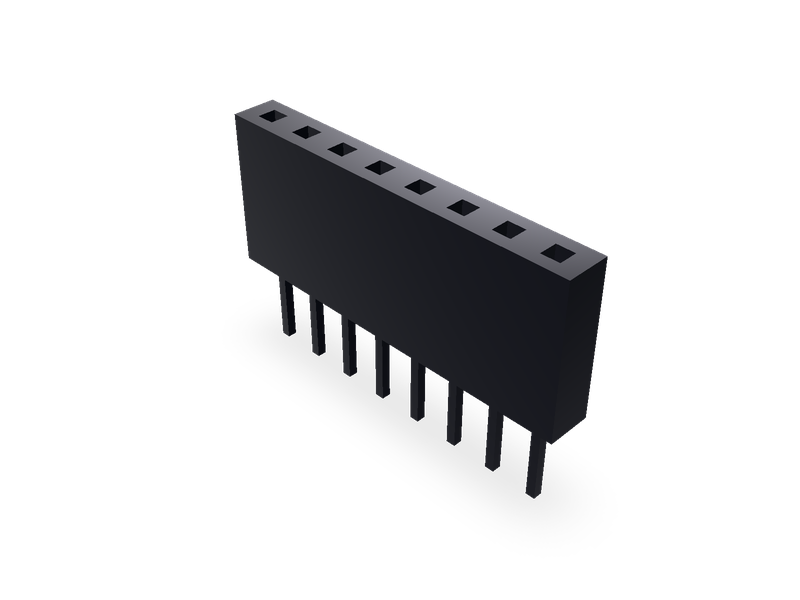
Pin socket (female header): 2.54 mm straight, 2.00 mm surface-mount, 1.27 mm surface-mount and right-angle, 1.00 mm straight and surface-mount, one or two rows.
SMD quartz crystals by maker series: Epson FA-238, FA-238V, TSX-3225, MA-406, MA-505; TXC 7M, AX; Abracon ABM8G, ABM3B; EuroQuartz MT.
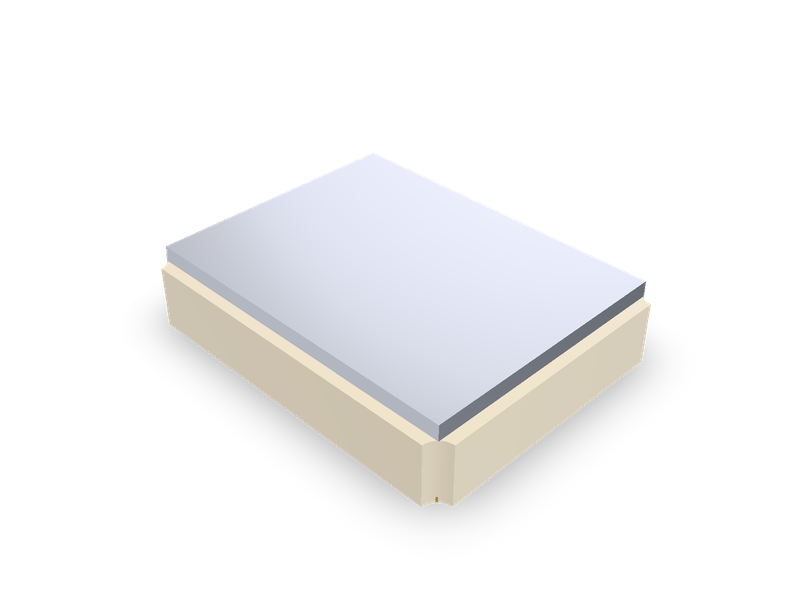
| 1 | """SMD quartz crystal by maker series: in a ceramic package, Epson FA-238, FA-238V and TSX-3225, TXC 7M and AX, Abracon ABM8G and ABM3B, |
| 2 | EuroQuartz MT; moulded with bent leads, Epson MA-406 and MA-505. Centred on the origin, seated on the XY plane, the long side along X. Seen |
| 3 | from above, pad or lead 1 is at -X -Y and they count counter-clockwise (2 at +X -Y, 3 at +X +Y, 4 at -X +Y); a two-pad package has pad 1 |
| 4 | at -X and pad 2 at +X. A ceramic package is the base with its pads underneath and a lid on top. Dimensions from each maker's data sheet, |
| 5 | listed in the README.""" |
| 6 | from steve import Model |
| 7 | |
| 8 | series = "FA-238" # Maker series |
| 9 | detail = "full" # full: with pads or leads; simple: the body only |
| 10 | |
| 11 | # Each entry: (length, width, height, pad length along X, pad width along Y, gap between pads along X, gap between pads along Y, pads, |
| 12 | # chamfered pad (0: none), chamfer, lid), lengths in mm. Lid "metal": seam-sealed metal cover; "ceramic": glass-sealed ceramic lid. |
| 13 | # Epson "Crystal unit FA-238V / FA-238 / TSX-3225" (download.epsondevice.com/td/pdf/brief/FA-238_en.pdf, (c) 2025), "External dimensions": |
| 14 | # FA-238: 3.2 x 2.5, 0.7 max; pads 0.9 x 0.8, 1.2 and 0.7 apart. FA-238V: the same, pad #1 chamfered. TSX-3225: 3.2 x 2.5, 0.6 max; |
| 15 | # pads 1.0 x 0.8, 1.0 and 0.7 apart, pad #2 chamfered C 0.3 min. "#2 and #4 are connected to the cover": a metal lid. |
| 16 | # TXC "7M MHz Crystal" Rev. 1.09 (www.txccrystal.com/images/pdf/7m-accuracy.pdf), page 2 "Dimensions": 3.20 x 2.50, 0.70 +/-0.1; |
| 17 | # pads 1.2 and 0.7 apart, pad 1 chamfered; "Seam sealing" (page 1). |
| 18 | # TXC catalogue page 22, "SMD Glass Sealing Crystals 8.0 x 4.5 x 1.5 mm AX Series" (copy hosted by LCSC, datasheet.lcsc.com, |
| 19 | # product C7078706): 8.0 x 4.5, 1.50 max; two pads 2.0 wide, 5.0 apart, one chamfered. |
| 20 | # Abracon "ABM8G" revised 08.13.15 (abracon.com/Resonators/ABM8G.pdf), page 2 "Outline drawing": 3.2 x 2.5, 1.0 max; pads 1.2 ref and |
| 21 | # 0.9 ref apart, 0.1 ref from the ends, pad 1 chamfered; "ceramic glass sealed". |
| 22 | # Abracon "ABM3B series" Revision U, 8/27/2024 (abracon.com/Resonators/ABM3B.pdf), page 3 "Mechanical Dimensions": 5.00 x 3.20, |
| 23 | # 1.1 max (ABM3B); pads 1.20 x 0.80, 2.60 and 1.40 apart, pad 1 chamfered; "Seam Sealing". |
| 24 | # EuroQuartz "MT Crystals" (www.euroquartz.co.uk/media/1904/mt.pdf), "Outline & dimensions": 3.2 x 2.5 x 0.7; pads 1.0 x 0.75, 1.2 and |
| 25 | # 1.0 apart; "metal lid"; the chamfered pad's position varies (the sheet's note), so none is drawn. |
| 26 | # Where a sheet gives only the gaps, the pads run from the gap to 0.1 inside the body's edge (TXC 7M both ways; ABM8G across, where the |
| 27 | # drawing gives 0.1 ref only at the ends), a proportion read off the drawings. AX's pads run to the ends, as drawn. |
| 28 | SERIES = { |
| 29 | "FA-238": (3.2, 2.5, 0.7, 0.9, 0.8, 1.2, 0.7, 4, 0, 0.0, "metal"), |
| 30 | "FA-238V": (3.2, 2.5, 0.7, 0.9, 0.8, 1.2, 0.7, 4, 1, 0.0, "metal"), |
| 31 | "TSX-3225": (3.2, 2.5, 0.6, 1.0, 0.8, 1.0, 0.7, 4, 2, 0.3, "metal"), |
| 32 | "7M": (3.2, 2.5, 0.7, 0.9, 0.8, 1.2, 0.7, 4, 1, 0.0, "metal"), |
| 33 | "AX": (8.0, 4.5, 1.5, 1.5, 2.0, 5.0, 0.0, 2, 2, 0.0, "ceramic"), |
| 34 | "ABM8G": (3.2, 2.5, 1.0, 0.9, 0.7, 1.2, 0.9, 4, 1, 0.0, "ceramic"), |
| 35 | "ABM3B": (5.0, 3.2, 1.1, 1.2, 0.8, 2.6, 1.4, 4, 1, 0.0, "metal"), |
| 36 | "MT": (3.2, 2.5, 0.7, 1.0, 0.75, 1.2, 1.0, 4, 0, 0.0, "metal"), |
| 37 | } |
| 38 | # Proportions, for looks (the sheets draw these but don't dimension them): the lid is 0.2 x the height thick (AX's ceramic lid 0.4 x, as |
| 39 | # its side view draws it) and set in from the base's edge by 0.04 x the width; the base's corners have castellation notches of radius |
| 40 | # 0.06 x the width; the pads are 0.05 thick, let into the base's underside; an undimensioned pad chamfer is 0.35 x the pad's smaller side. |
| 41 | LID = 0.2 |
| 42 | LID_AX = 0.4 |
| 43 | PAD_T = 0.05 |
| 44 | # Moulded packages with bent leads: (body length, body width, body height, overall height, lead centres along X, lead centres along Y, |
| 45 | # lead width, lead foot length, feet inner span, lead ends), lengths in mm; None where the drawing doesn't give it. |
| 46 | # Epson "Crystal unit MA-406 / MA-505 / MA-506" ((c) Seiko Epson Corporation 2020, marked discontinued; |
| 47 | # download.epsondevice.com/td/pdf/brief/MA-406_en.pdf, the same sheet as MA-505_en.pdf), page 1 "External dimensions": |
| 48 | # MA-406: body 11.7 max x 4.0, 3.5 high, 3.7 max overall, 4.8 max across the leads; leads 0.7 wide, 9.6 apart along the length, |
| 49 | # on the long sides, wrapped under the body: feet (1.2) ref with 2.1 between them. |
| 50 | # MA-505: body 12.70 x 5.08 max, 4.19 high, 4.6 max overall, 0.2 min under the body, 13.46 max over the leads; leads 1.09 wide, their |
| 51 | # centre lines 3.3 apart across the body, on the ends, wrapped under it: feet 2.54 long. |
| 52 | MOLDED = { |
| 53 | "MA-406": (11.7, 4.0, 3.5, 3.7, 9.6, None, 0.7, 1.2, 2.1, None), |
| 54 | "MA-505": (12.70, 5.08, 4.19, 4.6, None, 3.3, 1.09, 2.54, None, 13.46), |
| 55 | } |
| 56 | # Proportions, for looks: the leads are 0.2 thick and leave the moulding 0.4 x the overall height above the board (as the side views draw |
| 57 | # them); the moulding's top tapers to 0.85 x its width above 0.4 x its height (the end views); MA-406's pin-1 mark is a half-round notch at |
| 58 | # the -X end, radius 0.2 x the width and 0.1 deep; MA-505's -X top edge is bevelled 0.08 x the length. |
| 59 | LEAD_T = 0.2 |
| 60 | |
| 61 | if series not in SERIES and series not in MOLDED: |
| 62 | raise ValueError(f"no series {series!r}: {', '.join([*SERIES, *MOLDED])}") |
| 63 | if series in SERIES: |
| 64 | L, W, H, px, py, gx, gy, pads, chamfered, chamfer, lid = SERIES[series] |
| 65 | lid_t = (LID_AX if series == "AX" else LID) * H |
| 66 | base_t = H - lid_t |
| 67 | inset = 0.04 * W |
| 68 | notch = 0.06 * W |
| 69 | if not chamfer: |
| 70 | chamfer = 0.35 * min(px, py) |
| 71 | |
| 72 | # Pad centres, numbered as above: x and y signs. |
| 73 | if pads == 4: |
| 74 | places = {1: (-1, -1), 2: (1, -1), 3: (1, 1), 4: (-1, 1)} |
| 75 | else: |
| 76 | places = {1: (-1, 0), 2: (1, 0)} |
| 77 | |
| 78 | |
| 79 | def pad_outline(n): |
| 80 | sx, sy = places[n] |
| 81 | x0 = sx * gx / 2 |
| 82 | x1 = x0 + sx * px |
| 83 | y0 = sy * gy / 2 if sy else -py / 2 |
| 84 | y1 = y0 + (sy or 1) * py |
| 85 | # Corners in order round the pad; the inner corner (nearest the centre) is (x0, y0) for a four-pad package. |
| 86 | pts = [(x0, y0), (x1, y0), (x1, y1), (x0, y1)] |
| 87 | if n != chamfered: |
| 88 | return pts |
| 89 | c = chamfer |
| 90 | if pads == 4: |
| 91 | return [(x0 + sx * c, y0), (x1, y0), (x1, y1), (x0, y1), (x0, y0 + sy * c)] |
| 92 | # AX: the bottom view chamfers pad 2's corner at the gap on its lower side, which is +Y seen from above (the sheets that number their |
| 93 | # pads draw the bottom view turned over about the X axis). |
| 94 | return [(x0, y0), (x1, y0), (x1, y1), (x0 + sx * c, y1), (x0, y1 - c)] |
| 95 | |
| 96 | |
| 97 | model = Model() |
| 98 | with model.sketch("base_sketch", on="XY", name="Base") as sk: |
| 99 | sk.rect("base_rect", (-L / 2, -W / 2), (L / 2, W / 2)) |
| 100 | model.extrude("base", "base_sketch", distance=base_t, op="new", body="base_body", name="Base") |
| 101 | with model.sketch("notch_sketch", on="XY", name="Castellations") as sk: |
| 102 | for i, (sx, sy) in enumerate(((-1, -1), (1, -1), (1, 1), (-1, 1))): |
| 103 | sk.circle(f"notch_{i}", (sx * L / 2, sy * W / 2), notch) |
| 104 | model.extrude("notches", "notch_sketch", distance=base_t, op="cut", body="base_body", name="Castellations") |
| 105 | model.plane("lid_plane", on="XY", offset=base_t, name="Lid") |
| 106 | with model.sketch("lid_sketch", on="lid_plane", name="Lid") as sk: |
| 107 | sk.rect("lid_rect", (-L / 2 + inset, -W / 2 + inset), (L / 2 - inset, W / 2 - inset)) |
| 108 | model.extrude("lid", "lid_sketch", distance=lid_t, op="new", body="lid_body", name="Lid") |
| 109 | bodies = ["base_body", "lid_body"] |
| 110 | if detail == "full": |
| 111 | with model.sketch("pad_sketch", on="XY", name="Pads") as sk: |
| 112 | for n in places: |
| 113 | sk.polyline(f"pad_{n}", pad_outline(n), closed=True) |
| 114 | model.extrude("pad_pockets", "pad_sketch", distance=PAD_T, op="cut", body="base_body", name="Pad pockets") |
| 115 | for n in places: |
| 116 | with model.sketch(f"pad_{n}_sketch", on="XY", name=f"Pad {n}") as sk: |
| 117 | sk.polyline(f"pad_{n}_outline", pad_outline(n), closed=True) |
| 118 | model.extrude(f"pad_{n}", f"pad_{n}_sketch", distance=PAD_T, op="new", body=f"pad_{n}_body", name=f"Pad {n}") |
| 119 | model.extrude(f"pad_{n}_notches", "notch_sketch", distance=PAD_T, op="cut", body=f"pad_{n}_body", name=f"Pad {n} castellations") |
| 120 | # Materials, for looks and a rough mass: the base is alumina ceramic; a metal lid is a Fe-Ni-Co alloy (Kovar, density about 8.4), and invar, |
| 121 | # the Fe-Ni alloy in the material list (8.05), stands in for it; a ceramic lid is alumina too; the pads are gold-plated tungsten |
| 122 | # metallisation, gold (density 19.3, as tungsten's). |
| 123 | model.material("alumina", bodies=["base_body"], color="#d9cdb2") |
| 124 | if lid == "metal": |
| 125 | model.material("invar", bodies=["lid_body"], color="#c9ccd1") |
| 126 | else: |
| 127 | model.material("alumina", bodies=["lid_body"], color="#2e3033") |
| 128 | if detail == "full": |
| 129 | model.material("gold", bodies=[f"pad_{n}_body" for n in places], color="#d4a94a") |
| 130 | else: |
| 131 | BL, BW, BH, H, cx, cy, lw, foot, span, ends = MOLDED[series] |
| 132 | z0 = H - BH |
| 133 | rise = 0.4 * H |
| 134 | model = Model() |
| 135 | model.plane("body_end", on="YZ", offset=-BL / 2, name="Body") |
| 136 | with model.sketch("body_sketch", on="body_end", name="Body") as sk: |
| 137 | sk.polyline("body_outline", [(-BW / 2, z0), (BW / 2, z0), (BW / 2, z0 + 0.4 * BH), (0.425 * BW, H), (-0.425 * BW, H), |
| 138 | (-BW / 2, z0 + 0.4 * BH)], closed=True) |
| 139 | model.extrude("body", "body_sketch", distance=BL, op="new", body="body_body", name="Body") |
| 140 | if series == "MA-406": |
| 141 | model.plane("top_plane", on="XY", offset=H, name="Top") |
| 142 | with model.sketch("mark_sketch", on="top_plane", name="Pin-1 mark") as sk: |
| 143 | sk.circle("mark_circle", (-BL / 2, 0), 0.2 * BW) |
| 144 | model.extrude("mark", "mark_sketch", distance=-0.1, op="cut", body="body_body", name="Pin-1 mark") |
| 145 | else: |
| 146 | b = 0.08 * BL |
| 147 | model.plane("bevel_plane", on="XZ", offset=-(BW / 2 + 1), name="Bevel") |
| 148 | with model.sketch("bevel_sketch", on="bevel_plane", name="Pin-1 bevel") as sk: |
| 149 | sk.polyline("bevel_outline", [(-BL / 2 - 0.1, H - b), (-BL / 2 + b, H + 0.1), (-BL / 2 - 0.1, H + 0.1)], closed=True) |
| 150 | model.extrude("bevel", "bevel_sketch", distance=BW + 2, op="cut", body="body_body", name="Pin-1 bevel") |
| 151 | bodies = ["body_body"] |
| 152 | if detail == "full": |
| 153 | for n, (sx, sy) in {1: (-1, -1), 2: (1, -1), 3: (1, 1), 4: (-1, 1)}.items(): |
| 154 | if series == "MA-406": |
| 155 | # On a long side: the foot under the body from the inner span out, then up the side; sketched across Y on a YZ plane |
| 156 | # (normal +X), extruded along X by the lead's width. |
| 157 | u0, u1 = sy * span / 2, sy * (span / 2 + foot) |
| 158 | plane, offset = "YZ", sx * cx / 2 - lw / 2 |
| 159 | else: |
| 160 | # On an end: the foot under the body from the lead end in, then up the end; sketched along X on an XZ plane (normal -Y), |
| 161 | # extruded across Y by the lead's width. |
| 162 | u0, u1 = sx * (ends / 2 - foot), sx * ends / 2 |
| 163 | plane, offset = "XZ", -(sy * cy / 2 + lw / 2) |
| 164 | s_out = 1 if u1 > u0 else -1 |
| 165 | ub = u1 - s_out * LEAD_T |
| 166 | model.plane(f"lead_{n}_plane", on=plane, offset=offset, name=f"Lead {n}") |
| 167 | with model.sketch(f"lead_{n}_profile", on=f"lead_{n}_plane", name=f"Lead {n}") as sk: |
| 168 | sk.polyline(f"lead_{n}_shape", [(u0, 0), (u1, 0), (u1, rise), (ub, rise), (ub, LEAD_T), (u0, LEAD_T)], closed=True) |
| 169 | model.extrude(f"lead_{n}", f"lead_{n}_profile", distance=lw, op="new", body=f"lead_{n}_body", name=f"Lead {n}") |
| 170 | bodies.append(f"lead_{n}_body") |
| 171 | # Materials, for looks and a rough mass: epoxy moulding compound is mostly silica filler, density about 1.9 to 2.0, with the crystal's |
| 172 | # metal can inside; ptfe (2.2) is the nearest in the material list. The leads are tinned copper alloy, copper. |
| 173 | model.material("ptfe", bodies=["body_body"], color="#26282b") |
| 174 | if detail == "full": |
| 175 | model.material("copper", bodies=bodies[1:], color="#c9ccd1") |
| 176 | result = model.result() |
| 177 |
| 1 | name = "steve/smd-crystal" |
| 2 | version = "1.0.0" |
| 3 | runtime = "steve" |
| 4 | license = "MIT" |
| 5 | summary = "SMD quartz crystals by maker series: Epson FA-238, FA-238V, TSX-3225, MA-406, MA-505; TXC 7M, AX; Abracon ABM8G, ABM3B; EuroQuartz MT." |
| 6 | description = """SMD quartz crystal for board layouts, from the maker's data sheet drawing for each series. Ceramic packages, the base with its pads underneath and the lid on top: 3.2 x 2.5 four-pad (Epson FA-238, FA-238V and TSX-3225, TXC 7M, Abracon ABM8G, EuroQuartz MT), Abracon ABM3B (5.0 x 3.2) and TXC AX (8.0 x 4.5, two pads). Moulded with leads bent under the body: Epson MA-406 and MA-505. Pad or lead 1 at -X -Y seen from above. See the README.""" |
| 7 | tags = ["crystal", "quartz", "oscillator", "smd", "electronics"] |
| 8 | |
| 9 | [parameters.series] |
| 10 | type = "choice" |
| 11 | default = "FA-238" |
| 12 | choices = ["FA-238", "FA-238V", "TSX-3225", "MA-406", "MA-505", "7M", "AX", "ABM8G", "ABM3B", "MT"] |
| 13 | label = "Maker series" |
| 14 | |
| 15 | [parameters.detail] |
| 16 | type = "choice" |
| 17 | default = "full" |
| 18 | choices = ["full", "simple"] |
| 19 | label = "Detail" |
| 20 | description = "full: with pads or leads. simple: the body only (base and lid, or the moulding), for big assemblies." |
| 21 | |
| 22 | [[presets]] |
| 23 | id = "FA-238" |
| 24 | title = "Epson FA-238, SMD crystal 3.2 x 2.5 x 0.7 mm, 4 pads" |
| 25 | params = { series = "FA-238" } |
| 26 | aliases = ["Epson FA-238", "Seiko Epson FA-238", "FA-238", "Epson FA-238 crystal", "FA-238 crystal 3.2 x 2.5 mm", "Epson FA-238, SMD crystal 3.2 x 2.5 x 0.7 mm, 4 pads"] |
| 27 | standard = "Epson FA-238" |
| 28 | |
| 29 | [[presets]] |
| 30 | id = "FA-238V" |
| 31 | title = "Epson FA-238V, SMD crystal 3.2 x 2.5 x 0.7 mm, 4 pads" |
| 32 | params = { series = "FA-238V" } |
| 33 | aliases = ["Epson FA-238V", "Seiko Epson FA-238V", "FA-238V", "Epson FA-238V crystal", "FA-238V crystal 3.2 x 2.5 mm", "Epson FA-238V, SMD crystal 3.2 x 2.5 x 0.7 mm, 4 pads"] |
| 34 | standard = "Epson FA-238V" |
| 35 | |
| 36 | [[presets]] |
| 37 | id = "TSX-3225" |
| 38 | title = "Epson TSX-3225, SMD crystal 3.2 x 2.5 x 0.6 mm, 4 pads" |
| 39 | params = { series = "TSX-3225" } |
| 40 | aliases = ["Epson TSX-3225", "Seiko Epson TSX-3225", "TSX-3225", "Epson TSX-3225 crystal", "TSX-3225 crystal 3.2 x 2.5 mm", "Epson TSX-3225, SMD crystal 3.2 x 2.5 x 0.6 mm, 4 pads"] |
| 41 | standard = "Epson TSX-3225" |
| 42 | |
| 43 | [[presets]] |
| 44 | id = "MA-406" |
| 45 | title = "Epson MA-406, moulded SMD crystal 11.7 x 4 x 3.7 mm, 4 leads" |
| 46 | params = { series = "MA-406" } |
| 47 | aliases = ["Epson MA-406", "Seiko Epson MA-406", "MA-406", "Epson MA-406 crystal", "MA-406 crystal 11.7 x 4 mm"] |
| 48 | standard = "Epson MA-406" |
| 49 | |
| 50 | [[presets]] |
| 51 | id = "MA-505" |
| 52 | title = "Epson MA-505, moulded SMD crystal 12.7 x 5.08 x 4.6 mm, 4 leads" |
| 53 | params = { series = "MA-505" } |
| 54 | aliases = ["Epson MA-505", "Seiko Epson MA-505", "MA-505", "Epson MA-505 crystal", "MA-505 crystal 12.7 x 5.08 mm"] |
| 55 | standard = "Epson MA-505" |
| 56 | |
| 57 | [[presets]] |
| 58 | id = "7M" |
| 59 | title = "TXC 7M, SMD crystal 3.2 x 2.5 x 0.7 mm, 4 pads" |
| 60 | params = { series = "7M" } |
| 61 | aliases = ["TXC 7M", "TXC 7M crystal", "7M crystal 3.2 x 2.5 mm", "TXC 7M, SMD crystal 3.2 x 2.5 x 0.7 mm, 4 pads"] |
| 62 | standard = "TXC 7M" |
| 63 | |
| 64 | [[presets]] |
| 65 | id = "AX" |
| 66 | title = "TXC AX, SMD crystal 8 x 4.5 x 1.5 mm, 2 pads" |
| 67 | params = { series = "AX" } |
| 68 | aliases = ["TXC AX", "TXC AX crystal", "AX crystal 8 x 4.5 mm"] |
| 69 | standard = "TXC AX" |
| 70 | |
| 71 | [[presets]] |
| 72 | id = "ABM8G" |
| 73 | title = "Abracon ABM8G, SMD crystal 3.2 x 2.5 x 1 mm, 4 pads" |
| 74 | params = { series = "ABM8G" } |
| 75 | aliases = ["Abracon ABM8G", "ABM8G", "Abracon ABM8G crystal", "ABM8G crystal 3.2 x 2.5 mm"] |
| 76 | standard = "Abracon ABM8G" |
| 77 | |
| 78 | [[presets]] |
| 79 | id = "ABM3B" |
| 80 | title = "Abracon ABM3B, SMD crystal 5 x 3.2 x 1.1 mm, 4 pads" |
| 81 | params = { series = "ABM3B" } |
| 82 | aliases = ["Abracon ABM3B", "ABM3B", "Abracon ABM3B crystal", "ABM3B crystal 5 x 3.2 mm"] |
| 83 | standard = "Abracon ABM3B" |
| 84 | |
| 85 | [[presets]] |
| 86 | id = "MT" |
| 87 | title = "EuroQuartz MT, SMD crystal 3.2 x 2.5 x 0.7 mm, 4 pads" |
| 88 | params = { series = "MT" } |
| 89 | aliases = ["EuroQuartz MT", "EuroQuartz MT crystal", "MT crystal 3.2 x 2.5 mm", "EuroQuartz MT, SMD crystal 3.2 x 2.5 x 0.7 mm, 4 pads"] |
| 90 | standard = "EuroQuartz MT" |
| 91 | |
| 92 | [[presets]] |
| 93 | id = "FA-238-simple" |
| 94 | title = "Epson FA-238, SMD crystal 3.2 x 2.5 x 0.7 mm, 4 pads, simple" |
| 95 | params = { series = "FA-238", detail = "simple" } |
| 96 | aliases = ["Epson FA-238 simple"] |
| 97 | standard = "Epson FA-238" |
| 98 |
A surface-mount quartz crystal. Most series are ceramic packages: the ceramic base with its pads underneath and the lid on top. Epson MA-406 and MA-505 are moulded, with four leads bent under the body. The part is centred on the origin and seated on the XY plane, with the long side along X. Seen from above, pad or lead 1 is at -X -Y and they count counter-clockwise (2 at +X -Y, 3 at +X +Y, 4 at -X +Y). The two-pad TXC AX has pad 1 at -X and pad 2 at +X.
| Series | Maker | Length | Width | Height | Pads | Pad (X x Y) | Gaps between pads (X, Y) | Chamfered pad | Lid |
|---|---|---|---|---|---|---|---|---|---|
| FA-238 | Epson | 3.2 | 2.5 | 0.7 max | 4 | 0.9 x 0.8 | 1.2, 0.7 | none | metal |
| FA-238V | Epson | 3.2 | 2.5 | 0.7 max | 4 | 0.9 x 0.8 | 1.2, 0.7 | 1 | metal |
| TSX-3225 | Epson | 3.2 | 2.5 | 0.6 max | 4 | 1.0 x 0.8 | 1.0, 0.7 | 2, C 0.3 | metal |
| 7M | TXC | 3.20 | 2.50 | 0.70 | 4 | (0.9 x 0.8) | 1.2, 0.7 | 1 | metal |
| AX | TXC | 8.0 | 4.5 | 1.50 max | 2 | (1.5) x 2.0 | 5.0 | 2 | ceramic |
| ABM8G | Abracon | 3.2 | 2.5 | 1.0 max | 4 | (0.9 x 0.7) | 1.2 ref, 0.9 ref | 1 | ceramic |
| ABM3B | Abracon | 5.00 | 3.20 | 1.1 max | 4 | 1.20 x 0.80 | 2.60, 1.40 | 1 | metal |
| MT | EuroQuartz | 3.2 | 2.5 | 0.7 | 4 | 1.0 x 0.75 | 1.2, 1.0 | not drawn | metal |
Values in brackets follow from the drawing's gaps and the proportions below.
| Series | Body length | Body width | Body height | Overall height | Leads | Lead width | Lead positions | Feet |
|---|---|---|---|---|---|---|---|---|
| MA-406 | 11.7 max | 4.0 | 3.5 | 3.7 max | 4, on the long sides | 0.7 | 9.6 apart along the length | (1.2) ref, 2.1 between them |
| MA-505 | 12.70 | 5.08 max | 4.19 | 4.6 max | 4, on the ends | 1.09 | centre lines 3.3 apart across the body; 13.46 max over the ends | 2.54 long |
Every frequency of a series has the same package.
Each maker's data sheet, downloaded from the maker's own site except TXC AX:
MA-505_en.pdf is the same sheet). Page 1, "External dimensions". MA-406: body 11.7 max x 4.0, 3.5 high and 3.7 max overall, 4.8 max across the leads; leads 0.7 wide, 9.6 apart, wrapped under the body with feet (1.2) ref and 2.1 between them. MA-505: body 12.70 x 5.08 max, 4.19 high and 4.6 max overall, 0.2 min under the body, 13.46 max over the leads; leads 1.09 wide, wrapped round the ends with feet 2.54 long, their centre lines (the chain lines the 3.3 dimension runs to) 3.3 apart. MA-505's internal connection joins #1 to #4 and #2 to #3, so the old catalogue calls it 2-pin.Proportions, for looks only. The drawings show these but don't dimension them:
The old catalogue's models for the ceramic packages were placeholder blocks without pads, so each name maps to the part it names, built from the maker's drawing. Measured on the reference models:
Crystal_SMD_SeikoEpson_FA238, FA238V and TSX3225, Crystal_SMD_TXC_7M, Crystal_SMD_Abracon_ABM8G and Crystal_SMD_EuroQuartz_MT, each with its _HandSoldering footprint variant, is the same block, 3.2 x 2.5 x 0.64, with a step on top and no pads. ABM8G is 1.0 max on Abracon's sheet and TSX-3225 0.6 max on Epson's.Crystal_SMD_Abracon_ABM3B-4Pin_5.0x3.2mm is a block 5.0 x 3.2 x 1.1 with no pads.Crystal_SMD_TXC_AX_8045-2Pin_8.0x4.5mm is a block 8.0 x 4.5 x 1.45 with no pads.Epson MA-406 and MA-505's old models have leads, but not the leads on Epson's drawing, so they map to the parts built from the drawing:
| 1 | # SMD crystal |
| 2 | |
| 3 | A surface-mount quartz crystal. Most series are ceramic packages: the ceramic base with its pads underneath and the lid on top. Epson MA-406 and MA-505 are moulded, with four leads bent under the body. The part is centred on the origin and seated on the XY plane, with the long side along X. Seen from above, pad or lead 1 is at -X -Y and they count counter-clockwise (2 at +X -Y, 3 at +X +Y, 4 at -X +Y). The two-pad TXC AX has pad 1 at -X and pad 2 at +X. |
| 4 | |
| 5 | | Series | Maker | Length | Width | Height | Pads | Pad (X x Y) | Gaps between pads (X, Y) | Chamfered pad | Lid | |
| 6 | |---|---|---|---|---|---|---|---|---|---| |
| 7 | | FA-238 | Epson | 3.2 | 2.5 | 0.7 max | 4 | 0.9 x 0.8 | 1.2, 0.7 | none | metal | |
| 8 | | FA-238V | Epson | 3.2 | 2.5 | 0.7 max | 4 | 0.9 x 0.8 | 1.2, 0.7 | 1 | metal | |
| 9 | | TSX-3225 | Epson | 3.2 | 2.5 | 0.6 max | 4 | 1.0 x 0.8 | 1.0, 0.7 | 2, C 0.3 | metal | |
| 10 | | 7M | TXC | 3.20 | 2.50 | 0.70 | 4 | (0.9 x 0.8) | 1.2, 0.7 | 1 | metal | |
| 11 | | AX | TXC | 8.0 | 4.5 | 1.50 max | 2 | (1.5) x 2.0 | 5.0 | 2 | ceramic | |
| 12 | | ABM8G | Abracon | 3.2 | 2.5 | 1.0 max | 4 | (0.9 x 0.7) | 1.2 ref, 0.9 ref | 1 | ceramic | |
| 13 | | ABM3B | Abracon | 5.00 | 3.20 | 1.1 max | 4 | 1.20 x 0.80 | 2.60, 1.40 | 1 | metal | |
| 14 | | MT | EuroQuartz | 3.2 | 2.5 | 0.7 | 4 | 1.0 x 0.75 | 1.2, 1.0 | not drawn | metal | |
| 15 | |
| 16 | Values in brackets follow from the drawing's gaps and the proportions below. |
| 17 | |
| 18 | | Series | Body length | Body width | Body height | Overall height | Leads | Lead width | Lead positions | Feet | |
| 19 | |---|---|---|---|---|---|---|---|---| |
| 20 | | MA-406 | 11.7 max | 4.0 | 3.5 | 3.7 max | 4, on the long sides | 0.7 | 9.6 apart along the length | (1.2) ref, 2.1 between them | |
| 21 | | MA-505 | 12.70 | 5.08 max | 4.19 | 4.6 max | 4, on the ends | 1.09 | centre lines 3.3 apart across the body; 13.46 max over the ends | 2.54 long | |
| 22 | |
| 23 | Every frequency of a series has the same package. |
| 24 | |
| 25 | ## Source |
| 26 | |
| 27 | Each maker's data sheet, downloaded from the maker's own site except TXC AX: |
| 28 | |
| 29 | - Epson, "Crystal unit" sheet for FA-238V, FA-238 and TSX-3225 (© Seiko Epson Corporation 2025), from <https://download.epsondevice.com/td/pdf/brief/FA-238_en.pdf>, linked from the FA-238 product page. "External dimensions": the body 3.2 ±0.1 x 2.5 ±0.1 (TSX-3225 ±0.15), 0.7 max (TSX-3225 0.6 max); FA-238 and FA-238V pads 0.9 x 0.8 with 1.2 and 0.7 between them, FA-238V's pad #1 chamfered; TSX-3225 pads 1.0 x 0.8 with 1.0 and 0.7 between them, pad #2 chamfered "C 0.3 Min.". "#2 and #4 are connected to the cover", so the cover is metal. |
| 30 | - TXC, "7M MHz Crystal", Rev. 1.09, from <https://www.txccrystal.com/images/pdf/7m-accuracy.pdf>. Page 2, "Dimensions": 3.20 ±0.1 x 2.50 ±0.1, 0.70 ±0.1; the bottom view gives the gaps between pads, 1.2 and 0.7, with pad 1 chamfered. Page 1: "Ceramic SMD package", "Seam sealing". |
| 31 | - TXC, catalogue page 22, "SMD Glass Sealing Crystals 8.0 x 4.5 x 1.5 mm AX Series", the copy LCSC hosts for part C7078706 (<https://datasheet.lcsc.com/datasheet/pdf/9b110e8e7e14b36ea63b1aaa26210cde.pdf>), since TXC's site has no AX file we could find. "Dimensions": 8.0 ±0.15 x 4.5 ±0.15, 1.50 max; two pads 2.0 wide with 5.0 between them, one chamfered. |
| 32 | - Abracon, "ABM8G", revised 08.13.15, from <https://abracon.com/Resonators/ABM8G.pdf>. Page 2, "Outline drawing": 3.2 ±0.1 x 2.5 ±0.1, 1.0 max; pads 1.2 ref apart along X and 0.9 ref apart along Y, 0.1 ref in from the ends; pad 1 chamfered; "ceramic glass sealed". |
| 33 | - Abracon, "ABM3B series", Revision U, 8/27/2024, from <https://abracon.com/Resonators/ABM3B.pdf>. Page 3, "Mechanical Dimensions": 5.00 ±0.10 x 3.20 ±0.10, 1.1 max for ABM3B (ABM3B1, 0.8 max, isn't modelled); pads 1.20 ±0.15 x 0.80 ±0.15 with 2.60 and 1.40 between them; pad 1 chamfered; "Seam Sealing". |
| 34 | - Epson, "Crystal unit" sheet for MA-406, MA-505 and MA-506 (© Seiko Epson Corporation 2020, marked discontinued), from <https://download.epsondevice.com/td/pdf/brief/MA-406_en.pdf> (`MA-505_en.pdf` is the same sheet). Page 1, "External dimensions". MA-406: body 11.7 max x 4.0, 3.5 high and 3.7 max overall, 4.8 max across the leads; leads 0.7 wide, 9.6 apart, wrapped under the body with feet (1.2) ref and 2.1 between them. MA-505: body 12.70 x 5.08 max, 4.19 high and 4.6 max overall, 0.2 min under the body, 13.46 max over the leads; leads 1.09 wide, wrapped round the ends with feet 2.54 long, their centre lines (the chain lines the 3.3 dimension runs to) 3.3 apart. MA-505's internal connection joins #1 to #4 and #2 to #3, so the old catalogue calls it 2-pin. |
| 35 | - EuroQuartz, "MT Crystals", from <https://www.euroquartz.co.uk/media/1904/mt.pdf>. "Outline & dimensions": 3.2 x 2.5 x 0.7; pads 1.0 x 0.75 with 1.2 and 1.0 between them; "metal lid". The sheet's note says the chamfered pad's position varies, so no pad is chamfered here. |
| 36 | |
| 37 | **Proportions, for looks only.** The drawings show these but don't dimension them: |
| 38 | |
| 39 | - Where a sheet gives only the gaps, the pads run from the gap to 0.1 inside the body's edge: TXC 7M both ways, and ABM8G along Y, where the drawing gives the 0.1 ref only at the ends. AX's pads run to the ends, as drawn. |
| 40 | - An undimensioned pad chamfer is 0.35 x the pad's smaller side. The bottom views are drawn turned over about the X axis, as the sheets that number their pads show, so AX's chamfer is on pad 2's corner at the gap, on the +Y side seen from above. |
| 41 | - The lid is 0.2 x the height thick, and AX's ceramic lid 0.4 x, as its side view draws it. It's set in from the base's edge by 0.04 x the width. |
| 42 | - The base's corners have castellation notches of radius 0.06 x the width. |
| 43 | - The pads are 0.05 thick, let into the base's underside. |
| 44 | - MA-406 and MA-505: the leads are 0.2 thick and run up the body's side or end to 0.4 x the overall height, as the side views draw them. Above 0.4 x its height the moulding's top tapers to 0.85 x its width, as the end views draw it. MA-406's pin-1 mark is a half-round notch at the -X end, radius 0.2 x the width and 0.1 deep. MA-505's -X top edge is bevelled by 0.08 x the length. MA-406's feet start 0.05 outside the body's sides, because (1.2) + 2.1 + (1.2) is 4.5 against the body's 4.0. |
| 45 | - Materials are for looks and a rough mass. The base is alumina. A metal lid is a Fe-Ni-Co alloy (Kovar, density about 8.4), and invar, the Fe-Ni alloy in the material list (8.05), stands in for it. A ceramic lid is alumina. The pads are gold-plated tungsten metallisation, so gold (19.3, about tungsten's density). MA-406's and MA-505's moulding is epoxy compound, mostly silica filler (density about 1.9 to 2.0) round the crystal's metal can, and ptfe (2.2) is the nearest in the material list. Their leads are tinned copper alloy, so copper. |
| 46 | |
| 47 | ## Catalogue models |
| 48 | |
| 49 | The old catalogue's models for the ceramic packages were placeholder blocks without pads, so each name maps to the part it names, built from the maker's drawing. Measured on the reference models: |
| 50 | |
| 51 | - Every 3.2 x 2.5 one, `Crystal_SMD_SeikoEpson_FA238`, `FA238V` and `TSX3225`, `Crystal_SMD_TXC_7M`, `Crystal_SMD_Abracon_ABM8G` and `Crystal_SMD_EuroQuartz_MT`, each with its `_HandSoldering` footprint variant, is the same block, 3.2 x 2.5 x 0.64, with a step on top and no pads. ABM8G is 1.0 max on Abracon's sheet and TSX-3225 0.6 max on Epson's. |
| 52 | - `Crystal_SMD_Abracon_ABM3B-4Pin_5.0x3.2mm` is a block 5.0 x 3.2 x 1.1 with no pads. |
| 53 | - `Crystal_SMD_TXC_AX_8045-2Pin_8.0x4.5mm` is a block 8.0 x 4.5 x 1.45 with no pads. |
| 54 | |
| 55 | Epson MA-406 and MA-505's old models have leads, but not the leads on Epson's drawing, so they map to the parts built from the drawing: |
| 56 | |
| 57 | - MA-406: the old model's leads are gull-wing feet 0.6 long, 3.6 apart at the board. The drawing wraps the leads under the body, with feet (1.2) ref and 2.1 between them. |
| 58 | - MA-505: the old model's end leads are 0.8 wide, with feet 1.73 long, centres 3.84 apart. The drawing gives 1.09 wide, 2.54 long and 3.3 apart. |
| 59 |
SMD quartz crystal for board layouts, from the maker's data sheet drawing for each series. Ceramic packages, the base with its pads underneath and the lid on top: 3.2 x 2.5 four-pad (Epson FA-238, FA-238V and TSX-3225, TXC 7M, Abracon ABM8G, EuroQuartz MT), Abracon ABM3B (5.0 x 3.2) and TXC AX (8.0 x 4.5, two pads). Moulded with leads bent under the body: Epson MA-406 and MA-505. Pad or lead 1 at -X -Y seen from above. See the README.
A surface-mount quartz crystal. Most series are ceramic packages: the ceramic base with its pads underneath and the lid on top. Epson MA-406 and MA-505 are moulded, with four leads bent under the body. The part is centred on the origin and seated on the XY plane, with the long side along X. Seen from above, pad or lead 1 is at -X -Y and they count counter-clockwise (2 at +X -Y, 3 at +X +Y, 4 at -X +Y). The two-pad TXC AX has pad 1 at -X and pad 2 at +X.
| Series | Maker | Length | Width | Height | Pads | Pad (X x Y) | Gaps between pads (X, Y) | Chamfered pad | Lid |
|---|---|---|---|---|---|---|---|---|---|
| FA-238 | Epson | 3.2 | 2.5 | 0.7 max | 4 | 0.9 x 0.8 | 1.2, 0.7 | none | metal |
| FA-238V | Epson | 3.2 | 2.5 | 0.7 max | 4 | 0.9 x 0.8 | 1.2, 0.7 | 1 | metal |
| TSX-3225 | Epson | 3.2 | 2.5 | 0.6 max | 4 | 1.0 x 0.8 | 1.0, 0.7 | 2, C 0.3 | metal |
| 7M | TXC | 3.20 | 2.50 | 0.70 | 4 | (0.9 x 0.8) | 1.2, 0.7 | 1 | metal |
| AX | TXC | 8.0 | 4.5 | 1.50 max | 2 | (1.5) x 2.0 | 5.0 | 2 | ceramic |
| ABM8G | Abracon | 3.2 | 2.5 | 1.0 max | 4 | (0.9 x 0.7) | 1.2 ref, 0.9 ref | 1 | ceramic |
| ABM3B | Abracon | 5.00 | 3.20 | 1.1 max | 4 | 1.20 x 0.80 | 2.60, 1.40 | 1 | metal |
| MT | EuroQuartz | 3.2 | 2.5 | 0.7 | 4 | 1.0 x 0.75 | 1.2, 1.0 | not drawn | metal |
Values in brackets follow from the drawing's gaps and the proportions below.
| Series | Body length | Body width | Body height | Overall height | Leads | Lead width | Lead positions | Feet |
|---|---|---|---|---|---|---|---|---|
| MA-406 | 11.7 max | 4.0 | 3.5 | 3.7 max | 4, on the long sides | 0.7 | 9.6 apart along the length | (1.2) ref, 2.1 between them |
| MA-505 | 12.70 | 5.08 max | 4.19 | 4.6 max | 4, on the ends | 1.09 | centre lines 3.3 apart across the body; 13.46 max over the ends | 2.54 long |
Every frequency of a series has the same package.
Each maker's data sheet, downloaded from the maker's own site except TXC AX:
MA-505_en.pdf is the same sheet). Page 1, "External dimensions". MA-406: body 11.7 max x 4.0, 3.5 high and 3.7 max overall, 4.8 max across the leads; leads 0.7 wide, 9.6 apart, wrapped under the body with feet (1.2) ref and 2.1 between them. MA-505: body 12.70 x 5.08 max, 4.19 high and 4.6 max overall, 0.2 min under the body, 13.46 max over the leads; leads 1.09 wide, wrapped round the ends with feet 2.54 long, their centre lines (the chain lines the 3.3 dimension runs to) 3.3 apart. MA-505's internal connection joins #1 to #4 and #2 to #3, so the old catalogue calls it 2-pin.Proportions, for looks only. The drawings show these but don't dimension them:
The old catalogue's models for the ceramic packages were placeholder blocks without pads, so each name maps to the part it names, built from the maker's drawing. Measured on the reference models:
Crystal_SMD_SeikoEpson_FA238, FA238V and TSX3225, Crystal_SMD_TXC_7M, Crystal_SMD_Abracon_ABM8G and Crystal_SMD_EuroQuartz_MT, each with its _HandSoldering footprint variant, is the same block, 3.2 x 2.5 x 0.64, with a step on top and no pads. ABM8G is 1.0 max on Abracon's sheet and TSX-3225 0.6 max on Epson's.Crystal_SMD_Abracon_ABM3B-4Pin_5.0x3.2mm is a block 5.0 x 3.2 x 1.1 with no pads.Crystal_SMD_TXC_AX_8045-2Pin_8.0x4.5mm is a block 8.0 x 4.5 x 1.45 with no pads.Epson MA-406 and MA-505's old models have leads, but not the leads on Epson's drawing, so they map to the parts built from the drawing:
Pin socket (female header): 2.54 mm straight, 2.00 mm surface-mount, 1.27 mm surface-mount and right-angle, 1.00 mm straight and surface-mount, one or two rows.
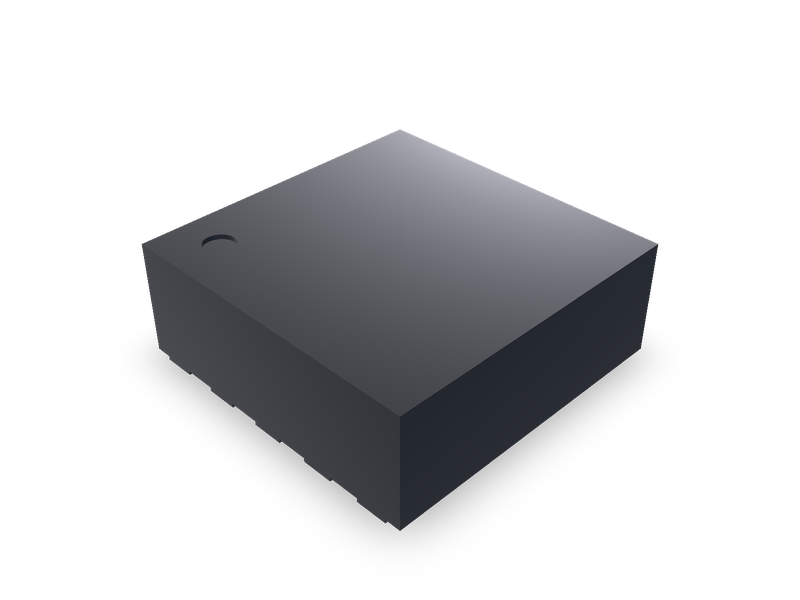
No-lead small-outline IC packages by TI outline: WSON-8/10/12/16, VSON-8 and X1SON-8, 0.4 to 0.8 mm pitch, with exposed thermal pad.
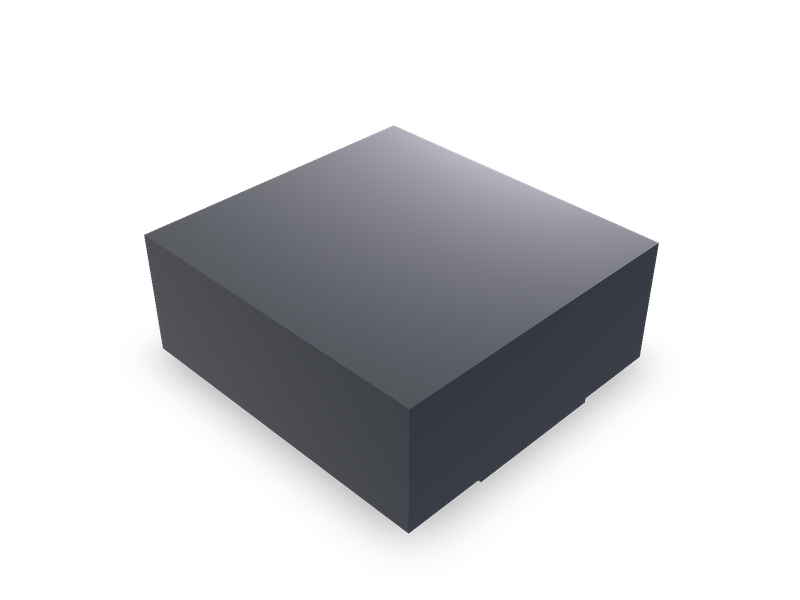
Molded SMD power inductors in the Sunlord MWSA-S sizes, 4.2 x 4.4 mm to 22 x 23.5 mm, by the maker's dimension table.
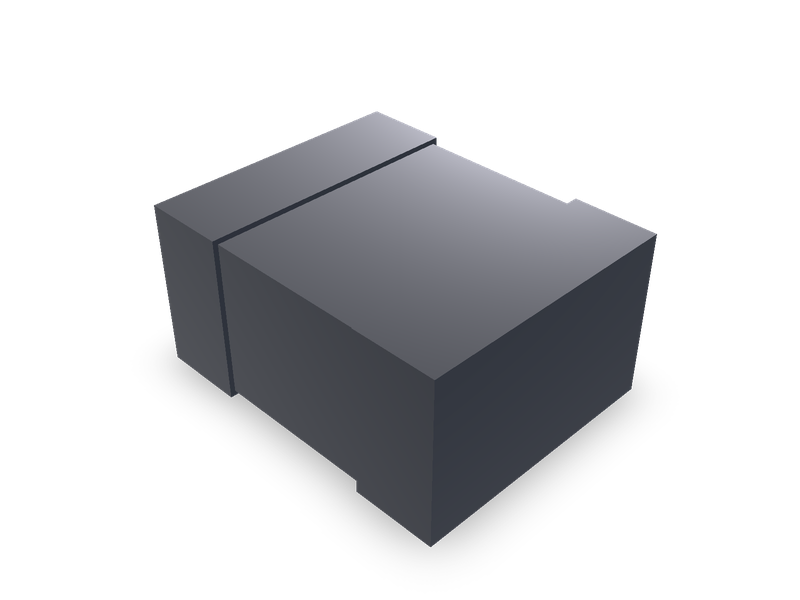
Power molded chip inductors in the Würth WE-PMCI sizes, 1.6 x 0.8 mm to 3.2 x 2.5 mm, by the maker's datasheets.