
STEVEMIT
steve/leaded-inductor
Axial leaded inductor, Fastron fixed choke coils (MICC, SMCC, MECC, HCCC, LACC, HBCC, VHBCC, XHBCC) and suppression coils (MISC, MESC, 77A), Vishay Dale molded IM-1 to IM-10, horizontal or vertical.
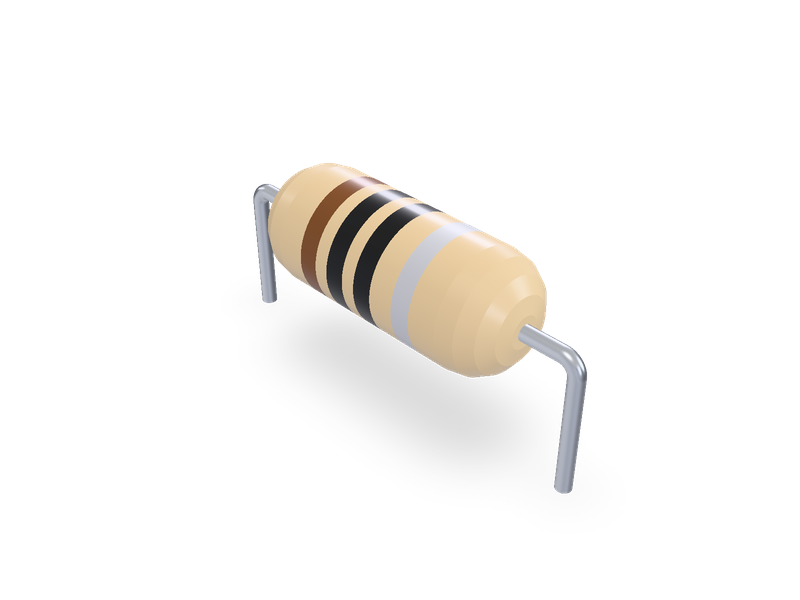
Axial leaded metal film resistor, Vishay Beyschlag MBA/SMA 0204, MBB/SMA 0207 and MBE/SMA 0414, with colour rings, horizontal or vertical.
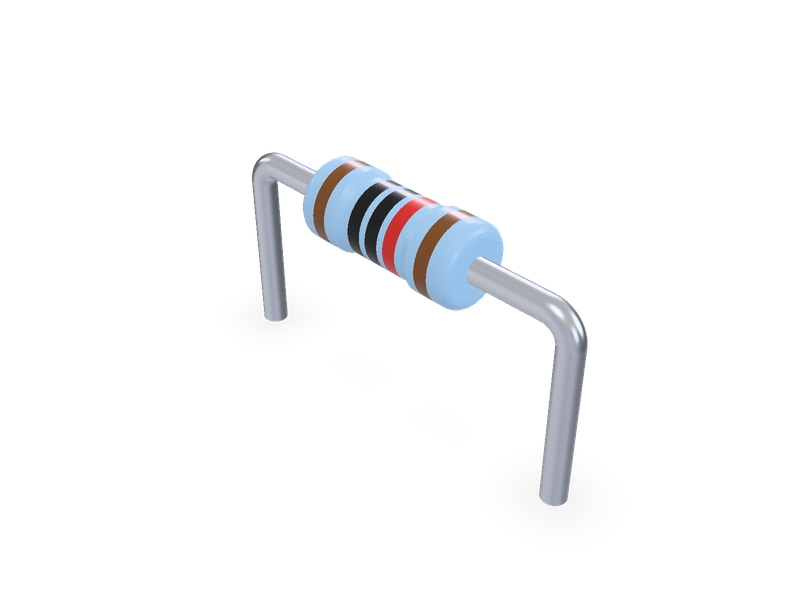
| 1 | """Axial leaded resistor, Vishay Beyschlag professional metal film MBA/SMA 0204, MBB/SMA 0207 and MBE/SMA 0414, mounted horizontal or |
| 2 | vertical. Lead 1 is at the origin and lead 2 at +X by the pitch; the leads go down through the board. Horizontal: the body lies on the board |
| 3 | along X, centred between the leads. Vertical: the body stands on the board over lead 1 and lead 2 comes back down beside it. The resistance |
| 4 | and tolerance make the colour rings (IEC 60062). Dimensions from Vishay's data sheet, listed in the README.""" |
| 5 | import math |
| 6 | |
| 7 | from steve import Model |
| 8 | |
| 9 | series = "MBA" # MBA (DIN size 0204), MBB (0207) or MBE (0414) |
| 10 | resistance = 10000.0 # Ω Resistance (in the range the sheet gives for the series and tolerance) |
| 11 | tolerance = "F" # D 0.5 %, F 1 %, G 2 %, J 5 % (one the sheet offers for this resistance) |
| 12 | mounting = "horizontal" # horizontal or vertical |
| 13 | pitch = 7.62 # mm Lead pitch on the board |
| 14 | tail = 3.0 # mm Leads below the board |
| 15 | detail = "full" # full: body, colour rings and leads; simple: the body only |
| 16 | |
| 17 | # Vishay Beyschlag "MBA/SMA 0204, MBB/SMA 0207, MBE/SMA 0414 - Professional Metal Film Leaded Resistors", document number 28766, revision |
| 18 | # 11-Jul-2018, page 13, table "DIMENSIONS - Leaded resistor types, mass and relevant physical dimensions": D max, L max, d nom and M min |
| 19 | # (the smallest bent lead spacing), in mm. |
| 20 | # Each entry: (body diameter max, body length max, lead diameter, smallest bent lead spacing). |
| 21 | SIZES = { |
| 22 | "MBA": (1.6, 3.6, 0.5, 5.0), |
| 23 | "MBB": (2.5, 6.5, 0.6, 10.0), |
| 24 | "MBE": (4.2, 11.9, 0.8, 15.0), |
| 25 | } |
| 26 | # The same sheet, page 3, "TEMPERATURE COEFFICIENT AND RESISTANCE RANGE - Standard Products", ± 50 ppm/K rows: resistance ranges in Ω by |
| 27 | # tolerance (the ± 25 ppm/K rows lie inside these). Values come from E24 (± 5 %, ± 2 %), E24/E96 (± 1 %) or E24/E192 (± 0.5 %). |
| 28 | RANGES = { |
| 29 | "MBA": {"J": ((0.22, 0.91),), "F": ((1, 10e6),), "D": ((10, 475e3),)}, |
| 30 | "MBB": {"J": ((0.22, 0.91), (11e6, 22e6)), "G": ((0.22, 0.91),), "F": ((1, 10e6),), "D": ((10, 1e6),)}, |
| 31 | "MBE": {"J": ((0.22, 0.91),), "F": ((1, 22e6),), "D": ((10, 2.43e6),)}, |
| 32 | } |
| 33 | # Colour code, IEC 60062 (the sheet, page 7: "Four or five color code rings designate the resistance value and tolerance in accordance with |
| 34 | # IEC 60062"): ± 5 % and ± 2 % carry two digit rings, ± 1 % and ± 0.5 % three; then the multiplier ring and the tolerance ring. |
| 35 | DIGIT_COLOURS = ("#1a1a1a", "#7a4a26", "#c8302c", "#e8792b", "#f2d22e", "#3f8f3f", "#2f5fb3", "#7d4fa8", "#8a8a8a", "#f4f4f4") |
| 36 | MULTIPLIER_COLOURS = {-2: "#c0c0c4", -1: "#cfa646", 0: "#1a1a1a", 1: "#7a4a26", 2: "#c8302c", 3: "#e8792b", 4: "#f2d22e", 5: "#3f8f3f", |
| 37 | 6: "#2f5fb3"} |
| 38 | TOLERANCE_COLOURS = {"D": "#3f8f3f", "F": "#7a4a26", "G": "#c8302c", "J": "#cfa646"} |
| 39 | |
| 40 | if series not in SIZES: |
| 41 | raise ValueError(f"no series {series!r}: {', '.join(SIZES)}") |
| 42 | if tolerance not in RANGES[series]: |
| 43 | raise ValueError(f"Vishay {series} comes in tolerance {', '.join(RANGES[series])}") |
| 44 | if not any(low * (1 - 1e-9) <= resistance <= high * (1 + 1e-9) for low, high in RANGES[series][tolerance]): |
| 45 | spans = " or ".join(f"{low:g} to {high:g} Ω" for low, high in RANGES[series][tolerance]) |
| 46 | raise ValueError(f"Vishay {series} at tolerance {tolerance}: {spans}") |
| 47 | DIGITS = 2 if tolerance in "JG" else 3 |
| 48 | exponent = math.floor(math.log10(resistance) + 1e-9) - (DIGITS - 1) |
| 49 | digits = round(resistance / 10 ** exponent) |
| 50 | if digits >= 10 ** DIGITS: |
| 51 | digits, exponent = digits // 10, exponent + 1 |
| 52 | if not math.isclose(digits * 10.0 ** exponent, resistance, rel_tol=1e-6) or exponent not in MULTIPLIER_COLOURS: |
| 53 | raise ValueError(f"{resistance} Ω can't be written in {DIGITS} digit rings and a multiplier ring") |
| 54 | diameter, length, lead, spacing = SIZES[series] |
| 55 | if mounting not in ("horizontal", "vertical"): |
| 56 | raise ValueError("mounting is horizontal or vertical") |
| 57 | R, r = diameter / 2, lead / 2 |
| 58 | BEND = lead # bend radius of the formed leads, one lead diameter: a proportion, for looks (the sheet gives none) |
| 59 | LOOP = 2.0 # vertical: lead 2 clears the body's top end by this before it turns down, a proportion |
| 60 | if mounting == "horizontal" and pitch < max(spacing, length + 2 * BEND): |
| 61 | raise ValueError(f"horizontal pitch: at least {max(spacing, length + 2 * BEND):.2f} mm for {series} (the sheet's M min is {spacing})") |
| 62 | if mounting == "vertical" and pitch < max(R + r, 2 * BEND): |
| 63 | raise ValueError(f"vertical pitch must let lead 2 pass the body: at least {max(R + r, 2 * BEND):.2f} mm for a {diameter} mm body") |
| 64 | |
| 65 | |
| 66 | def body_profile(): |
| 67 | """The body outline as (u along the axis from the body's lead-1 end, radius), and the ring segments' indices in ring order. Proportions, |
| 68 | for looks (the sheet draws the body but dimensions only D and L): the end caps are 0.25 x the length at the full diameter, their outer |
| 69 | edges rounded by 0.25 x the radius; the coated middle is 0.9 x the diameter, reached over 0.05 x the length. Rings 0.08 x the length wide: |
| 70 | the first on the lead-1 cap, the tolerance ring on the other cap, the rest spread over the middle.""" |
| 71 | e, cap, taper, mid, w = 0.25 * R, 0.25 * length, 0.05 * length, 0.9 * R, 0.08 * length |
| 72 | rings = DIGITS + 2 |
| 73 | middle = (cap + taper, length - cap - taper) |
| 74 | inner = rings - 2 |
| 75 | gap = (middle[1] - middle[0] - inner * w) / (inner + 1) |
| 76 | centres = [(e + cap) / 2] + [middle[0] + gap * (i + 1) + w * (i + 0.5) for i in range(inner)] + [length - (e + cap) / 2] |
| 77 | pts = [(0, 0), (0, R - e)] |
| 78 | pts += [(e * (1 - math.cos(math.pi / 2 * i / 4)), R - e + e * math.sin(math.pi / 2 * i / 4)) for i in range(1, 5)] |
| 79 | flats = [(e, cap, R), (middle[0], middle[1], mid), (length - cap, length - e, R)] |
| 80 | segments = [] |
| 81 | for k, (a, b, rad) in enumerate(flats): |
| 82 | if k: |
| 83 | pts.append((a, rad)) |
| 84 | for c in centres: |
| 85 | if a < c < b: |
| 86 | pts += [(c - w / 2, rad), (c + w / 2, rad)] |
| 87 | segments.append(len(pts) - 2) |
| 88 | pts.append((b, rad)) |
| 89 | pts += [(length - u, v) for u, v in reversed(pts[1:5])] |
| 90 | pts += [(length, 0)] |
| 91 | return pts, segments |
| 92 | |
| 93 | |
| 94 | def ring_colours(): |
| 95 | text = str(digits).rjust(DIGITS, "0") |
| 96 | return [DIGIT_COLOURS[int(t)] for t in text] + [MULTIPLIER_COLOURS[exponent], TOLERANCE_COLOURS[tolerance]] |
| 97 | |
| 98 | |
| 99 | model = Model() |
| 100 | outline, rings = body_profile() |
| 101 | horizontal = mounting == "horizontal" |
| 102 | x0 = pitch / 2 - length / 2 |
| 103 | axis_z = R # horizontal: the body rests on the board |
| 104 | if horizontal: |
| 105 | points = [(x0 + u, axis_z + v) for u, v in outline] |
| 106 | axis = ((0, 0, axis_z), (1, 0, 0)) |
| 107 | else: |
| 108 | points = [(v, u) for u, v in outline] |
| 109 | axis = "Z" |
| 110 | with model.sketch("body_sketch", on="XZ", name="Body") as sk: |
| 111 | sk.polyline("body_outline", points, closed=True) |
| 112 | model.revolve("body", "body_sketch", axis=axis, op="new", body="body_body", name="Body") |
| 113 | bodies = ["body_body"] |
| 114 | if detail == "full": |
| 115 | # Leads, swept along their bends. Horizontal: up from below the board at x = 0 and x = pitch to the body's axis, bent toward the body. |
| 116 | # Vertical: lead 1 straight down from the body's bottom end; lead 2 up from the top end, over and down at x = pitch. |
| 117 | if horizontal: |
| 118 | legs = [(0.0, 1, x0), (pitch, -1, x0 + length)] |
| 119 | for i, (x, side, x_end) in enumerate(legs, 1): |
| 120 | with model.sketch(f"lead_{i}_path", on="XZ", name=f"Lead {i} path") as sk: |
| 121 | sk.line(f"lead_{i}_up", (x, -tail), (x, axis_z - BEND), construction=True) |
| 122 | if side > 0: |
| 123 | sk.arc(f"lead_{i}_bend", (x + BEND, axis_z - BEND), BEND, 90, 180, construction=True) |
| 124 | else: |
| 125 | sk.arc(f"lead_{i}_bend", (x - BEND, axis_z - BEND), BEND, 0, 90, construction=True) |
| 126 | sk.line(f"lead_{i}_along", (x + side * BEND, axis_z), (x_end, axis_z), construction=True) |
| 127 | model.plane(f"lead_{i}_start", on="XY", offset=-tail, name=f"Lead {i} end") |
| 128 | with model.sketch(f"lead_{i}_section", on=f"lead_{i}_start", name=f"Lead {i}") as sk: |
| 129 | sk.circle(f"lead_{i}_round", (x, 0), r) |
| 130 | model.sweep(f"lead_{i}", f"lead_{i}_section", f"lead_{i}_path", op="new", body=f"lead_{i}_body", name=f"Lead {i}") |
| 131 | bodies.append(f"lead_{i}_body") |
| 132 | else: |
| 133 | model.plane("lead_1_start", on="XY", offset=-tail, name="Lead 1 end") |
| 134 | with model.sketch("lead_1_section", on="lead_1_start", name="Lead 1") as sk: |
| 135 | sk.circle("lead_1_round", (0, 0), r) |
| 136 | model.extrude("lead_1", "lead_1_section", distance=tail, op="new", body="lead_1_body", name="Lead 1") |
| 137 | top = length + LOOP |
| 138 | with model.sketch("lead_2_path", on="XZ", name="Lead 2 path") as sk: |
| 139 | sk.line("lead_2_up", (0, length), (0, top - BEND), construction=True) |
| 140 | sk.arc("lead_2_bend_1", (BEND, top - BEND), BEND, 90, 180, construction=True) |
| 141 | sk.line("lead_2_over", (BEND, top), (pitch - BEND, top), construction=True) |
| 142 | sk.arc("lead_2_bend_2", (pitch - BEND, top - BEND), BEND, 0, 90, construction=True) |
| 143 | sk.line("lead_2_down", (pitch, top - BEND), (pitch, -tail), construction=True) |
| 144 | model.plane("lead_2_start", on="XY", offset=length, name="Lead 2 start") |
| 145 | with model.sketch("lead_2_section", on="lead_2_start", name="Lead 2") as sk: |
| 146 | sk.circle("lead_2_round", (0, 0), r) |
| 147 | model.sweep("lead_2", "lead_2_section", "lead_2_path", op="new", body="lead_2_body", name="Lead 2") |
| 148 | bodies += ["lead_1_body", "lead_2_body"] |
| 149 | # Materials, for looks and a rough mass: the body as its ceramic core (the sheet: "a high grade ceramic body") in the sheet's "light blue |
| 150 | # protective coating"; the leads copper, tin plated ("electrolytic copper plated with 100 % pure tin"). |
| 151 | model.material("alumina", bodies=["body_body"], color="#9cc3e0") |
| 152 | if detail == "full": |
| 153 | model.material("copper", bodies=[b for b in bodies if b.startswith("lead")], color="#c9ccd1") |
| 154 | for i, colour in zip(rings, ring_colours()): |
| 155 | model.appearance(color=colour, faces=[f"body.side(body_outline.side{i})"]) |
| 156 | result = model.result() |
| 157 |
| 1 | name = "steve/axial-resistor" |
| 2 | version = "1.0.0" |
| 3 | runtime = "steve" |
| 4 | license = "MIT" |
| 5 | summary = "Axial leaded metal film resistor, Vishay Beyschlag MBA/SMA 0204, MBB/SMA 0207 and MBE/SMA 0414, with colour rings, horizontal or vertical." |
| 6 | description = """Axial leaded resistor with formed leads, lying on the board or standing up. Vishay Beyschlag's professional metal film resistors in DIN sizes 0204, 0207 and 0414, with the colour rings of the resistance and tolerance. The series gives the size, from Vishay's data sheet. Lead 1 at the origin, lead 2 along +X. See the README.""" |
| 7 | tags = ["resistor", "axial", "through-hole", "metal-film", "vishay", "electronics"] |
| 8 | |
| 9 | [parameters.series] |
| 10 | type = "choice" |
| 11 | default = "MBA" |
| 12 | choices = ["MBA", "MBB", "MBE"] |
| 13 | label = "Series" |
| 14 | description = "MBA: DIN size 0204 (3.6 x Ø 1.6). MBB: 0207 (6.5 x Ø 2.5). MBE: 0414 (11.9 x Ø 4.2)." |
| 15 | |
| 16 | [parameters.resistance] |
| 17 | type = "number" |
| 18 | default = 10000.0 |
| 19 | min = 0.22 |
| 20 | max = 22000000 |
| 21 | unit = "Ω" |
| 22 | label = "Resistance" |
| 23 | description = "In the range the sheet gives for the series and tolerance; it sets the colour rings." |
| 24 | |
| 25 | [parameters.tolerance] |
| 26 | type = "choice" |
| 27 | default = "F" |
| 28 | choices = ["D", "F", "G", "J"] |
| 29 | label = "Tolerance" |
| 30 | description = "D 0.5 %, F 1 % (five rings), G 2 %, J 5 % (four rings). One the sheet offers for this resistance." |
| 31 | |
| 32 | [parameters.mounting] |
| 33 | type = "choice" |
| 34 | default = "horizontal" |
| 35 | choices = ["horizontal", "vertical"] |
| 36 | label = "Mounting" |
| 37 | description = "horizontal: the body lies on the board between the leads. vertical: it stands over lead 1 and lead 2 comes back down beside it." |
| 38 | |
| 39 | [parameters.pitch] |
| 40 | type = "number" |
| 41 | default = 7.62 |
| 42 | min = 1.27 |
| 43 | max = 60 |
| 44 | unit = "mm" |
| 45 | label = "Lead pitch" |
| 46 | description = "The board's hole spacing. Horizontal: at least the sheet's smallest bent lead spacing (5.0, 10.0, 15.0). Vertical: room for lead 2 to pass the body." |
| 47 | |
| 48 | [parameters.tail] |
| 49 | type = "number" |
| 50 | default = 3.0 |
| 51 | min = 0.5 |
| 52 | max = 30 |
| 53 | unit = "mm" |
| 54 | label = "Leads below the board" |
| 55 | |
| 56 | [parameters.detail] |
| 57 | type = "choice" |
| 58 | default = "full" |
| 59 | choices = ["full", "simple"] |
| 60 | label = "Detail" |
| 61 | description = "full: body, colour rings and leads. simple: the body only, for big assemblies." |
| 62 | |
| 63 | [[presets]] |
| 64 | id = "MBA-10kF-H5.08" |
| 65 | title = "Vishay MBA/SMA 0204, 10 kΩ ±1 %, horizontal, 5.08 mm pitch" |
| 66 | params = { series = "MBA", resistance = 10000, tolerance = "F", mounting = "horizontal", pitch = 5.08 } |
| 67 | aliases = ["Vishay MBA/SMA 0204 10k F", "Vishay MBA 0204", "MBA 0204", "MBA0204", "SMA 0204", "10k resistor axial 0204", "axial resistor DIN 0204 horizontal", "metal film resistor 0204"] |
| 68 | standard = "Vishay MBA/SMA 0204" |
| 69 | |
| 70 | [[presets]] |
| 71 | id = "MBA-10kF-H7.62" |
| 72 | title = "Vishay MBA/SMA 0204, 10 kΩ ±1 %, horizontal, 7.62 mm pitch" |
| 73 | params = { series = "MBA", resistance = 10000, tolerance = "F", mounting = "horizontal", pitch = 7.62 } |
| 74 | aliases = ["Vishay MBA/SMA 0204 10k F", "Vishay MBA 0204", "MBA 0204", "MBA0204", "SMA 0204", "10k resistor axial 0204", "axial resistor DIN 0204 horizontal", "metal film resistor 0204"] |
| 75 | standard = "Vishay MBA/SMA 0204" |
| 76 | |
| 77 | [[presets]] |
| 78 | id = "MBA-10kF-V1.9" |
| 79 | title = "Vishay MBA/SMA 0204, 10 kΩ ±1 %, vertical, 1.9 mm pitch" |
| 80 | params = { series = "MBA", resistance = 10000, tolerance = "F", mounting = "vertical", pitch = 1.9 } |
| 81 | aliases = ["Vishay MBA/SMA 0204 10k F", "Vishay MBA 0204", "MBA 0204", "MBA0204", "SMA 0204", "10k resistor axial 0204", "axial resistor DIN 0204 vertical", "metal film resistor 0204"] |
| 82 | standard = "Vishay MBA/SMA 0204" |
| 83 | |
| 84 | [[presets]] |
| 85 | id = "MBA-10kF-V2.54" |
| 86 | title = "Vishay MBA/SMA 0204, 10 kΩ ±1 %, vertical, 2.54 mm pitch" |
| 87 | params = { series = "MBA", resistance = 10000, tolerance = "F", mounting = "vertical", pitch = 2.54 } |
| 88 | aliases = ["Vishay MBA/SMA 0204 10k F", "Vishay MBA 0204", "MBA 0204", "MBA0204", "SMA 0204", "10k resistor axial 0204", "axial resistor DIN 0204 vertical", "metal film resistor 0204"] |
| 89 | standard = "Vishay MBA/SMA 0204" |
| 90 | |
| 91 | [[presets]] |
| 92 | id = "MBA-10kF-V5.08" |
| 93 | title = "Vishay MBA/SMA 0204, 10 kΩ ±1 %, vertical, 5.08 mm pitch" |
| 94 | params = { series = "MBA", resistance = 10000, tolerance = "F", mounting = "vertical", pitch = 5.08 } |
| 95 | aliases = ["Vishay MBA/SMA 0204 10k F", "Vishay MBA 0204", "MBA 0204", "MBA0204", "SMA 0204", "10k resistor axial 0204", "axial resistor DIN 0204 vertical", "metal film resistor 0204"] |
| 96 | standard = "Vishay MBA/SMA 0204" |
| 97 | |
| 98 | [[presets]] |
| 99 | id = "MBB-10kF-H10.16" |
| 100 | title = "Vishay MBB/SMA 0207, 10 kΩ ±1 %, horizontal, 10.16 mm pitch" |
| 101 | params = { series = "MBB", resistance = 10000, tolerance = "F", mounting = "horizontal", pitch = 10.16 } |
| 102 | aliases = ["Vishay MBB/SMA 0207 10k F", "Vishay MBB 0207", "MBB 0207", "MBB0207", "SMA 0207", "10k resistor axial 0207", "axial resistor DIN 0207 horizontal", "metal film resistor 0207"] |
| 103 | standard = "Vishay MBB/SMA 0207" |
| 104 | |
| 105 | [[presets]] |
| 106 | id = "MBE-10kF-H15.24" |
| 107 | title = "Vishay MBE/SMA 0414, 10 kΩ ±1 %, horizontal, 15.24 mm pitch" |
| 108 | params = { series = "MBE", resistance = 10000, tolerance = "F", mounting = "horizontal", pitch = 15.24 } |
| 109 | aliases = ["Vishay MBE/SMA 0414 10k F", "Vishay MBE 0414", "MBE 0414", "MBE0414", "SMA 0414", "10k resistor axial 0414", "axial resistor DIN 0414 horizontal", "metal film resistor 0414"] |
| 110 | standard = "Vishay MBE/SMA 0414" |
| 111 | |
| 112 | [[presets]] |
| 113 | id = "MBA-R47J-H7.62" |
| 114 | title = "Vishay MBA/SMA 0204, 0.47 Ω ±5 %, horizontal, 7.62 mm pitch" |
| 115 | params = { series = "MBA", resistance = 0.47, tolerance = "J", mounting = "horizontal", pitch = 7.62 } |
| 116 | aliases = ["Vishay MBA/SMA 0204 R47 J", "Vishay MBA 0204", "MBA 0204", "MBA0204", "SMA 0204", "R47 resistor axial 0204", "axial resistor DIN 0204 horizontal", "metal film resistor 0204"] |
| 117 | standard = "Vishay MBA/SMA 0204" |
| 118 | |
| 119 | [[presets]] |
| 120 | id = "MBB-10kF-H10.16-simple" |
| 121 | title = "Vishay MBB/SMA 0207, 10 kΩ ±1 %, horizontal, 10.16 mm pitch, simple" |
| 122 | params = { series = "MBB", resistance = 10000, tolerance = "F", mounting = "horizontal", pitch = 10.16, detail = "simple" } |
| 123 | aliases = ["Vishay MBB 0207 simple"] |
| 124 | standard = "Vishay MBB/SMA 0207" |
| 125 |
An axial leaded metal film resistor with formed leads. Lead 1 is at the origin, lead 2 is at +X by the pitch, and the leads go down through the board.
The series is Vishay Beyschlag's professional metal film resistor in one DIN size. The resistance and tolerance set the colour rings.
| Series | DIN size | Body length max | Body Ø max | Lead Ø | Smallest bent lead spacing |
|---|---|---|---|---|---|
| MBA/SMA 0204 | 0204 | 3.6 | 1.6 | 0.5 | 5.0 |
| MBB/SMA 0207 | 0207 | 6.5 | 2.5 | 0.6 | 10.0 |
| MBE/SMA 0414 | 0414 | 11.9 | 4.2 | 0.8 | 15.0 |
Resistance ranges (Ω), by tolerance:
| Series | ± 5 % (J) | ± 2 % (G) | ± 1 % (F) | ± 0.5 % (D) |
|---|---|---|---|---|
| MBA | 0.22 to 0.91 | 1 to 10 M | 10 to 475 k | |
| MBB | 0.22 to 0.91, 11 M to 22 M | 0.22 to 0.91 | 1 to 10 M | 10 to 1 M |
| MBE | 0.22 to 0.91 | 1 to 22 M | 10 to 2.43 M |
The sheet says values come from E24 for ± 5 % and ± 2 %, E24 or E96 for ± 1 %, and E24 or E192 for ± 0.5 %. This part checks the range, and that the value can be written in the rings: two digits for ± 5 % and ± 2 %, three for ± 1 % and ± 0.5 %.
Vishay Beyschlag, "MBA/SMA 0204, MBB/SMA 0207, MBE/SMA 0414 - Professional Metal Film Leaded Resistors", document number 28766, revision 11-Jul-2018, from Vishay's own site: https://www.vishay.com/docs/28766/mbxsma.pdf.
The rings follow IEC 60062: two or three digit rings, a multiplier ring (gold x0.1, silver x0.01) and a tolerance ring (green D, brown F, red G, gold J).
Proportions, for looks only:
tail).Horizontal mounting needs the sheet's smallest bent lead spacing (M min), and room for the body plus two bend radii. Vertical mounting needs lead 2 to clear the body: half its diameter plus half the lead's.
The catalogue's R_Axial_DIN0204_L3.6mm_D1.6mm_... models map to MBA/SMA 0204, at the model's own pitch and mounting. Each preset shows 10 kΩ ± 1 %. Measured on the reference models: the body is 3.6 long and Ø 1.6 at the caps, with a middle of Ø 1.44, and the leads are Ø 0.5. That's the sheet's maximum and its lead. The horizontal bodies touch the board. The vertical ones stand about 0.9 above it, where this part's touch it. The leads end 3.0 below the board.
MBB/SMA 0207 and MBE/SMA 0414 have no catalogue model of their size, so they're extra presets lying on the board at the 2.54 mm grid pitch nearest above the smallest bent lead spacing.
The catalogue's DIN 0207 and DIN 0414 models aren't here yet. No maker's table read so far matches their bodies:
The other DIN sizes, power, shunt, box, radial and array resistors aren't here yet either; see COVERAGE.md.
| 1 | # Axial resistor |
| 2 | |
| 3 | An axial leaded metal film resistor with formed leads. Lead 1 is at the origin, lead 2 is at +X by the pitch, and the leads go down through the board. |
| 4 | |
| 5 | - **Horizontal:** the body lies on the board along X, centred between the leads. The leads come out of its ends at the body's axis and bend down. |
| 6 | - **Vertical:** the body stands on the board over lead 1. Lead 2 leaves the top end, turns over and comes down at the pitch. |
| 7 | |
| 8 | The series is Vishay Beyschlag's professional metal film resistor in one DIN size. The resistance and tolerance set the colour rings. |
| 9 | |
| 10 | | Series | DIN size | Body length max | Body Ø max | Lead Ø | Smallest bent lead spacing | |
| 11 | |---|---|---|---|---|---| |
| 12 | | MBA/SMA 0204 | 0204 | 3.6 | 1.6 | 0.5 | 5.0 | |
| 13 | | MBB/SMA 0207 | 0207 | 6.5 | 2.5 | 0.6 | 10.0 | |
| 14 | | MBE/SMA 0414 | 0414 | 11.9 | 4.2 | 0.8 | 15.0 | |
| 15 | |
| 16 | Resistance ranges (Ω), by tolerance: |
| 17 | |
| 18 | | Series | ± 5 % (J) | ± 2 % (G) | ± 1 % (F) | ± 0.5 % (D) | |
| 19 | |---|---|---|---|---| |
| 20 | | MBA | 0.22 to 0.91 | | 1 to 10 M | 10 to 475 k | |
| 21 | | MBB | 0.22 to 0.91, 11 M to 22 M | 0.22 to 0.91 | 1 to 10 M | 10 to 1 M | |
| 22 | | MBE | 0.22 to 0.91 | | 1 to 22 M | 10 to 2.43 M | |
| 23 | |
| 24 | The sheet says values come from E24 for ± 5 % and ± 2 %, E24 or E96 for ± 1 %, and E24 or E192 for ± 0.5 %. This part checks the range, and that the value can be written in the rings: two digits for ± 5 % and ± 2 %, three for ± 1 % and ± 0.5 %. |
| 25 | |
| 26 | ## Source |
| 27 | |
| 28 | Vishay Beyschlag, "MBA/SMA 0204, MBB/SMA 0207, MBE/SMA 0414 - Professional Metal Film Leaded Resistors", document number 28766, revision 11-Jul-2018, from Vishay's own site: <https://www.vishay.com/docs/28766/mbxsma.pdf>. |
| 29 | |
| 30 | - Page 13, table "DIMENSIONS - Leaded resistor types, mass and relevant physical dimensions": D max, L max, d nom and M min (the first table above). |
| 31 | - Page 3, "TEMPERATURE COEFFICIENT AND RESISTANCE RANGE - Standard Products": the ± 50 ppm/K ranges (the second table). The ± 25 ppm/K ranges lie inside them. |
| 32 | - Page 7, "DESCRIPTION": a high grade ceramic body, plated steel caps, tin plated copper leads, "a light blue protective coating", and "four or five color code rings" to IEC 60062. |
| 33 | |
| 34 | The rings follow IEC 60062: two or three digit rings, a multiplier ring (gold x0.1, silver x0.01) and a tolerance ring (green D, brown F, red G, gold J). |
| 35 | |
| 36 | **Proportions, for looks only:** |
| 37 | |
| 38 | - The sheet draws the body but dimensions only its diameter and length. The end caps are each 0.25 x the length at the full diameter, with their outer edges rounded by 0.25 x the radius. The coated middle is 0.9 x the diameter, reached over 0.05 x the length. |
| 39 | - Each ring is 0.08 x the length wide. The first ring is on the lead-1 cap, the tolerance ring on the other cap, and the rest are spread evenly over the middle. |
| 40 | - The leads bend with a radius of one lead diameter. Vertical lead 2 rises 2.0 above the body before it turns. The body touches the board. The leads end 3.0 below the board by default (`tail`). |
| 41 | - The body is drawn as its ceramic core in the sheet's light blue. Its colour is for looks. |
| 42 | |
| 43 | Horizontal mounting needs the sheet's smallest bent lead spacing (M min), and room for the body plus two bend radii. Vertical mounting needs lead 2 to clear the body: half its diameter plus half the lead's. |
| 44 | |
| 45 | ## Catalogue models |
| 46 | |
| 47 | The catalogue's `R_Axial_DIN0204_L3.6mm_D1.6mm_...` models map to MBA/SMA 0204, at the model's own pitch and mounting. Each preset shows 10 kΩ ± 1 %. Measured on the reference models: the body is 3.6 long and Ø 1.6 at the caps, with a middle of Ø 1.44, and the leads are Ø 0.5. That's the sheet's maximum and its lead. The horizontal bodies touch the board. The vertical ones stand about 0.9 above it, where this part's touch it. The leads end 3.0 below the board. |
| 48 | |
| 49 | MBB/SMA 0207 and MBE/SMA 0414 have no catalogue model of their size, so they're extra presets lying on the board at the 2.54 mm grid pitch nearest above the smallest bent lead spacing. |
| 50 | |
| 51 | The catalogue's DIN 0207 and DIN 0414 models aren't here yet. No maker's table read so far matches their bodies: |
| 52 | |
| 53 | - DIN 0207: measured 6.3 long and Ø 2.5 at the caps, leads Ø 0.6. Vishay MBB/SMA 0207 is 6.5 x Ø 2.5 max. KOA Speer MF1/4 (sheet "MF, MFS, RK", dated 10/27/25) is 6.3 ± 0.5 x Ø 2.3 ± 0.3. |
| 54 | - DIN 0414: measured 11.9 long and Ø 4.5 at the caps, leads Ø 0.8. Vishay MBE/SMA 0414 is 11.9 x Ø 4.2 max. KOA Speer's sheet has no 0414 size. |
| 55 | |
| 56 | The other DIN sizes, power, shunt, box, radial and array resistors aren't here yet either; see `COVERAGE.md`. |
| 57 |
Axial leaded resistor with formed leads, lying on the board or standing up. Vishay Beyschlag's professional metal film resistors in DIN sizes 0204, 0207 and 0414, with the colour rings of the resistance and tolerance. The series gives the size, from Vishay's data sheet. Lead 1 at the origin, lead 2 along +X. See the README.
An axial leaded metal film resistor with formed leads. Lead 1 is at the origin, lead 2 is at +X by the pitch, and the leads go down through the board.
The series is Vishay Beyschlag's professional metal film resistor in one DIN size. The resistance and tolerance set the colour rings.
| Series | DIN size | Body length max | Body Ø max | Lead Ø | Smallest bent lead spacing |
|---|---|---|---|---|---|
| MBA/SMA 0204 | 0204 | 3.6 | 1.6 | 0.5 | 5.0 |
| MBB/SMA 0207 | 0207 | 6.5 | 2.5 | 0.6 | 10.0 |
| MBE/SMA 0414 | 0414 | 11.9 | 4.2 | 0.8 | 15.0 |
Resistance ranges (Ω), by tolerance:
| Series | ± 5 % (J) | ± 2 % (G) | ± 1 % (F) | ± 0.5 % (D) |
|---|---|---|---|---|
| MBA | 0.22 to 0.91 | 1 to 10 M | 10 to 475 k | |
| MBB | 0.22 to 0.91, 11 M to 22 M | 0.22 to 0.91 | 1 to 10 M | 10 to 1 M |
| MBE | 0.22 to 0.91 | 1 to 22 M | 10 to 2.43 M |
The sheet says values come from E24 for ± 5 % and ± 2 %, E24 or E96 for ± 1 %, and E24 or E192 for ± 0.5 %. This part checks the range, and that the value can be written in the rings: two digits for ± 5 % and ± 2 %, three for ± 1 % and ± 0.5 %.
Vishay Beyschlag, "MBA/SMA 0204, MBB/SMA 0207, MBE/SMA 0414 - Professional Metal Film Leaded Resistors", document number 28766, revision 11-Jul-2018, from Vishay's own site: https://www.vishay.com/docs/28766/mbxsma.pdf.
The rings follow IEC 60062: two or three digit rings, a multiplier ring (gold x0.1, silver x0.01) and a tolerance ring (green D, brown F, red G, gold J).
Proportions, for looks only:
tail).Horizontal mounting needs the sheet's smallest bent lead spacing (M min), and room for the body plus two bend radii. Vertical mounting needs lead 2 to clear the body: half its diameter plus half the lead's.
The catalogue's R_Axial_DIN0204_L3.6mm_D1.6mm_... models map to MBA/SMA 0204, at the model's own pitch and mounting. Each preset shows 10 kΩ ± 1 %. Measured on the reference models: the body is 3.6 long and Ø 1.6 at the caps, with a middle of Ø 1.44, and the leads are Ø 0.5. That's the sheet's maximum and its lead. The horizontal bodies touch the board. The vertical ones stand about 0.9 above it, where this part's touch it. The leads end 3.0 below the board.
MBB/SMA 0207 and MBE/SMA 0414 have no catalogue model of their size, so they're extra presets lying on the board at the 2.54 mm grid pitch nearest above the smallest bent lead spacing.
The catalogue's DIN 0207 and DIN 0414 models aren't here yet. No maker's table read so far matches their bodies:
The other DIN sizes, power, shunt, box, radial and array resistors aren't here yet either; see COVERAGE.md.
Axial leaded inductor, Fastron fixed choke coils (MICC, SMCC, MECC, HCCC, LACC, HBCC, VHBCC, XHBCC) and suppression coils (MISC, MESC, 77A), Vishay Dale molded IM-1 to IM-10, horizontal or vertical.
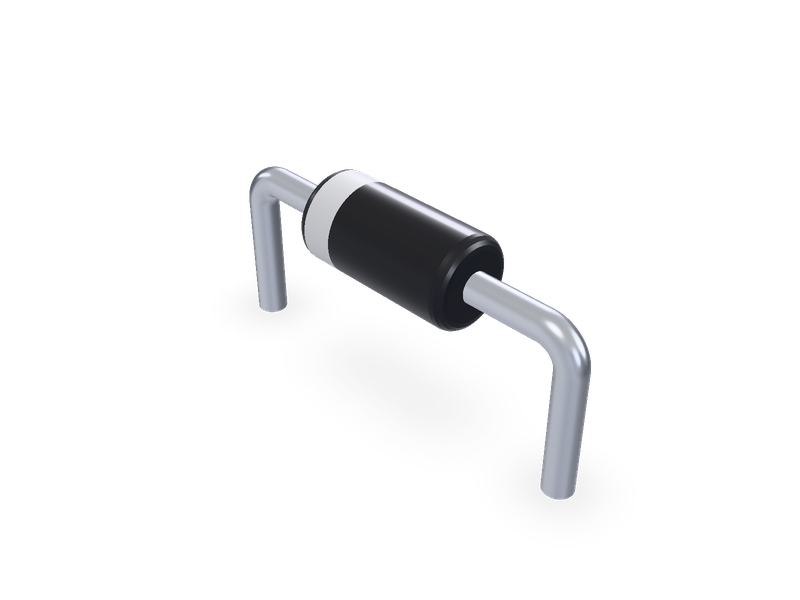
Axial leaded diodes in Vishay's DO-35, DO-41, DO-15, DO-201AD and P600 packages, with the cathode band, horizontal or vertical.
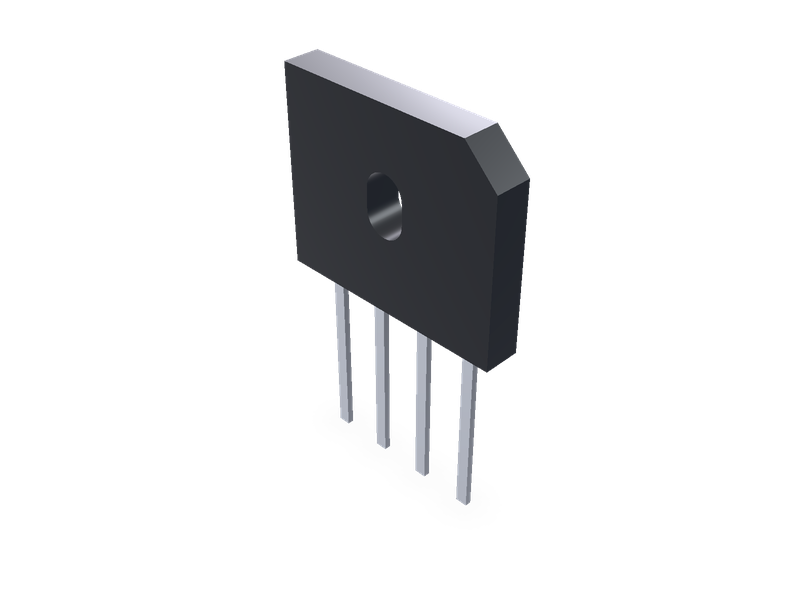
Single-phase bridge rectifiers in Vishay's through-hole cases: GBL, GBU, KBL and KBU in-line, KBPC1 and KBPC6 square, from Vishay's data sheets.
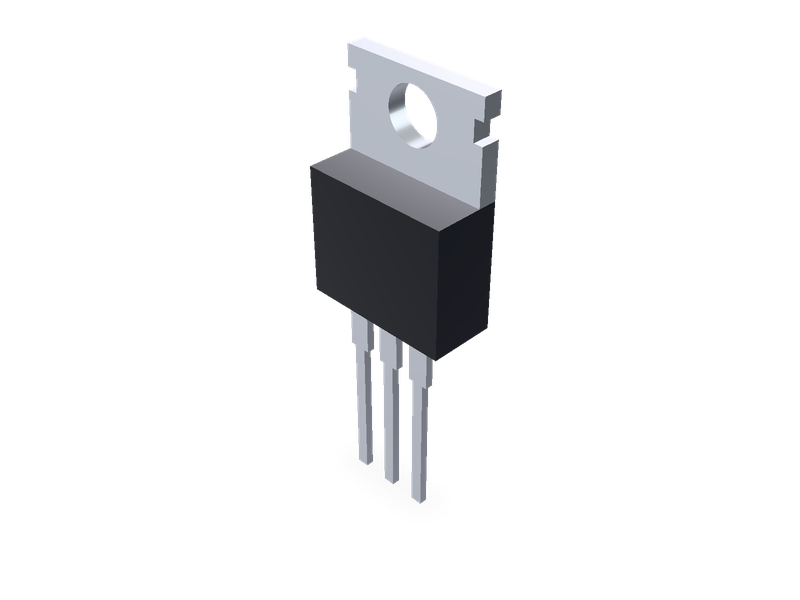
Through-hole TO packages standing on the board: TO-220AB, TO-220AC, TO-220F, TO-247AC, TO-126, TO-92 and the TO-18, TO-39 and TO-46 metal cans, from the makers' drawings.