
STEVEMIT
steve/tht-led
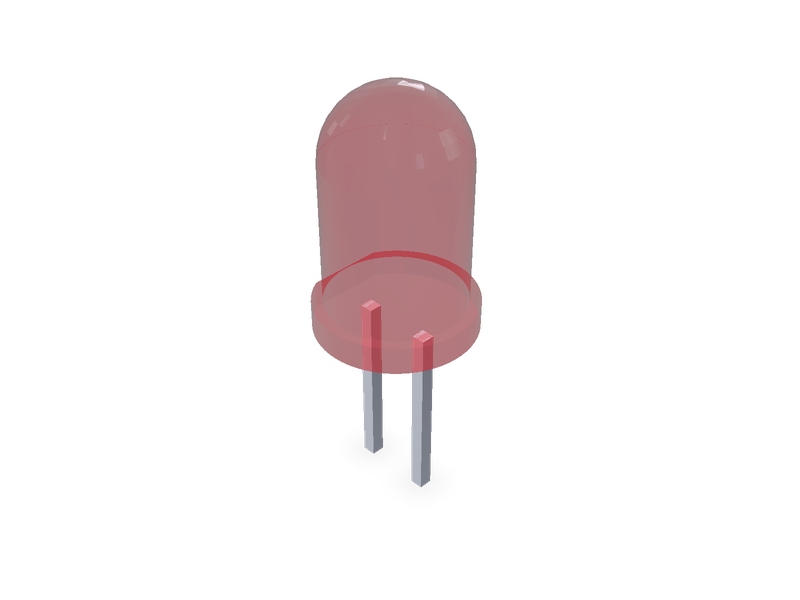
Through-hole round LEDs from Vishay's drawings: 5 mm (T-1 3/4, TLHx5400) and 3 mm (T-1, TLHx4400), red, yellow or green.
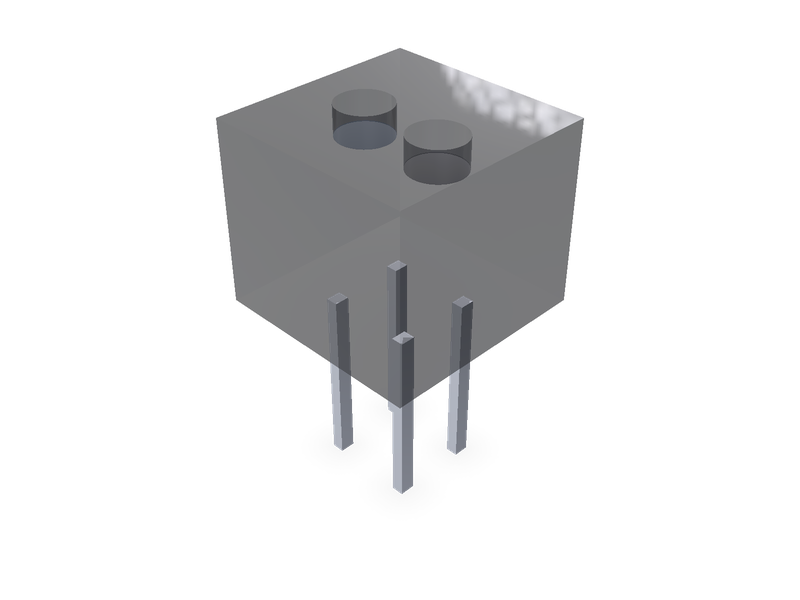
Vishay reflective optical sensors with transistor output: CNY70, TCRT5000 and TCRT5000L, by part number.
| 1 | """Vishay reflective optical sensors with transistor output: the CNY70 cube and the TCRT5000 / TCRT5000L with two domed lenses and |
| 2 | mounting clips. The sensor stands on the board (the XY plane), its body centred on the origin, the emitter and detector side by |
| 3 | side along X, looking up (+Z), and the leads down through the board. The housing is one solid, each lens its own solid, and each |
| 4 | lead its own solid. Dimensions from Vishay's data sheets; see the README.""" |
| 5 | from steve import Model |
| 6 | |
| 7 | part_number = "CNY70" # Vishay part number |
| 8 | |
| 9 | # CNY70: Vishay CNY70 data sheet, Rev. 1.8, 30-Jul-12 (document 83751), page 5, PACKAGE DIMENSIONS, drawing 6.544-5062.01-4 issue 6: |
| 10 | # body 7 +/-0.1 square, 6 -0.1 high, 12 overall (so the leads reach 6 below the body); leads 0.4 x 0.5 at 2.8 (+0.3) along X and |
| 11 | # 2.54 nom. along Y, centred on the body's centre lines; windows d1.8 -0.1, 2.8 apart, on the body's centre line, 1 deep (side |
| 12 | # view, "1"). Weight ca. 0.70 g. |
| 13 | # (body length X, width Y, height, lead length below the body, lead section X, lead section Y, lead pitch X, lead pitch Y, |
| 14 | # window diameter, window pitch, window depth) |
| 15 | CNY70 = (7.0, 7.0, 6.0, 6.0, 0.4, 0.5, 2.8, 2.54, 1.8, 2.8, 1.0) |
| 16 | # TCRT5000 / TCRT5000L: Vishay TCRT5000 data sheet, Rev. 1.7, 17-Aug-09 (document 83760), PACKAGE DIMENSIONS, page 4 (TCRT5000, |
| 17 | # drawing 6.550-5096.01-4 issue 4) and page 5 (TCRT5000L, drawing 6.550-5146.01-4): body 10.2 (+0.1/-0.2) x 5.8 (+0.1/-0.2), its |
| 18 | # nose flat 2.5 +/-0.3 wide; 3 from the reference plane (the board) to the shoulder, 6.3 (+0.5/-0.1) to the lens tops, 7 +/-0.2 to |
| 19 | # the divider's top; leads 0.4 x 0.65 max, 5.5 apart along X and 2.54 along Y, 3.5 +/-0.3 (TCRT5000) or 15 +/-0.5 (TCRT5000L) |
| 20 | # below the reference plane; locating peg d0.9 +/-0.05, 1.5 +/-0.2 below, 4.65 +/-0.1 from the clips' centre (footprint: 2.45 off |
| 21 | # the centre line); two clips 0.95 +/-0.05 wide, reaching 3 below, barb 1.2 wide, 0.5 beyond the body's side, its top 1.6 to 1.8 |
| 22 | # and its widest 2.2 +/-0.1 below, tips 2.45 off the centre line. Weight ca. 0.23 g. |
| 23 | # (body length X, width Y, nose flat, shoulder height, lens top, divider top, lead section X, lead section Y, lead pitch X, |
| 24 | # lead pitch Y, peg diameter, peg length, peg X from centre, peg Y from centre, clip width X, clip depth, barb width, barb out, |
| 25 | # barb top, barb top inner, barb widest, clip tip Y) |
| 26 | TCRT5000 = (10.2, 5.8, 2.5, 3.0, 6.3, 7.0, 0.4, 0.65, 5.5, 2.54, 0.9, 1.5, 4.65, 2.45, 0.95, 3.0, 1.2, 0.5, 1.8, 1.6, 2.2, 2.45) |
| 27 | LEADS = {"TCRT5000": 3.5, "TCRT5000L": 15.0} |
| 28 | # Proportions, for looks (the TCRT5000 drawings show these but don't dimension them; README): the body's underside stands 0.5 above |
| 29 | # the reference plane except the foot at the peg end, which reaches it and runs 1.42 in from that end; above the shoulder the body |
| 30 | # tapers to a top face 4.45 above the plane, 1.45 in at the ends and 1.1 in at the sides; the nose's corner chamfers run 1.7 along X; |
| 31 | # each lens is 3.0 x 3.0, upright sides then a half-round top (radius 1.5) across Y, its centre 1.75 off the middle; the divider |
| 32 | # between them is 0.45 thick and 3.0 long; the clip's stem is the barb's inner 0.7, and its tip is pointed 0.25 in from its inner |
| 33 | # face. |
| 34 | TCRT_PROPORTIONS = {"underside": 0.5, "foot": 1.42, "top": 4.45, "inset_x": 1.45, "inset_y": 1.1, "nose_x": 1.7, "lens": 3.0, |
| 35 | "lens_x": 1.75, "divider": 0.45} |
| 36 | PROUD = 0.03 # the CNY70's lens discs stand this far proud of the window floors so the renderer draws their edges |
| 37 | |
| 38 | model = Model() |
| 39 | leads = [] |
| 40 | if part_number == "CNY70": |
| 41 | L, W, H, lead_len, lx, ly, px, py, wd, wp, depth = CNY70 |
| 42 | model.box("housing", L, W, H, at=(0, 0, H / 2), op="new", body="housing_body", name="Housing") |
| 43 | model.plane("window_plane", on="XY", offset=H - depth, name="Window floor") |
| 44 | lenses = [] |
| 45 | for k, (x, what) in enumerate(((-wp / 2, "emitter"), (wp / 2, "detector"))): |
| 46 | with model.sketch(f"window_{k}_sketch", on="window_plane", name=f"{what.capitalize()} window") as sk: |
| 47 | sk.circle(f"window_{k}_circle", (x, 0), wd / 2) |
| 48 | model.extrude(f"window_{k}", f"window_{k}_sketch", distance=depth, op="cut", body="housing_body", name=f"{what.capitalize()} window") |
| 49 | with model.sketch(f"lens_{k}_sketch", on="window_plane", name=f"{what.capitalize()} lens") as sk: |
| 50 | sk.circle(f"lens_{k}_circle", (x, 0), wd / 2) |
| 51 | model.extrude(f"lens_{k}", f"lens_{k}_sketch", distance=PROUD, op="new", body=f"lens_{k}_body", name=f"{what.capitalize()} lens") |
| 52 | lenses.append(f"lens_{k}_body") |
| 53 | emitter, detector = lenses |
| 54 | for i, x in enumerate((-px / 2, px / 2)): |
| 55 | for j, y in enumerate((-py / 2, py / 2)): |
| 56 | n = 2 * i + j |
| 57 | model.box(f"lead_{n}", lx, ly, lead_len, at=(x, y, -lead_len / 2), op="new", body=f"lead_{n}_body", name=f"Lead {n + 1}") |
| 58 | leads.append(f"lead_{n}_body") |
| 59 | elif part_number in LEADS: |
| 60 | (L, W, nose, shoulder, lens_top, divider_top, lx, ly, px, py, peg_d, peg_len, peg_x, peg_y, clip_w, clip_depth, barb_w, barb_out, |
| 61 | barb_top, barb_top_in, barb_wide, tip_y) = TCRT5000 |
| 62 | P = TCRT_PROPORTIONS |
| 63 | lead_len = LEADS[part_number] |
| 64 | under, top = P["underside"], P["top"] |
| 65 | |
| 66 | def outline(dx, dy): |
| 67 | """The body's plan outline (the nose at +X, its corners chamfered, its flat nose wide), inset dx at the ends and dy at |
| 68 | the sides.""" |
| 69 | x0, x1, y1, f = -L / 2 + dx, L / 2 - dx, W / 2 - dy, nose / 2 |
| 70 | xn = x1 - P["nose_x"] |
| 71 | return [(x0, -y1), (xn, -y1), (x1, -f), (x1, f), (xn, y1), (x0, y1)] |
| 72 | |
| 73 | model.plane("under_plane", on="XY", offset=under, name="Underside") |
| 74 | with model.sketch("body_sketch", on="under_plane", name="Body") as sk: |
| 75 | sk.polyline("body_outline", outline(0, 0), closed=True) |
| 76 | model.extrude("housing", "body_sketch", distance=shoulder - under, op="new", body="housing_body", name="Housing") |
| 77 | model.plane("shoulder_plane", on="XY", offset=shoulder, name="Shoulder") |
| 78 | model.plane("top_plane", on="XY", offset=top, name="Top") |
| 79 | with model.sketch("taper_base", on="shoulder_plane", name="Taper") as sk: |
| 80 | sk.polyline("taper_base_outline", outline(0, 0), closed=True) |
| 81 | with model.sketch("taper_top", on="top_plane", name="Taper") as sk: |
| 82 | sk.polyline("taper_top_outline", outline(P["inset_x"], P["inset_y"]), closed=True) |
| 83 | model.loft("taper", ["taper_base", "taper_top"], ruled=True, op="join", body="housing_body", name="Taper") |
| 84 | # The foot at the peg end, down to the reference plane, and the locating peg below it. |
| 85 | foot = P["foot"] |
| 86 | model.box("foot", foot, W, under, at=(-L / 2 + foot / 2, 0, under / 2), op="join", body="housing_body", name="Foot") |
| 87 | model.cylinder("peg", peg_d / 2, peg_len, at=(-peg_x, -peg_y, -peg_len), op="join", body="housing_body", name="Locating peg") |
| 88 | # The divider between the lenses, up to its dimensioned top. |
| 89 | d = P["divider"] |
| 90 | model.box("divider", d, P["lens"], divider_top - top, at=(0, 0, top + (divider_top - top) / 2), op="join", body="housing_body", |
| 91 | name="Divider") |
| 92 | # The two clips, a side-view (YZ) outline each, extruded clip_w along X and centred on X = 0. |
| 93 | for s, side in ((1, "right"), (-1, "left")): |
| 94 | body_side, out = W / 2, W / 2 + barb_out |
| 95 | stem_in = out - barb_w |
| 96 | pts = [(stem_in, under), (body_side, under), (body_side, -barb_top_in), (out, -barb_top), (out, -barb_wide), (tip_y, -clip_depth), |
| 97 | (stem_in, -clip_depth + (tip_y - stem_in))] |
| 98 | with model.sketch(f"clip_{side}_sketch", on="YZ", name=f"Clip {side}") as sk: |
| 99 | sk.polyline(f"clip_{side}_outline", [(s * y, z) for y, z in pts], closed=True) |
| 100 | model.extrude(f"clip_{side}", f"clip_{side}_sketch", distance=clip_w, both=True, op="join", body="housing_body", name=f"Clip {side}") |
| 101 | # The lenses: upright sides, then a half-round top across Y, each P["lens"] long along X. |
| 102 | r = P["lens"] / 2 |
| 103 | lenses = [] |
| 104 | for k, (x, what) in enumerate(((-P["lens_x"], "detector"), (P["lens_x"], "emitter"))): |
| 105 | model.plane(f"lens_{k}_plane", on="YZ", offset=x, name=f"{what.capitalize()} lens") |
| 106 | with model.sketch(f"lens_{k}_sketch", on=f"lens_{k}_plane", name=f"{what.capitalize()} lens") as sk: |
| 107 | sk.polyline(f"lens_{k}_sides", [(-r, lens_top - r), (-r, top), (r, top), (r, lens_top - r)], closed=False) |
| 108 | sk.arc(f"lens_{k}_top", (0, lens_top - r), r, 0, 180) |
| 109 | model.extrude(f"lens_{k}", f"lens_{k}_sketch", distance=P["lens"], both=True, op="new", body=f"lens_{k}_body", name=f"{what.capitalize()} lens") |
| 110 | lenses.append(f"lens_{k}_body") |
| 111 | detector, emitter = lenses |
| 112 | for i, x in enumerate((-px / 2, px / 2)): |
| 113 | for j, y in enumerate((-py / 2, py / 2)): |
| 114 | n = 2 * i + j |
| 115 | run = lead_len + under |
| 116 | model.box(f"lead_{n}", lx, ly, run, at=(x, y, under - run / 2), op="new", body=f"lead_{n}_body", name=f"Lead {n + 1}") |
| 117 | leads.append(f"lead_{n}_body") |
| 118 | else: |
| 119 | raise ValueError(f"no part {part_number!r}: CNY70, TCRT5000, TCRT5000L") |
| 120 | |
| 121 | # Materials (the sheets name none): the housing is black moulded plastic that blocks visible light ("daylight blocking filter", |
| 122 | # page 1), shown as pc; the lenses are the clear epoxy over the emitter and the dark filter epoxy over the detector, shown as pmma |
| 123 | # (1.18; epoxy is about 1.2); the leads are metal, shown as copper. |
| 124 | model.material("pc", bodies=["housing_body"], color="#1c1c1e") |
| 125 | model.material("pmma", bodies=[emitter], color="#8fb4e8") |
| 126 | model.material("pmma", bodies=[detector], color="#2a2a30") |
| 127 | model.material("copper", bodies=leads, color="#c9ccd1") |
| 128 | result = model.result() |
| 129 |
| 1 | name = "steve/reflective-optical-sensor" |
| 2 | version = "1.0.0" |
| 3 | runtime = "steve" |
| 4 | license = "MIT" |
| 5 | summary = "Vishay reflective optical sensors with transistor output: CNY70, TCRT5000 and TCRT5000L, by part number." |
| 6 | description = """Reflective optical sensors (an infrared emitter and a phototransistor side by side) for board layouts and enclosures, as Vishay draws them: the CNY70 cube with its two windows, and the TCRT5000 with two domed lenses, a divider, a locating peg and two mounting clips, with standard (TCRT5000) or long leads (TCRT5000L). The housing, each lens and each lead are their own solids. Dimensions from Vishay's data sheets. See the README.""" |
| 7 | tags = ["optical-sensor", "reflective-sensor", "opto", "through-hole", "vishay", "electronics"] |
| 8 | |
| 9 | [parameters.part_number] |
| 10 | type = "choice" |
| 11 | default = "CNY70" |
| 12 | choices = ["CNY70", "TCRT5000", "TCRT5000L"] |
| 13 | label = "Part number" |
| 14 | description = "Vishay part number: CNY70 7 x 7 x 6 cube; TCRT5000 10.2 x 5.8 with domed lenses and clips, leads 3.5 long; TCRT5000L the same with leads 15 long." |
| 15 | |
| 16 | [[presets]] |
| 17 | id = "CNY70" |
| 18 | title = "Vishay CNY70 reflective optical sensor (7 x 7 x 6 cube, leads 6 long)" |
| 19 | params = { part_number = "CNY70" } |
| 20 | aliases = ["Vishay CNY70", "CNY70", "CNY70 reflective sensor"] |
| 21 | standard = "Vishay CNY70" |
| 22 | |
| 23 | [[presets]] |
| 24 | id = "TCRT5000" |
| 25 | title = "Vishay TCRT5000 reflective optical sensor (10.2 x 5.8, two domed lenses, clips, leads 3.5 long)" |
| 26 | params = { part_number = "TCRT5000" } |
| 27 | aliases = ["Vishay TCRT5000", "TCRT5000", "TCRT5000 reflective sensor"] |
| 28 | standard = "Vishay TCRT5000" |
| 29 | |
| 30 | [[presets]] |
| 31 | id = "TCRT5000L" |
| 32 | title = "Vishay TCRT5000L reflective optical sensor (10.2 x 5.8, two domed lenses, clips, leads 15 long)" |
| 33 | params = { part_number = "TCRT5000L" } |
| 34 | aliases = ["Vishay TCRT5000L", "TCRT5000L", "TCRT5000L reflective sensor"] |
| 35 | standard = "Vishay TCRT5000L" |
| 36 |
Vishay's reflective optical sensors with transistor output, chosen by part number: an infrared emitter and a phototransistor side by side, looking up. The sensor stands on the board (the XY plane), its body centred on the origin, the emitter and detector along X, and the leads down through the board. The housing is one solid. Each lens is its own solid, and so is each lead.
| Part number | Body (X x Y x height) | Leads below the board | Weight (sheet) |
|---|---|---|---|
| CNY70 | 7 x 7 x 6, two windows Ø 1.8 | 6 | ca. 0.70 g |
| TCRT5000 | 10.2 x 5.8, 7 high to the divider, two domed lenses, peg and clips | 3.5 | ca. 0.23 g |
| TCRT5000L | as TCRT5000 | 15 | ca. 0.23 g |
All dimensions are in mm.
| CNY70 | Value |
|---|---|
| Body | 7 ±0.1 x 7 ±0.1, 6 -0.1 high |
| Overall height | 12 (leads 6 below the body) |
| Leads | 0.4 x 0.5, 2.8 (+0.3) apart along X and 2.54 nom. along Y, centred on the body |
| Windows | Ø 1.8 -0.1, 2.8 apart on the body's centre line, 1 deep (side view) |
| TCRT5000 / TCRT5000L | Value |
|---|---|
| Body | 10.2 (+0.1/-0.2) x 5.8 (+0.1/-0.2); its nose end flat 2.5 ±0.3 wide |
| Heights above the reference plane (the board) | shoulder 3, lens tops 6.3 (+0.5/-0.1), divider top 7 ±0.2 |
| Leads | 0.4 x 0.65 max, 5.5 apart along X and 2.54 along Y; 3.5 ±0.3 (TCRT5000) or 15 ±0.5 (TCRT5000L) below the plane |
| Locating peg | Ø 0.9 ±0.05, 1.5 ±0.2 below, 4.65 ±0.1 from the clips' centre along X and 2.45 off the centre line (footprint) |
| Clips | 0.95 ±0.05 wide (X), 3 below the plane; barb 1.2 wide, 0.5 beyond the body's side, its top 1.6 to 1.8 below and its widest 2.2 ±0.1 below; tips 2.45 off the centre line |
The leads and the clips are centred on the body. The sheet gives the leads' width only as "0.65 max", and the model uses 0.65 along their whole length.
Proportions, stated plainly. The TCRT5000 drawings show these but don't dimension them. They are scaled off the drawings:
Materials. The sheets name no materials. The housing is black moulded plastic that blocks visible light (the sheets list a "daylight blocking filter"), shown as pc. The lenses are the epoxy over the emitter (clear, tinted blue) and over the detector (dark filter), shown as pmma (1.18; epoxy is about 1.2). The leads are metal, shown as copper.
Mass. CNY70: the model weighs about 0.39 g (housing 289 mm³ of pc, leads 4.8 mm³ of copper) against the sheet's ca. 0.70 g. TCRT5000: about 0.32 g (housing 212 mm³, lenses 27.5 mm³, leads 4.2 mm³) against ca. 0.23 g. The sheets don't describe what is inside the housings (lead frame, chips, filler) or the hollows the drawings don't dimension, so the difference isn't explained further. No material was picked to match the weight.
The old catalogue's Vishay_CNY70 and Vishay_TCRT5000 entries map to the presets of those part numbers. Their reference models were measured and agree with the drawings:
| Model | Measured | Drawing |
|---|---|---|
| Vishay_CNY70 | body 7.01 x 7.00 x 6.00, 12 overall; leads 0.40 x 0.50 at 2.80 x 2.54, centred; windows Ø 1.8, 2.8 apart, floors 1 below the top | 7 x 7 x 6, 12; 0.4 x 0.5 at 2.8 x 2.54; Ø 1.8 at 2.8 |
| Vishay_TCRT5000 | body 10.2 x 5.8, 7.0 high, leads 3.5 below; leads 0.40 x 0.66 at 5.50 x 2.54; peg Ø 0.9, 1.5 below, 4.65 from the centre; clips 0.96 wide, 3.0 below | 10.2 x 5.8, 7; 3.5; 0.4 x 0.65 max at 5.5 x 2.54; Ø 0.9, 1.5, 4.65; 0.95, 3 |
The family's other entries name other parts and makers (Everlight, Kodenshi, Osram, Sharp, Broadcom, light-dependent resistors and Vishay's IR receiver packages). They are left with their reasons in COVERAGE.md.
| 1 | # Reflective optical sensor |
| 2 | |
| 3 | Vishay's reflective optical sensors with transistor output, chosen by part number: an infrared emitter and a phototransistor side by side, looking up. The sensor stands on the board (the XY plane), its body centred on the origin, the emitter and detector along X, and the leads down through the board. The housing is one solid. Each lens is its own solid, and so is each lead. |
| 4 | |
| 5 | | Part number | Body (X x Y x height) | Leads below the board | Weight (sheet) | |
| 6 | |---|---|---|---| |
| 7 | | CNY70 | 7 x 7 x 6, two windows Ø 1.8 | 6 | ca. 0.70 g | |
| 8 | | TCRT5000 | 10.2 x 5.8, 7 high to the divider, two domed lenses, peg and clips | 3.5 | ca. 0.23 g | |
| 9 | | TCRT5000L | as TCRT5000 | 15 | ca. 0.23 g | |
| 10 | |
| 11 | ## Source |
| 12 | |
| 13 | - **CNY70:** Vishay, CNY70 "Reflective Optical Sensor with Transistor Output", Rev. 1.8, 30-Jul-12, document number 83751, page 5, PACKAGE DIMENSIONS, drawing 6.544-5062.01-4, issue 6. Copy: vishay.com/docs/83751/cny70.pdf (1 request). |
| 14 | - **TCRT5000, TCRT5000L:** Vishay, TCRT5000, TCRT5000L "Reflective Optical Sensor with Transistor Output", Rev. 1.7, 17-Aug-09, document number 83760, page 4 (TCRT5000, drawing 6.550-5096.01-4, issue 4) and page 5 (TCRT5000L, drawing 6.550-5146.01-4), PACKAGE DIMENSIONS. Copy: vishay.com/docs/83760/tcrt5000.pdf (1 request). |
| 15 | |
| 16 | All dimensions are in mm. |
| 17 | |
| 18 | | CNY70 | Value | |
| 19 | |---|---| |
| 20 | | Body | 7 ±0.1 x 7 ±0.1, 6 -0.1 high | |
| 21 | | Overall height | 12 (leads 6 below the body) | |
| 22 | | Leads | 0.4 x 0.5, 2.8 (+0.3) apart along X and 2.54 nom. along Y, centred on the body | |
| 23 | | Windows | Ø 1.8 -0.1, 2.8 apart on the body's centre line, 1 deep (side view) | |
| 24 | |
| 25 | | TCRT5000 / TCRT5000L | Value | |
| 26 | |---|---| |
| 27 | | Body | 10.2 (+0.1/-0.2) x 5.8 (+0.1/-0.2); its nose end flat 2.5 ±0.3 wide | |
| 28 | | Heights above the reference plane (the board) | shoulder 3, lens tops 6.3 (+0.5/-0.1), divider top 7 ±0.2 | |
| 29 | | Leads | 0.4 x 0.65 max, 5.5 apart along X and 2.54 along Y; 3.5 ±0.3 (TCRT5000) or 15 ±0.5 (TCRT5000L) below the plane | |
| 30 | | Locating peg | Ø 0.9 ±0.05, 1.5 ±0.2 below, 4.65 ±0.1 from the clips' centre along X and 2.45 off the centre line (footprint) | |
| 31 | | Clips | 0.95 ±0.05 wide (X), 3 below the plane; barb 1.2 wide, 0.5 beyond the body's side, its top 1.6 to 1.8 below and its widest 2.2 ±0.1 below; tips 2.45 off the centre line | |
| 32 | |
| 33 | The leads and the clips are centred on the body. The sheet gives the leads' width only as "0.65 max", and the model uses 0.65 along their whole length. |
| 34 | |
| 35 | **Proportions, stated plainly.** The TCRT5000 drawings show these but don't dimension them. They are scaled off the drawings: |
| 36 | |
| 37 | - The body's underside stands 0.5 above the reference plane. Only the foot at the peg end reaches the plane, and it runs 1.42 in from that end. |
| 38 | - Above the shoulder, the body tapers to a top face 4.45 above the plane, 1.45 in at the ends and 1.1 in at the sides. The nose flat keeps its 2.5 width at the top face. |
| 39 | - The nose's corner chamfers run 1.7 along X. |
| 40 | - Each lens is 3.0 x 3.0, with upright sides and then a half-round top (radius 1.5) across Y. Its centre is 1.75 off the middle. The divider between the lenses is 0.45 thick and 3.0 long. |
| 41 | - Each clip's stem is the barb's inner 0.7. Its tip is pointed, 0.25 in from its inner face. |
| 42 | - The CNY70's small notches and the inner frame lines on its top and bottom views aren't modelled. Its lens discs stand 0.03 above the window floors so their edges show. |
| 43 | |
| 44 | **Materials.** The sheets name no materials. The housing is black moulded plastic that blocks visible light (the sheets list a "daylight blocking filter"), shown as pc. The lenses are the epoxy over the emitter (clear, tinted blue) and over the detector (dark filter), shown as pmma (1.18; epoxy is about 1.2). The leads are metal, shown as copper. |
| 45 | |
| 46 | **Mass.** CNY70: the model weighs about 0.39 g (housing 289 mm³ of pc, leads 4.8 mm³ of copper) against the sheet's ca. 0.70 g. TCRT5000: about 0.32 g (housing 212 mm³, lenses 27.5 mm³, leads 4.2 mm³) against ca. 0.23 g. The sheets don't describe what is inside the housings (lead frame, chips, filler) or the hollows the drawings don't dimension, so the difference isn't explained further. No material was picked to match the weight. |
| 47 | |
| 48 | ## Catalogue models |
| 49 | |
| 50 | The old catalogue's `Vishay_CNY70` and `Vishay_TCRT5000` entries map to the presets of those part numbers. Their reference models were measured and agree with the drawings: |
| 51 | |
| 52 | | Model | Measured | Drawing | |
| 53 | |---|---|---| |
| 54 | | Vishay_CNY70 | body 7.01 x 7.00 x 6.00, 12 overall; leads 0.40 x 0.50 at 2.80 x 2.54, centred; windows Ø 1.8, 2.8 apart, floors 1 below the top | 7 x 7 x 6, 12; 0.4 x 0.5 at 2.8 x 2.54; Ø 1.8 at 2.8 | |
| 55 | | Vishay_TCRT5000 | body 10.2 x 5.8, 7.0 high, leads 3.5 below; leads 0.40 x 0.66 at 5.50 x 2.54; peg Ø 0.9, 1.5 below, 4.65 from the centre; clips 0.96 wide, 3.0 below | 10.2 x 5.8, 7; 3.5; 0.4 x 0.65 max at 5.5 x 2.54; Ø 0.9, 1.5, 4.65; 0.95, 3 | |
| 56 | |
| 57 | The family's other entries name other parts and makers (Everlight, Kodenshi, Osram, Sharp, Broadcom, light-dependent resistors and Vishay's IR receiver packages). They are left with their reasons in `COVERAGE.md`. |
| 58 |
Reflective optical sensors (an infrared emitter and a phototransistor side by side) for board layouts and enclosures, as Vishay draws them: the CNY70 cube with its two windows, and the TCRT5000 with two domed lenses, a divider, a locating peg and two mounting clips, with standard (TCRT5000) or long leads (TCRT5000L). The housing, each lens and each lead are their own solids. Dimensions from Vishay's data sheets. See the README.
Vishay's reflective optical sensors with transistor output, chosen by part number: an infrared emitter and a phototransistor side by side, looking up. The sensor stands on the board (the XY plane), its body centred on the origin, the emitter and detector along X, and the leads down through the board. The housing is one solid. Each lens is its own solid, and so is each lead.
| Part number | Body (X x Y x height) | Leads below the board | Weight (sheet) |
|---|---|---|---|
| CNY70 | 7 x 7 x 6, two windows Ø 1.8 | 6 | ca. 0.70 g |
| TCRT5000 | 10.2 x 5.8, 7 high to the divider, two domed lenses, peg and clips | 3.5 | ca. 0.23 g |
| TCRT5000L | as TCRT5000 | 15 | ca. 0.23 g |
All dimensions are in mm.
| CNY70 | Value |
|---|---|
| Body | 7 ±0.1 x 7 ±0.1, 6 -0.1 high |
| Overall height | 12 (leads 6 below the body) |
| Leads | 0.4 x 0.5, 2.8 (+0.3) apart along X and 2.54 nom. along Y, centred on the body |
| Windows | Ø 1.8 -0.1, 2.8 apart on the body's centre line, 1 deep (side view) |
| TCRT5000 / TCRT5000L | Value |
|---|---|
| Body | 10.2 (+0.1/-0.2) x 5.8 (+0.1/-0.2); its nose end flat 2.5 ±0.3 wide |
| Heights above the reference plane (the board) | shoulder 3, lens tops 6.3 (+0.5/-0.1), divider top 7 ±0.2 |
| Leads | 0.4 x 0.65 max, 5.5 apart along X and 2.54 along Y; 3.5 ±0.3 (TCRT5000) or 15 ±0.5 (TCRT5000L) below the plane |
| Locating peg | Ø 0.9 ±0.05, 1.5 ±0.2 below, 4.65 ±0.1 from the clips' centre along X and 2.45 off the centre line (footprint) |
| Clips | 0.95 ±0.05 wide (X), 3 below the plane; barb 1.2 wide, 0.5 beyond the body's side, its top 1.6 to 1.8 below and its widest 2.2 ±0.1 below; tips 2.45 off the centre line |
The leads and the clips are centred on the body. The sheet gives the leads' width only as "0.65 max", and the model uses 0.65 along their whole length.
Proportions, stated plainly. The TCRT5000 drawings show these but don't dimension them. They are scaled off the drawings:
Materials. The sheets name no materials. The housing is black moulded plastic that blocks visible light (the sheets list a "daylight blocking filter"), shown as pc. The lenses are the epoxy over the emitter (clear, tinted blue) and over the detector (dark filter), shown as pmma (1.18; epoxy is about 1.2). The leads are metal, shown as copper.
Mass. CNY70: the model weighs about 0.39 g (housing 289 mm³ of pc, leads 4.8 mm³ of copper) against the sheet's ca. 0.70 g. TCRT5000: about 0.32 g (housing 212 mm³, lenses 27.5 mm³, leads 4.2 mm³) against ca. 0.23 g. The sheets don't describe what is inside the housings (lead frame, chips, filler) or the hollows the drawings don't dimension, so the difference isn't explained further. No material was picked to match the weight.
The old catalogue's Vishay_CNY70 and Vishay_TCRT5000 entries map to the presets of those part numbers. Their reference models were measured and agree with the drawings:
| Model | Measured | Drawing |
|---|---|---|
| Vishay_CNY70 | body 7.01 x 7.00 x 6.00, 12 overall; leads 0.40 x 0.50 at 2.80 x 2.54, centred; windows Ø 1.8, 2.8 apart, floors 1 below the top | 7 x 7 x 6, 12; 0.4 x 0.5 at 2.8 x 2.54; Ø 1.8 at 2.8 |
| Vishay_TCRT5000 | body 10.2 x 5.8, 7.0 high, leads 3.5 below; leads 0.40 x 0.66 at 5.50 x 2.54; peg Ø 0.9, 1.5 below, 4.65 from the centre; clips 0.96 wide, 3.0 below | 10.2 x 5.8, 7; 3.5; 0.4 x 0.65 max at 5.5 x 2.54; Ø 0.9, 1.5, 4.65; 0.95, 3 |
The family's other entries name other parts and makers (Everlight, Kodenshi, Osram, Sharp, Broadcom, light-dependent resistors and Vishay's IR receiver packages). They are left with their reasons in COVERAGE.md.
Through-hole round LEDs from Vishay's drawings: 5 mm (T-1 3/4, TLHx5400) and 3 mm (T-1, TLHx4400), red, yellow or green.
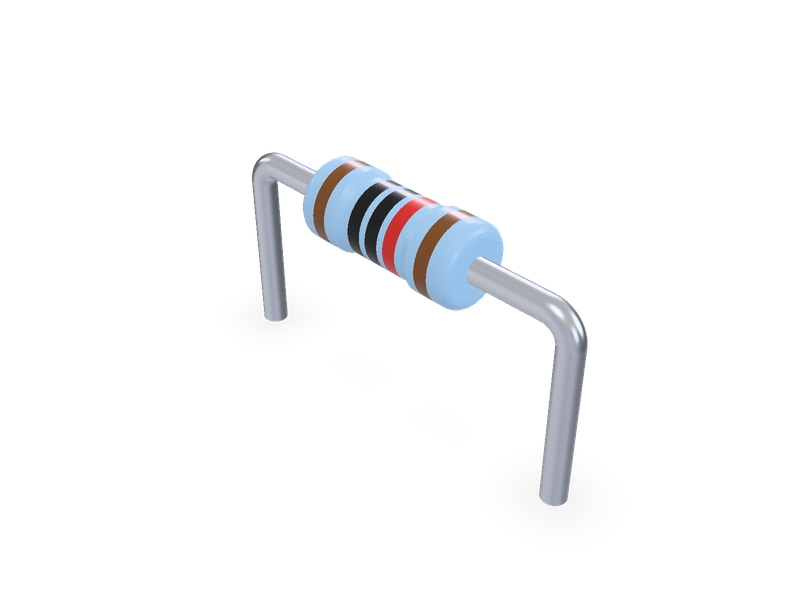
Axial leaded metal film resistor, Vishay Beyschlag MBA/SMA 0204, MBB/SMA 0207 and MBE/SMA 0414, with colour rings, horizontal or vertical.
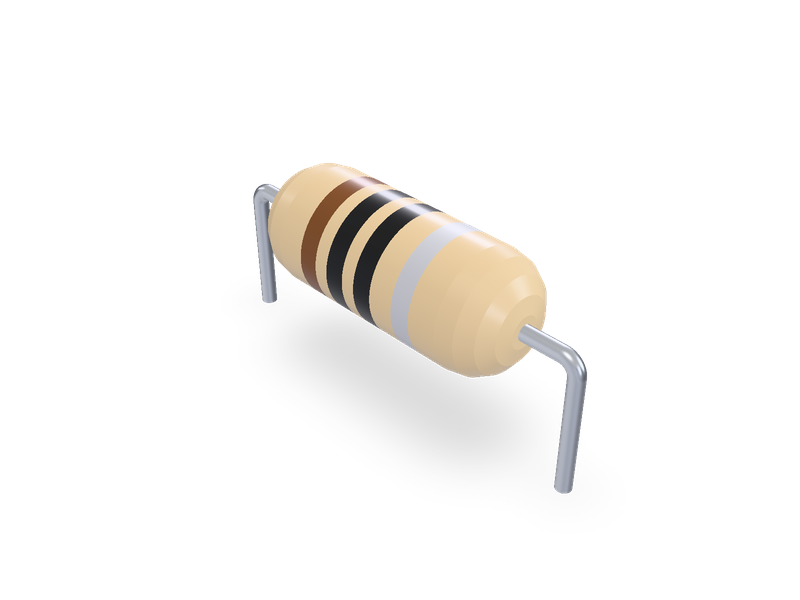
Axial leaded inductor, Fastron fixed choke coils (MICC, SMCC, MECC, HCCC, LACC, HBCC, VHBCC, XHBCC) and suppression coils (MISC, MESC, 77A), Vishay Dale molded IM-1 to IM-10, horizontal or vertical.
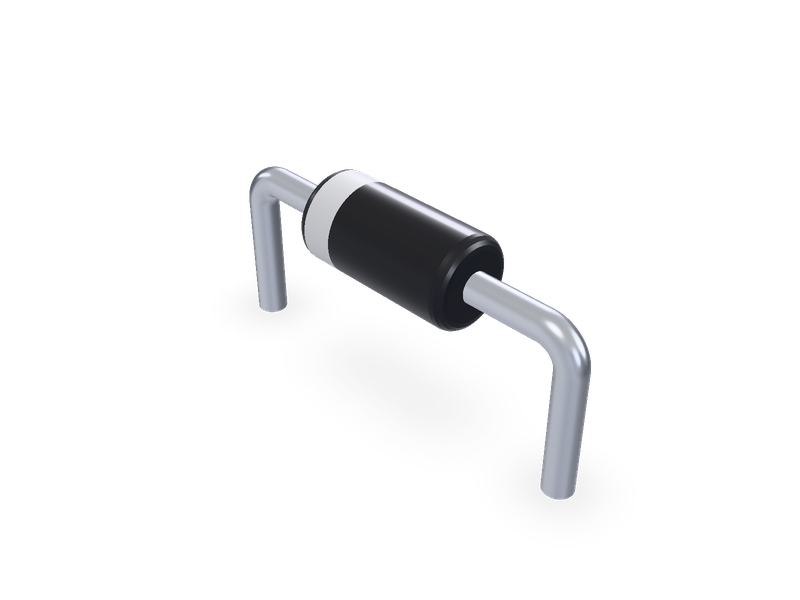
Axial leaded diodes in Vishay's DO-35, DO-41, DO-15, DO-201AD and P600 packages, with the cathode band, horizontal or vertical.